Thank you for visiting SNEWPapers!
Sign up free
Literary
October 10, 1935
Clarke Courier
Berryville, Clarke County, Virginia
What is this article about?
A reflective essay by William Harper Dean describing how a father teaches his child to visualize God through the natural beauty, seasonal changes, and dramatic weather of the Shenandoah Valley in Virginia, culminating in a rainbow as a divine pledge.
Clipping
OCR Quality
98%
Excellent
Full Text
The Shenandoah Valley
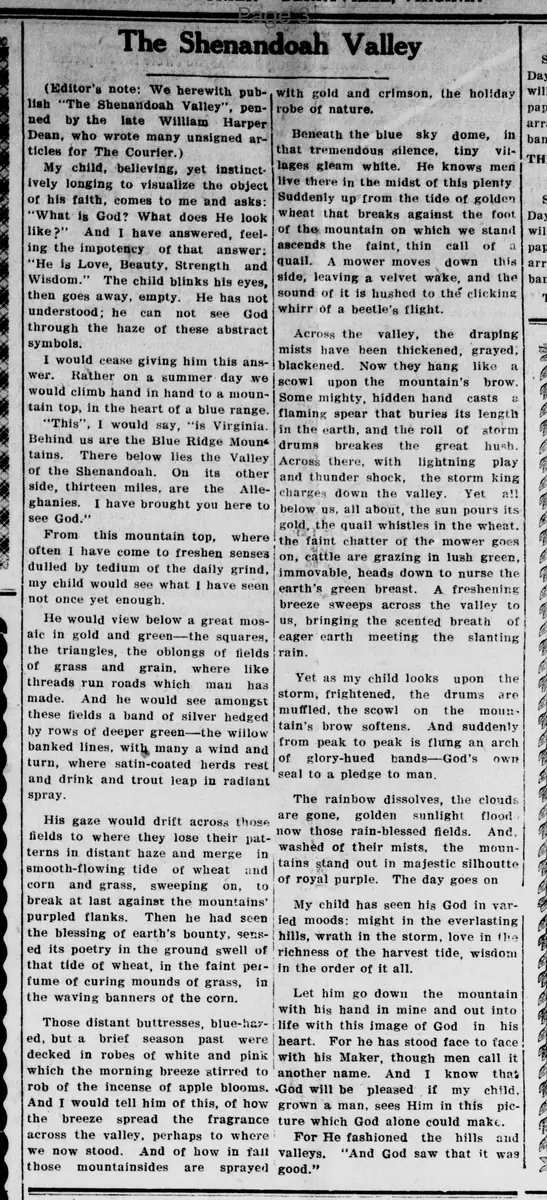
(Editor’s note: We herewith publish “The Shenandoah Valley,” penned by the late William Harper Dean, who wrote many unsigned articles for The Courier.)
My child, believing, yet instinctively longing to visualize the object of his faith, comes to me and asks: “What is God? What does He look like?” And I have answered, feeling the impotency of that answer: “He is Love, Beauty, Strength and Wisdom.” The child blinks his eyes, then goes away, empty. He has not understood; he cannot see God through the haze of these abstract symbols.
I would cease giving him this answer. Rather on a summer day we would climb hand in hand to a mountain top, in the heart of a blue range. “This,” I would say, “is Virginia. Behind us are the Blue Ridge Mountains. There below lies the Valley of the Shenandoah. On its other side, thirteen miles, are the Alleghanies. I have brought you here to see God.”
From this mountain top, where often I have come to freshen senses dulled by tedium of the daily grind, my child would see what I have seen not once yet enough.
He would view below a great mosaic in gold and green—the squares, the triangles, the oblongs of fields of grass and grain, where like threads run roads which man has made. And he would see amongst these fields a band of silver hedged by rows of deeper green—the willow banked lines, with many a wind and turn, where satin-coated herds rest and drink and trout leap in radiant spray.
His gaze would drift across those fields to where they lose their patterns in distant haze and merge in smooth-flowing tide of wheat and corn and grass, sweeping on, to break at last against the mountains’ purpled flanks. Then he had seen the blessing of earth’s bounty, sensed its poetry in the ground swell of that tide of wheat, in the faint perfume of curing mounds of grass, in the waving banners of the corn.
Those distant buttresses, blue-hazed, but a brief season past were decked in robes of white and pink which the morning breeze stirred to rob of the incense of apple blooms. And I would tell him of this, of how the breeze spread the fragrance across the valley, perhaps to where we now stood.
And of how in fall those mountainsides are sprayed with gold and crimson, the holiday robe of nature.
Beneath the blue sky dome, in that tremendous silence, tiny villages gleam white. He knows men live there in the midst of this plenty.
Suddenly up from the tide of golden wheat that breaks against the foot of the mountain on which we stand ascends the faint, thin call of a quail. A mower moves down this side, leaving a velvet wake, and the sound of it is hushed to the clicking whirr of a beetle’s flight.
Across the valley, the draping mists have been thickened, grayed; blackened. Now they hang like a scowl upon the mountain’s brow. Some mighty, hidden hand casts a flaming spear that buries its length in the earth, and the roll of storm drums breaks the great hush.
Across there, with lightning play and thunder shock, the storm king charges down the valley. Yet all below us, all about, the sun pours its gold, the quail whistles in the wheat, the faint chatter of the mower goes on, cattle are grazing in lush green, immovable, heads down to nurse the earth’s green breast. A freshening breeze sweeps across the valley to us, bringing the scented breath of eager earth meeting the slanting rain.
Yet as my child looks upon the storm, frightened, the drums are muffled, the scowl on the mountain’s brow softens. And suddenly from peak to peak is flung an arch of glory-hued bands—God’s own seal to a pledge to man.
The rainbow dissolves, the clouds are gone, golden sunlight flood now those rain-blessed fields. And, washed of their mists, the mountains stand out in majestic silhouette of royal purple. The day goes on.
My child has seen his God in varied moods: might in the everlasting hills, wrath in the storm, love in the richness of the harvest tide, wisdom in the order of it all.
Let him go down the mountain with his hand in mine and out into life with this image of God in his heart. For he has stood face to face with his Maker, though men call it another name. And I know that God will be pleased if my child, grown a man, sees Him in this picture which God alone could make.
For He fashioned the hills and valleys.
“And God saw that it was good.”
(Editor’s note: We herewith publish “The Shenandoah Valley,” penned by the late William Harper Dean, who wrote many unsigned articles for The Courier.)
My child, believing, yet instinctively longing to visualize the object of his faith, comes to me and asks: “What is God? What does He look like?” And I have answered, feeling the impotency of that answer: “He is Love, Beauty, Strength and Wisdom.” The child blinks his eyes, then goes away, empty. He has not understood; he cannot see God through the haze of these abstract symbols.
I would cease giving him this answer. Rather on a summer day we would climb hand in hand to a mountain top, in the heart of a blue range. “This,” I would say, “is Virginia. Behind us are the Blue Ridge Mountains. There below lies the Valley of the Shenandoah. On its other side, thirteen miles, are the Alleghanies. I have brought you here to see God.”
From this mountain top, where often I have come to freshen senses dulled by tedium of the daily grind, my child would see what I have seen not once yet enough.
He would view below a great mosaic in gold and green—the squares, the triangles, the oblongs of fields of grass and grain, where like threads run roads which man has made. And he would see amongst these fields a band of silver hedged by rows of deeper green—the willow banked lines, with many a wind and turn, where satin-coated herds rest and drink and trout leap in radiant spray.
His gaze would drift across those fields to where they lose their patterns in distant haze and merge in smooth-flowing tide of wheat and corn and grass, sweeping on, to break at last against the mountains’ purpled flanks. Then he had seen the blessing of earth’s bounty, sensed its poetry in the ground swell of that tide of wheat, in the faint perfume of curing mounds of grass, in the waving banners of the corn.
Those distant buttresses, blue-hazed, but a brief season past were decked in robes of white and pink which the morning breeze stirred to rob of the incense of apple blooms. And I would tell him of this, of how the breeze spread the fragrance across the valley, perhaps to where we now stood.
And of how in fall those mountainsides are sprayed with gold and crimson, the holiday robe of nature.
Beneath the blue sky dome, in that tremendous silence, tiny villages gleam white. He knows men live there in the midst of this plenty.
Suddenly up from the tide of golden wheat that breaks against the foot of the mountain on which we stand ascends the faint, thin call of a quail. A mower moves down this side, leaving a velvet wake, and the sound of it is hushed to the clicking whirr of a beetle’s flight.
Across the valley, the draping mists have been thickened, grayed; blackened. Now they hang like a scowl upon the mountain’s brow. Some mighty, hidden hand casts a flaming spear that buries its length in the earth, and the roll of storm drums breaks the great hush.
Across there, with lightning play and thunder shock, the storm king charges down the valley. Yet all below us, all about, the sun pours its gold, the quail whistles in the wheat, the faint chatter of the mower goes on, cattle are grazing in lush green, immovable, heads down to nurse the earth’s green breast. A freshening breeze sweeps across the valley to us, bringing the scented breath of eager earth meeting the slanting rain.
Yet as my child looks upon the storm, frightened, the drums are muffled, the scowl on the mountain’s brow softens. And suddenly from peak to peak is flung an arch of glory-hued bands—God’s own seal to a pledge to man.
The rainbow dissolves, the clouds are gone, golden sunlight flood now those rain-blessed fields. And, washed of their mists, the mountains stand out in majestic silhouette of royal purple. The day goes on.
My child has seen his God in varied moods: might in the everlasting hills, wrath in the storm, love in the richness of the harvest tide, wisdom in the order of it all.
Let him go down the mountain with his hand in mine and out into life with this image of God in his heart. For he has stood face to face with his Maker, though men call it another name. And I know that God will be pleased if my child, grown a man, sees Him in this picture which God alone could make.
For He fashioned the hills and valleys.
“And God saw that it was good.”
What sub-type of article is it?
Essay
Prose Fiction
What themes does it cover?
Religious
Nature
What keywords are associated?
Shenandoah Valley
God In Nature
Virginia Landscape
Religious Reflection
Natural Beauty
Divine Providence
Father Child Teaching
What entities or persons were involved?
William Harper Dean
Literary Details
Title
The Shenandoah Valley
Author
William Harper Dean
Subject
Visualizing God Through The Shenandoah Valley
Key Lines
My Child, Believing, Yet Instinctively Longing To Visualize The Object Of His Faith, Comes To Me And Asks: “What Is God? What Does He Look Like?”
“This,” I Would Say, “Is Virginia. Behind Us Are The Blue Ridge Mountains. There Below Lies The Valley Of The Shenandoah.
And Suddenly From Peak To Peak Is Flung An Arch Of Glory Hued Bands—God’s Own Seal To A Pledge To Man.
My Child Has Seen His God In Varied Moods: Might In The Everlasting Hills, Wrath In The Storm, Love In The Richness Of The Harvest Tide, Wisdom In The Order Of It All.
“And God Saw That It Was Good.”