Thank you for visiting SNEWPapers!
Sign up free
Story
September 12, 1933
Seward Daily Gateway
Seward, Seward County, Alaska
What is this article about?
Article reports on epidemic encephalitis, or sleeping sickness, not caused by tsetse fly, affecting St. Louis with unknown viral cause; describes symptoms and historical context from 221 years ago.
Clipping
OCR Quality
98%
Excellent
Full Text
SLEEP MALADY NOT CAUSED BY BITE TSETSE FLY
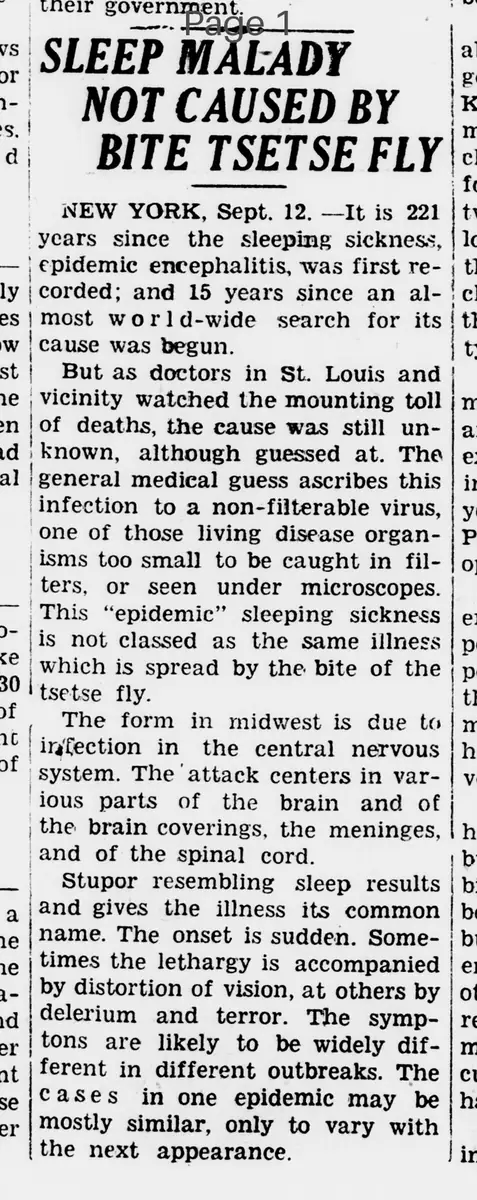
NEW YORK, Sept. 12. --It is 221 years since the sleeping sickness, epidemic encephalitis, was first recorded; and 15 years since an almost world-wide search for its cause was begun.
But as doctors in St. Louis and vicinity watched the mounting toll of deaths, the cause was still unknown, although guessed at. The general medical guess ascribes this infection to a non-filterable virus, one of those living disease organisms too small to be caught in filters or seen under microscopes.
This "epidemic" sleeping sickness is not classed as the same illness which is spread by the bite of the tsetse fly.
The form in midwest is due to infection in the central nervous system. The attack centers in various parts of the brain and of the brain coverings, the meninges, and of the spinal cord.
Stupor resembling sleep results and gives the illness its common name. The onset is sudden. Sometimes the lethargy is accompanied by distortion of vision, at others by delirium and terror. The symptoms are likely to be widely different in different outbreaks. The cases in one epidemic may be mostly similar, only to vary with the next appearance.
NEW YORK, Sept. 12. --It is 221 years since the sleeping sickness, epidemic encephalitis, was first recorded; and 15 years since an almost world-wide search for its cause was begun.
But as doctors in St. Louis and vicinity watched the mounting toll of deaths, the cause was still unknown, although guessed at. The general medical guess ascribes this infection to a non-filterable virus, one of those living disease organisms too small to be caught in filters or seen under microscopes.
This "epidemic" sleeping sickness is not classed as the same illness which is spread by the bite of the tsetse fly.
The form in midwest is due to infection in the central nervous system. The attack centers in various parts of the brain and of the brain coverings, the meninges, and of the spinal cord.
Stupor resembling sleep results and gives the illness its common name. The onset is sudden. Sometimes the lethargy is accompanied by distortion of vision, at others by delirium and terror. The symptoms are likely to be widely different in different outbreaks. The cases in one epidemic may be mostly similar, only to vary with the next appearance.
What sub-type of article is it?
Medical Curiosity
Curiosity
What themes does it cover?
Misfortune
Catastrophe
What keywords are associated?
Sleeping Sickness
Epidemic Encephalitis
Tsetse Fly
St Louis
Virus Infection
Central Nervous System
Symptoms
Where did it happen?
St. Louis And Vicinity, Midwest
Story Details
Location
St. Louis And Vicinity, Midwest
Event Date
Sept. 12
Story Details
Doctors in St. Louis observe rising deaths from epidemic encephalitis, a sleeping sickness caused by a non-filterable virus affecting the central nervous system, distinct from tsetse fly disease; symptoms include sudden stupor, vision distortion, delirium; first recorded 221 years ago, cause search ongoing for 15 years.