Thank you for visiting SNEWPapers!
Sign up free
Alexandria Daily Advertiser
Alexandria, Virginia
What is this article about?
Secretary Albert Gallatin's 1803 report to the House details US revenue exceeding $10M annually, expenses of $9.8M leaving a $600K surplus, and proposes using existing funds and New Orleans duties to cover $13M Louisiana Purchase debt interest without new taxes.
Merged-components note: Merged as continuation of the Secretary of the Treasury's report across pages, based on sequential reading order and content flow.
Clippings
1 of 2
OCR Quality
Full Text
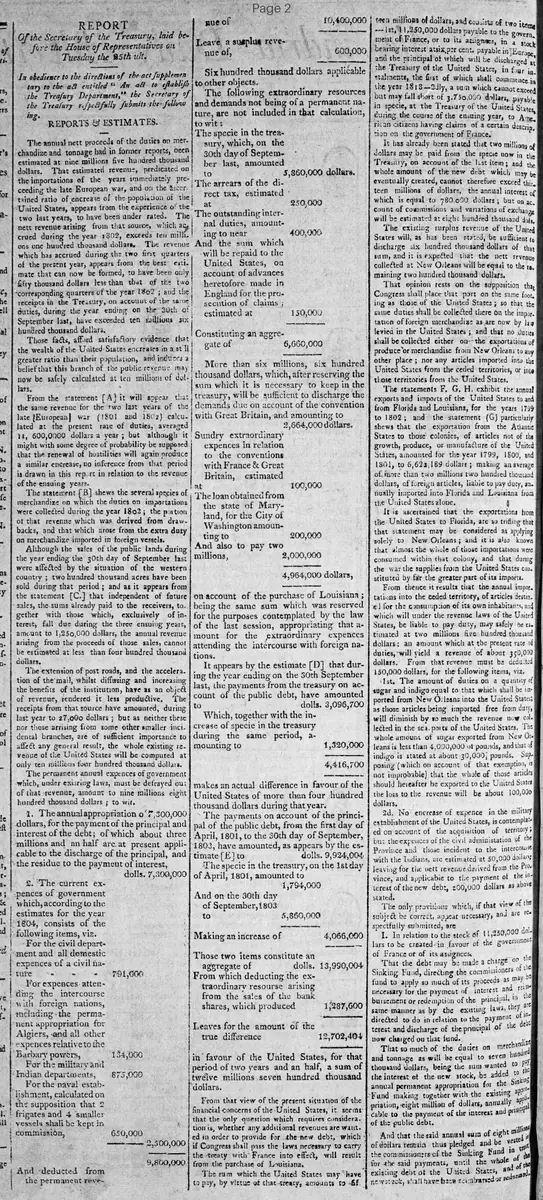
Of the Secretary of the Treasury, laid before the House of Representatives on Tuesday the 25th ult.
In obedience to the directions of the act supplementary to the act entitled "An act to establish the Treasury Department," the Secretary of the Treasury respectfully submits the following REPORTS & ESTIMATES.
The annual nett proceeds of the duties on merchandise and tonnage had in former reports, been estimated at nine millions five hundred thousand dollars. That estimated revenue, predicated on the importations of the years immediately preceding the late European war, and on the ascertained ratio of encrease of the population of the United States, appears from the experience of the two last years, to have been under rated. The nett revenue arising from that source, which accrued during the year 1802, exceeds ten millions one hundred thousand dollars. The revenue which has accrued during the two first quarters of the present year, appears from the best estimate that can now be formed, to have been only fifty thousand dollars less than that of the two corresponding quarters of the year 1802 ; and the receipts in the Treasury, on account of the same duties, during the year ending on the 30th of September last, have exceeded ten millions six hundred thousand dollars.
Those facts, afford satisfactory evidence that the wealth of the United States encreases in a still greater ratio than their population, and induces a belief that this branch of the public revenue may now be safely calculated at ten millions of dollars.
From the statement [A] it will appear that the same revenue for the two last years of the late European war (1801 and 1802) calculated at the present rate of duties, averaged 11,600,000 dollars a year ; but although it might with some degree of probability be supposed that the renewal of hostilities will again produce a similar encrease, no inference from that period is drawn in this report in relation to the revenue of the ensuing years.
The statement [B] shews the several species of merchandise on which the duties on importations were collected during the year 1802; the portion of that revenue which was derived from drawbacks, and that which arose from the extra duty on merchandise imported in foreign vessels.
Although the sales of the public lands during the year ending the 30th day of September last were affected by the situation of the western country ; two hundred thousand acres have been sold during that period; and as it appears from the statement [C.] that independent of future sales, the sums already paid to the receivers, together with those which, exclusively of interest, fall due during the three ensuing years, amount to 1,250,000 dollars, the annual revenue arising from the proceeds of those sales, cannot be estimated at less than four hundred thousand dollars.
The extension of post roads, and the acceleration of the mail, whilst diffusing and increasing the benefits of the institution, have as an object of revenue, rendered it less productive. The receipts from that source have amounted, during last year to 270,000 dollars ; but as neither these nor those arising from some other smaller incidental branches, are of sufficient importance to affect any general result, the whole existing revenue of the United States will be computed at only ten millions four hundred thousand dollars.
The permanent annual expences of government which, under existing laws, must be defrayed out of that revenue, amount to nine millions eight hundred thousand dollars ; to wit.
1. The annual appropriation of 7,300,000 dollars, for the payment of the principal and interest of the debt; of which about three millions and an half are at present applicable to the discharge of the principal, and the residue to the payment of interest,
dolls. 7,300,000
2. The current expences of government which, according to the estimates for the year 1804, consists of the following items, viz.
-For the civil department and all domestic expences of a civil nature 791,000
For expences attending the intercourse with foreign nations, including the permanent appropriation for Algiers, and all other expences relative to the Barbary powers, 134,000
For the military and Indian departments, 875,000
For the naval establishment, calculated on the supposition that 2 frigates and 4 smaller vessels shall be kept in commission, 650,000
2,500,000
9,800,000
And deducted from the permanent revenue leave a surplus revenue of, 600,000
Six hundred thousand dollars applicable to other objects.
The following extraordinary resources and demands not being of a permanent nature, are not included in that calculation, to wit :
The specie in the treasury, which, on the 30th day of September last, amounted to 5,860,000 dollars.
The arrears of the direct tax, estimated at 250,000
The outstanding internal duties, amounting to near 400,000
And the sum which will be repaid to the United States, on account of advances heretofore made in England for the prosecution of claims : estimated at 150,000
Constituting an aggregate of 6,660,000
More than six millions, six hundred thousand dollars, which, after reserving the sum which it is necessary to keep in the treasury, will be sufficient to discharge the demands due on account of the convention with Great Britain, and amounting to 2,664,000 dollars.
Sundry extraordinary expences in relation to the conventions with France & Great Britain, estimated at 100,000
The loan obtained from the state of Maryland, for the City of Washington amounting to 200,000
And also to pay two millions, 2,000,000
4,964,000 dollars, on account of the purchase of Louisiana; being the same sum which was reserved for the purposes contemplated by the law of the last session, appropriating, that amount for the extraordinary expences attending the intercourse with foreign nations.
It appears by the estimate [D] that during the year ending on the 30th September last, the payments from the treasury on account of the public debt, have amounted to dolls. 3,096,700
Which. together with the increase of specie in the treasury during the same period, amounting to 1,320,000 4,416,700
makes an actual difference in favour of the United States of more then four hundred thousand dollars during that year.
The payments on account of the principal of the public debt, from the first day of April, 1801, to the 30th day of September, 1803, have amounted, as appears by the estimate [E] to dolls. 9,924,004
The specie in the treasury, on the 1st day of April, 1801, amounted to 1,794,000
And on the 30th day of September, 1803 to 5,860,000
Making an increase of 4,066,000
Those two items constitute an aggregate of dolls. 13,990,004
From which deducting the extraordinary resourse arising from the sales of the bank shares, which produced 1,287,600
Leaves for the amount of the true difference 12,702,404
in favour of the United States. for that period of two years and an half, a sum of twelve millions seven hundred thousand dollars.
From that view of the present situation of the financial concerns of the United States. it seems that the only question which requires consideration is, whether any additional revenues are wanted in order to provide for the new debt, which if Congress shall pass the laws necessary to carry the treaty with France into effect, will result from the purchase of Louisiana.
The sum which the United States may have to pay, by virtue of that treaty, amounts to fifteen millions of dollars, and consists of two items ..- 1st, 11,250,000 dollars payable to the government of France, or to its assignees, in a stock bearing interest at six per cent. payable in Europe. and the principal of which will be discharged at the Treasury of the United States, in four installments, the first of which shall commence in the year 1818--2dly, a sum which cannot exceed but may fall short of 3,750,000 dollars, payable in specie, at the Treasury of the United States, during the course of the ensuing year, to American citizens having claims of a certain description on the government of France.
It has already been stated that two millions of dollars may be paid from the specie now in the Treasury, on account of the last item; and the whole amount of the new debt which may be eventually created, cannot therefore exceed thirteen millions of dollars, the annual interest of which is equal to 780,000 dollars; but on account of commissions and variations of exchange will be estimated at eight hundred thousand dols.
The existing surplus revenue of the United States will, as has been stated, be sufficient to discharge six hundred thousand dollars of that sum, and it is expected that the nett revenue collected at New Orleans will be equal to the remaining two hundred thousand dollars.
That opinion rests on the supposition that Congress shall place that port on the same footing as those of the United States; so that the same duties shall be collected there on the importation of foreign merchandize as are now by law levied in the United States ; and that no duties shall be collected either on the exportations of produce or merchandise from New Orleans to any other place ; nor any articles imported into the United States from the ceded territories, or into those territories from the United States.
The statements F. G. H. exhibit the annual exports and imports of the United States to and from Florida and Louisiana, for the years 1799 to 1802; and the statement (G) particularly shews that the exportation from the Atlantic States to those colonies, of articles not of the growth, produce, or manufacture of the United States, amounted for the year 1799, 1800, and 1801, to 6,622,189 dollars ; making an average of. more than two millions two hundred thousand dollars, of foreign articles, liable to pay duty, annually imported into Florida and Louisiana from the United States alone.
It is ascertained that the exportations from the United States to Florida, are so trifling that that statement may be considered as applying solely to New Orleans; and it is also known that almost the whole of those importations were consumed within that colony, and that during the war the supplies from the United States constituted by far the greater part of its imports.
From thence it results that the annual importations into the ceded territory, of articles destined for the consumption of its own inhabitants, and which will under the revenue laws of the United States, be liable to pay duty, may safely be estimated at two millions five hundred thousand dollars: an amount which at the present rate of duties, will yield a revenue of about 350,000 dollars. From that revenue must be deducted 150,000 dollars, for the following items, viz.
1st. The amount of duties on a quantity of sugar and indigo equal to that which shall be imported from New Orleans into the United States; as those articles being imported free from duty, will diminish by so much the revenue now collected in the sea. ports of the United States. The whole amount of sugar exported from New Orleans is less than 4,000,000 of pounds, and that of indigo is stated at about 30,000 pounds. Supposing (which on account of that exemption, is not improbable) that the whole of those articles should hereafter be exported to the United States the loss to the revenue will be about 100,000 dollars.
2d. No encrease of expence in the military establishment of the United States, is contemplated on account of the acquisition of territory; but the expences of the civil administration of the Province and those incident to the intercourse with the Indians, are estimated at 50,000 dollars; leaving for the nett revenue derived from the Province, and applicable to the payment of the interest of the new debt, 200,000 dollars as above stated.
The only provisions which, if that view of the subject be correct, appear necessary, and are respectfully submitted, are
That the debt may be made a charge on the Sinking Fund, directing the commissioners of the Sinking Fund to apply so much of its proceeds as may be necessary for the payment of interest and reimbursement or redemption of the principal, in the same manner as by the existing laws, they are directed to do in relation to the payment of interest and discharge of the principal of the debt now charged on that fund.
That so much of the duties on merchandize and tonnage as will be equal to seven hundred thousand dollars, being the sum wanted to pay the interest of the new stock, be added to the annual permanent appropriation for the Sinking Fund making together with the existing appro. priation, eight million of dollars, annually applicable to the payment of the interest and principal of the public debt.
And that the said annual sum of eight millions of dollars remain thus pledged and be vested in the Sinking Fund for the said payments, until the whole of the existing debt of the United States, and of the new debt, shall have been reimbursed or redeemed.
New stock will thus be added to the sinking fund. As a sum equal to the interest accruing on the operation of that fund, as it relates to the extinguishment of the existing debt, will remain for provided by Congress. The new debt will precisely on the same footing as has been heretofore. Neither impede nor retard the payment of the sufficient besides paying the interest on both, to principal of the old debt; and the fund will be year this, and that of the new within one year discharge the principal of the old debt, before the and a half after that year. Payment of which is assumed by the convention II. In relation to the American claims the with France: That a sum not exceeding 3,750,000 dollars inclusive of the two millions appropriated by a law of the last session of Congress for defraying the extraordinary expenses incident to the intercourse with foreign nations, be appropriated for the payment of those claims, to be paid out of any monies in the Treasury not otherwise appropriated That for the purpose of effecting the whole of that payment, the President of the United States be authorized to borrow a sum not exceeding 1,750,000 dollars, at an interest not exceeding six per cent a year: And that so much of the proceeds of the duties on merchandize and tonnage as may be necessary, be appropriated for the payment of the interest and for the reimbursement of the principal of the loan which may eventually be effected by virtue of the preceding provision. It is not proposed to charge that loan on the sinking fund, because its amount, in case it shall be effected, cannot at present be ascertained; and because it may, perhaps under the then existing circumstances of the Treasury, be found more expedient not to borrow the money, and in lieu of it, repay out of the sinking fund the whole or part of the two last instalments payable by virtue of the Convention with Great Britain, as authorized by the act making provision for the payment of the whole of the public debt. It is evident that the possibility of thus providing for the payment of the interest of a new debt of thirteen millions of dollars, without either recurring to new taxes or interfering with the provisions heretofore made for the payment of the existing debt, depends on the correctness of the estimate of the public Revenue which has been submitted. Although it is not without diffidence that the hope of such favorable result is entertained, some reliance is placed on the solidity of the basis on which the estimate is grounded. It rests principally on the expectation that the revenue of the ensuing year shall not be less than that which accrued in the year 1802. No part of it depends on the probable increase which may result from the neutrality of the United States during the continuance of the war in Europe; nor even on the progressive augmentation, which from past experience may naturally be expected to arise from the gradual increase of population and wealth. Nor has that effect been taken into consideration which the uninterrupted free navigation of the Mississippi, and the acquisition of New Orleans may have either on the sales of public lands, or on the general resources of the inhabitants of the western states. All which is respectfully submitted,
ALBERT GALLATIN,
Secretary of the Treasury.
What sub-type of article is it?
What keywords are associated?
What entities or persons were involved?
Where did it happen?
Domestic News Details
Primary Location
United States
Event Date
Tuesday The 25th Ult.
Key Persons
Outcome
surplus revenue of $600,000; provisions to fund $13m louisiana purchase debt using existing revenues and new orleans duties, without new taxes; public debt payments exceed $9.9m from 1801-1803.
Event Details
Secretary of the Treasury Albert Gallatin reports on US revenues from duties, lands, and post roads totaling over $10.4M annually, exceeding prior estimates; details government expenses of $9.8M including debt service; outlines extraordinary resources and uses for Louisiana Purchase and other obligations; recommends charging new debt to Sinking Fund and appropriations to cover interest.