Thank you for visiting SNEWPapers!
Sign up free
Virginia Argus
Richmond, Virginia
What is this article about?
Mr. Pitt presented the British budget to Parliament on February 28, outlining war supplies totaling 44,475,000 pounds for navy, army, ordnance, and diplomacy, plus additional charges. A 22.5 million pound loan was raised, funded by new taxes on mail, salt, horses, and legacies. Compared to U.S. finances, Britain's expenditures are vastly higher.
Merged-components note: Sequential components form a single article on the British budget and loan, relabeled from editorial to foreign_news as it reports on foreign financial matters.
Clipping
OCR Quality
Full Text
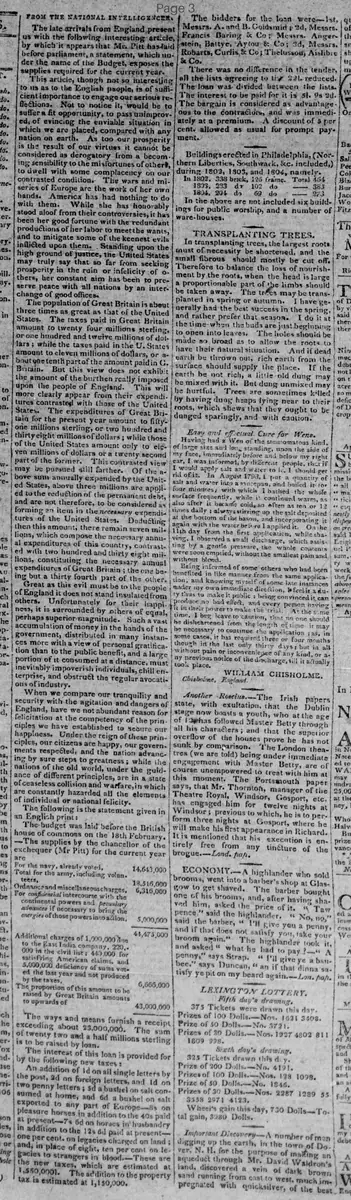
The late arrivals from England present us with the following interesting article, by which it appears that Mr. Pitt has laid before parliament, a statement, which under the name of the Budget, exposes the supplies required for the current year.
This article, though not so interesting to us as to the English people, is of sufficient importance to engage our serious reflections. Not to notice it, would be to suffer a fit opportunity, to pass unimproved, of evincing the enviable situation in which we are placed, compared with any nation on earth. As too our prosperity is the result of our virtues it cannot be considered as derogatory from a becoming sensibility to the misfortunes of others, to dwell with some complacency on our contrasted condition. The wars and miseries of Europe are the work of her own hands. America has had nothing to do with them. While she has honorably stood aloof from their controversies, it has been her good fortune with the redundant productions of her labor to meet the wants, and to mitigate some of the keenest evils inflicted upon them. Standing upon the high ground of justice, the United States may truly say that so far from seeking prosperity in the ruin or infelicity of others, her constant aim has been to preserve peace with all nations by an interchange of good offices.
The population of Great Britain is about three times as great as that of the United States. The taxes paid in Great Britain amount to twenty four millions sterling, or one hundred and twelve millions of dollars ; while the taxes paid in the U. States amount to eleven millions of dollars, or about one tenth part of the amount paid in G. Britain. But this view does not exhibit the amount of the burthen really imposed upon the people of England. This will more clearly appear from their expenditures contrasted with those of the United States. The expenditures of Great Britain for the present year amount to sixty-one millions sterling, or two hundred and thirty eight millions of dollars; while those of the United States amount only to eleven millions of dollars or a twenty second part of the former. This contrasted view may be pursued still farther. Of the above sum annually expended by the United States, above three millions are applied to the reduction of the permanent debt, and are not therefore, to be considered as forming an item in the necessary expenditures of the United States. Deducting then this amount; there remain seven millions, which compose the necessary annual expenditures of this country, contrasted with two hundred and thirty eight millions, constituting the necessary annual expenditures of Great Britain ; the one being but a thirty fourth part of the other.
Great as this evil must be to the people of England it does not stand insulated from others. Unfortunately for their happiness, it is surrounded by others of equal, perhaps superior magnitude. Such a vast accumulation of money in the hands of the government, distributed in many instances more with a view of personal gratification than to the public benefit, and a large portion of it consumed at a distance, must inevitably impoverish individuals, chill enterprise, and obstruct the regular avocations of industry.
When we compare our tranquility and security with the agitation and dangers of England, have we not abundant reason for felicitation at the competency of the principles we have established to secure our happiness. Under the reign of these principles, our citizens are happy, our governments respected, and the nation advancing by sure steps to greatness; while the nations of the old world, under the guidance of different principles, are in a state of ceaseless collision and warfare, in which are constantly hazarded all the elements of individual or national felicity.
The following is the statement given in an English print:
The budget was laid before the British house of commons on the 28th February. --The supplies by the chancellor of the exchequer (Mr Pitt) for the current year are
For the navy, already voted, 14,643,000
Total for the army, including volunteers, 18,516,000
Ordnance and miscellaneous charges,
For confidential intercourse with the continental powers and pecuniary advances if necessary to bring the energies of those powers into action, 6,316,000
5,000,000
44,475,000
Additional charges of 1,000,000 due to the East India company, 220,000 in the civil list : 440,000 for satisfying American claims. and 5,000,000 deficiency of sums voted the last year and not produced by the taxes, 6,666,000
The proportion of this amount to be raised by Great Britain amounts to upwards of 43,000,000
The ways and means furnish a receipt exceeding about 23,000,000.
The sum of twenty two and a half millions sterling is to be raised by loan.
The interest of this loan is provided for by the following new taxes:
An addition of 1d on all single letters by the post, 2d on foreign letters, and 1d on two penny letters ; 5d a bushel on salt consumed at home, and 6d a bushel on salt exported to any part of Europe—8s on pleasure horses in addition to the 40s paid at present—7s 6d on horses in husbandry in addition to the 12s 6d paid at present— one per cent. on legacies charged on land ; and, in place of eight, ten per cent on legacies to strangers in blood.—These are the new taxes, which are estimated at 1,550,000l. The addition to the property tax is estimated at 1,150,000,
The bidders for the loan were—1st. Messrs. A. and B. Goldsmid ; 2d, Messrs. Francis Baring & Co; Messrs. Angerstein, Boldero, Aytoun & Co; 3d, Messrs. Robarts, Curtis & Co; Thellusson, Aislabie & Co.
There was no difference in the tender, all the lists agreeing to the 22l. reduced.
The loan was divided between the lists.
The interest to be paid for it is 5l. 6s 2d.
The bargain is considered as advantageous to the contractors, and was immediately at a premium. -A discount of 5 per cent. allowed as usual for prompt payment.
What sub-type of article is it?
What keywords are associated?
What entities or persons were involved?
Where did it happen?
Foreign News Details
Primary Location
Great Britain
Event Date
28th February
Key Persons
Outcome
supplies total 44,475,000 pounds for navy, army, ordnance, and diplomacy; additional charges 6,666,000 pounds; loan of 22.5 million pounds raised at 5l. 6s 2d interest; new taxes estimated at 1,550,000l plus 1,150,000 from property tax addition.
Event Details
Mr. Pitt, Chancellor of the Exchequer, laid the budget before the British House of Commons on 28th February, detailing supplies for the current year including 14,643,000 for navy, 18,516,000 for army, 6,316,000 for ordnance and miscellaneous, 5,000,000 for confidential intercourse with continental powers, totaling 44,475,000. Additional charges include 1,000,000 to East India Company, 220,000 civil list, 440,000 for American claims, and 5,000,000 deficiency. Proportion to be raised by Great Britain over 43,000,000, with ways and means providing about 23,000,000; balance by 22.5 million pound loan. New taxes on letters, salt, horses, legacies, and property tax addition to cover interest.