Thank you for visiting SNEWPapers!
Sign up free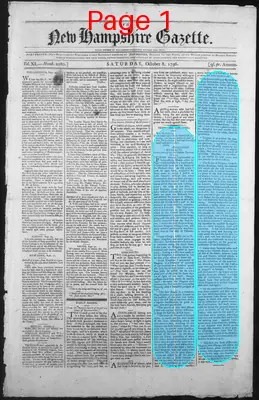
Literary
October 8, 1796
The New Hampshire Gazette
Portsmouth, Rockingham County, New Hampshire
What is this article about?
Travel account from 1794 detailing a journey from Albany to Schenectady, along the Mohawk River to Lake Ontario via Oswego, then to Niagara and Kingston. Describes routes, British forts, fur trade, settlements, fish, government at Niagara, Niagara Falls, and forts like Detroit and Michilimackinac, noting their positions post-1783 treaty.
Clipping
OCR Quality
95%
Excellent
Full Text
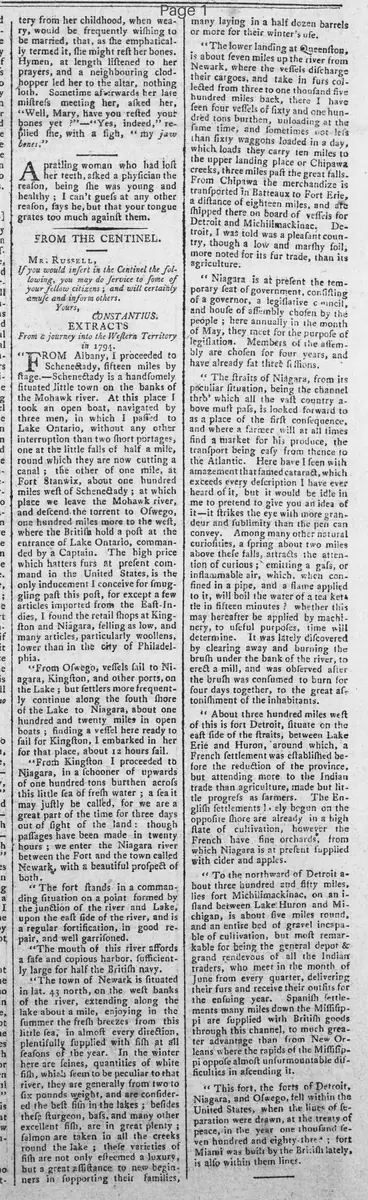
FROM THE CENTINEL.
Mr: Russell,
If you would insert in the Centinel the following, you may do service to some of your fellow citizens; and will certainly amuse and inform others.
Yours,
CONSTANTIUS:
EXTRACTS
From a journey into the Western Territory in 1794.
From Albany, I proceeded to Schenectady, fifteen miles by stage. Schenectady is a handsomely situated little town on the banks of the Mohawk river. At this place I took an open boat, navigated by three men, in which I passed to Lake Ontario, without any other interruption than two short portages, one at the little falls of half a mile, round which they are now cutting a canal; the other of one mile, at Fort Stanwix, about one hundred miles west of Schenectady; at which place we leave the Mohawk river, and descend the torrent to Oswego, one hundred miles more to the west, where the British hold a post at the entrance of Lake Ontario, commanded by a Captain. The high price which hatters furs at present command in the United States, is the only inducement I conceive for smuggling past this post, for except a few articles imported from the East-Indies, I found the retail shops at Kingston and Niagara, selling as low, and many articles, particularly woollens, lower than in the city of Philadelphia.
From Oswego, vessels sail to Niagara, Kingston, and other ports, on the Lake; but settlers more frequently continue along the south shore of the Lake to Niagara, about one hundred and twenty miles in open boats; finding a vessel here ready to sail for Kingston, I embarked in her for that place, about 12 hours sail.
From Kingston I proceeded to Niagara, in a schooner of upwards of one hundred tons burthen across this little sea of fresh water; a sea it may justly be called, for we are a great part of the time for three days out of sight of the land: though passages have been made in twenty hours; we enter the Niagara river between the Fort and the town called Newark, with a beautiful prospect of both.
The fort stands in a commanding situation on a point formed by the junction of the river and Lake, upon the east side of the river, and is a regular fortification, in good repair, and well garrisoned.
The mouth of this river affords a safe and copious harbor, sufficiently large for half the British navy.
The town of Newark is situated in lat. 43 north, on the west banks of the river, extending along the lake about a mile, enjoying in the summer the fresh breezes from this little sea, in almost every direction, plentifully supplied with fish at all seasons of the year. In the winter here are Seines, quantities of white fish, which seem to be peculiar to that river, they are generally from two to six pounds weight, and are considered the best fish in the lakes: besides these sturgeon, bass, and many other excellent fish, are in great plenty; salmon are taken in all the creeks round the lake; these varieties of fish are not only esteemed a luxury, but a great assistance to new beginners in supporting their families. many laying in a half dozen barrels or more for their winter's use.
The lower landing at Queenston, is about seven miles up the river from Newark, where the vessels discharge their cargoes, and take in furs collected from three to one thousand five hundred miles back, there I have seen four vessels of sixty and one hundred tons burthen, unloading at the same time, and sometimes not less than sixty waggons loaded in a day, which loads they carry ten miles to the upper landing place or Chipawa creeks, three miles past the great falls. From Chipawa the merchandize is transported in Batteaux to Fort Erie, a distance of eighteen miles, and are shipped there on board of vessels for Detroit and Michilimackinac. Detroit, I was told was a pleasant country, though a low and marshy soil; more noted for its fur trade, than its agriculture.
Niagara is at present the temporary seat of government, consisting of a governor, a legislative council, and house of assembly chosen by the people; here annually in the month of May, they meet for the purpose of legislation. Members of the assembly are chosen for four years, and have already at three sessions.
The straits of Niagara, from its peculiar situation, being the channel thro' which all the vast country above must pass, is looked forward to as a place of the first consequence, and where a farmer will at all times find a market for his produce, the transport being easy from thence to the Atlantic. Here have I seen with amazement that famed cataract, which exceeds every description I have ever heard of it, but it would be idle in me to pretend to give you an idea of it. it strikes the eye with more grandeur and sublimity than the pen can convey. Among many other natural curiosities, a spring about two miles above these falls, attracts the attention of the curious; emitting a gas, or inflammable air, which, when confined in a pipe, and a flame applied to it, will boil the water of a tea kettle in fifteen minutes? whether this may hereafter be applied by machinery, to useful purposes, time will determine. It was lately discovered by clearing away and burning the brush under the bank of the river, to erect a mill, and was observed after the brush was consumed to burn for four days together, to the great astonishment of the inhabitants.
About three hundred miles west of this is fort Detroit, situate on the east side of the straits, between Lake Erie and Huron, around which, a French settlement was established before the reduction of the province. but attending more to the Indian trade than agriculture, made but little progress as farmers. The English settlements lately begun on the opposite shore are already in a high state of cultivation, however the French have fine orchards, from which Niagara is at present supplied with cider and apples.
To the northward of Detroit about three hundred and sixty miles, lies fort Michilimackinac, on an island between Lake Huron and Michigan, is about five miles round, and an entire bed of gravel incapable of cultivation, but most remarkable for being the general depot & grand rendevous of all the Indian traders, who meet in the month of June from every quarter, delivering their furs and receive their outfits for the ensuing year. Spanish Settlements many miles down the Mississippi are supplied with British goods through this channel, to much greater advantage than from New Orleans where the rapids of the Mississippi oppose almost insurmountable difficulties in ascending it.
This fort, the forts of Detroit, Niagara, and Oswego, fell within the United States, when the lines of separation were drawn, at the treaty of peace, in the year one thousand seven hundred and eighty-three; fort Miami was built by the British lately, is also within them lines.
Mr: Russell,
If you would insert in the Centinel the following, you may do service to some of your fellow citizens; and will certainly amuse and inform others.
Yours,
CONSTANTIUS:
EXTRACTS
From a journey into the Western Territory in 1794.
From Albany, I proceeded to Schenectady, fifteen miles by stage. Schenectady is a handsomely situated little town on the banks of the Mohawk river. At this place I took an open boat, navigated by three men, in which I passed to Lake Ontario, without any other interruption than two short portages, one at the little falls of half a mile, round which they are now cutting a canal; the other of one mile, at Fort Stanwix, about one hundred miles west of Schenectady; at which place we leave the Mohawk river, and descend the torrent to Oswego, one hundred miles more to the west, where the British hold a post at the entrance of Lake Ontario, commanded by a Captain. The high price which hatters furs at present command in the United States, is the only inducement I conceive for smuggling past this post, for except a few articles imported from the East-Indies, I found the retail shops at Kingston and Niagara, selling as low, and many articles, particularly woollens, lower than in the city of Philadelphia.
From Oswego, vessels sail to Niagara, Kingston, and other ports, on the Lake; but settlers more frequently continue along the south shore of the Lake to Niagara, about one hundred and twenty miles in open boats; finding a vessel here ready to sail for Kingston, I embarked in her for that place, about 12 hours sail.
From Kingston I proceeded to Niagara, in a schooner of upwards of one hundred tons burthen across this little sea of fresh water; a sea it may justly be called, for we are a great part of the time for three days out of sight of the land: though passages have been made in twenty hours; we enter the Niagara river between the Fort and the town called Newark, with a beautiful prospect of both.
The fort stands in a commanding situation on a point formed by the junction of the river and Lake, upon the east side of the river, and is a regular fortification, in good repair, and well garrisoned.
The mouth of this river affords a safe and copious harbor, sufficiently large for half the British navy.
The town of Newark is situated in lat. 43 north, on the west banks of the river, extending along the lake about a mile, enjoying in the summer the fresh breezes from this little sea, in almost every direction, plentifully supplied with fish at all seasons of the year. In the winter here are Seines, quantities of white fish, which seem to be peculiar to that river, they are generally from two to six pounds weight, and are considered the best fish in the lakes: besides these sturgeon, bass, and many other excellent fish, are in great plenty; salmon are taken in all the creeks round the lake; these varieties of fish are not only esteemed a luxury, but a great assistance to new beginners in supporting their families. many laying in a half dozen barrels or more for their winter's use.
The lower landing at Queenston, is about seven miles up the river from Newark, where the vessels discharge their cargoes, and take in furs collected from three to one thousand five hundred miles back, there I have seen four vessels of sixty and one hundred tons burthen, unloading at the same time, and sometimes not less than sixty waggons loaded in a day, which loads they carry ten miles to the upper landing place or Chipawa creeks, three miles past the great falls. From Chipawa the merchandize is transported in Batteaux to Fort Erie, a distance of eighteen miles, and are shipped there on board of vessels for Detroit and Michilimackinac. Detroit, I was told was a pleasant country, though a low and marshy soil; more noted for its fur trade, than its agriculture.
Niagara is at present the temporary seat of government, consisting of a governor, a legislative council, and house of assembly chosen by the people; here annually in the month of May, they meet for the purpose of legislation. Members of the assembly are chosen for four years, and have already at three sessions.
The straits of Niagara, from its peculiar situation, being the channel thro' which all the vast country above must pass, is looked forward to as a place of the first consequence, and where a farmer will at all times find a market for his produce, the transport being easy from thence to the Atlantic. Here have I seen with amazement that famed cataract, which exceeds every description I have ever heard of it, but it would be idle in me to pretend to give you an idea of it. it strikes the eye with more grandeur and sublimity than the pen can convey. Among many other natural curiosities, a spring about two miles above these falls, attracts the attention of the curious; emitting a gas, or inflammable air, which, when confined in a pipe, and a flame applied to it, will boil the water of a tea kettle in fifteen minutes? whether this may hereafter be applied by machinery, to useful purposes, time will determine. It was lately discovered by clearing away and burning the brush under the bank of the river, to erect a mill, and was observed after the brush was consumed to burn for four days together, to the great astonishment of the inhabitants.
About three hundred miles west of this is fort Detroit, situate on the east side of the straits, between Lake Erie and Huron, around which, a French settlement was established before the reduction of the province. but attending more to the Indian trade than agriculture, made but little progress as farmers. The English settlements lately begun on the opposite shore are already in a high state of cultivation, however the French have fine orchards, from which Niagara is at present supplied with cider and apples.
To the northward of Detroit about three hundred and sixty miles, lies fort Michilimackinac, on an island between Lake Huron and Michigan, is about five miles round, and an entire bed of gravel incapable of cultivation, but most remarkable for being the general depot & grand rendevous of all the Indian traders, who meet in the month of June from every quarter, delivering their furs and receive their outfits for the ensuing year. Spanish Settlements many miles down the Mississippi are supplied with British goods through this channel, to much greater advantage than from New Orleans where the rapids of the Mississippi oppose almost insurmountable difficulties in ascending it.
This fort, the forts of Detroit, Niagara, and Oswego, fell within the United States, when the lines of separation were drawn, at the treaty of peace, in the year one thousand seven hundred and eighty-three; fort Miami was built by the British lately, is also within them lines.
What sub-type of article is it?
Journey Narrative
Essay
What themes does it cover?
Commerce Trade
Political
Nature
What keywords are associated?
Western Territory
Niagara Falls
Fur Trade
British Forts
Lake Ontario
Mohawk River
Treaty 1783
Travel Account
What entities or persons were involved?
Constantius
Literary Details
Title
Extracts From A Journey Into The Western Territory In 1794.
Author
Constantius
Subject
Journey Into The Western Territory In 1794
Form / Style
Travel Narrative In Prose
Key Lines
Here Have I Seen With Amazement That Famed Cataract, Which Exceeds Every Description I Have Ever Heard Of It, But It Would Be Idle In Me To Pretend To Give You An Idea Of It. It Strikes The Eye With More Grandeur And Sublimity Than The Pen Can Convey.
The High Price Which Hatters Furs At Present Command In The United States, Is The Only Inducement I Conceive For Smuggling Past This Post
This Fort, The Forts Of Detroit, Niagara, And Oswego, Fell Within The United States, When The Lines Of Separation Were Drawn, At The Treaty Of Peace, In The Year One Thousand Seven Hundred And Eighty Three