Thank you for visiting SNEWPapers!
Sign up free
Editorial
November 24, 1866
Keowee Courier
Walhalla, Pickens, Oconee County, Pickens County, South Carolina
What is this article about?
John E. Tobin proposes that South Carolina planters cultivate fewer acres intensively with fertilizers to reduce labor costs and demand, potentially displacing many freed laborers and ensuring cheap coerced free labor.
Clipping
OCR Quality
95%
Excellent
Full Text
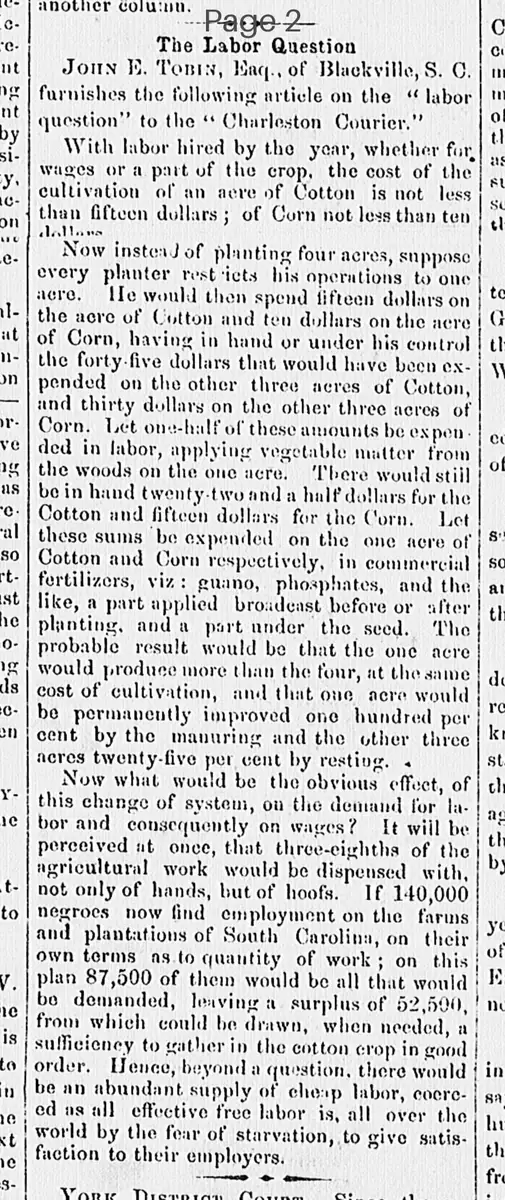
The Labor Question
John E. Tobin, Esq., of Blackville, S. C.
furnishes the following article on the "labor
question" to the "Charleston Courier."
With labor hired by the year, whether for
wages or a part of the crop, the cost of the
cultivation of an acre of Cotton is not less
than fifteen dollars ; of Corn not less than ten
dollars
Now instead of planting four acres, suppose
every planter restricts his operations to one
acre. He would then spend fifteen dollars on
the acre of Cotton and ten dollars on the acre
of Corn, having in hand or under his control
the forty-five dollars that would have been
expended on the other three acres of Cotton,
and thirty dollars on the other three acres of
Corn. Let one-half of these amounts be expended in labor, applying vegetable matter from
the woods on the one acre. There would still
be in hand twenty-two and a half dollars for the
Cotton and fifteen dollars for the Corn. Let
these sums be expended on the one acre of
Cotton and Corn respectively, in commercial
fertilizers, viz : guano, phosphates, and the
like, a part applied broadcast before or after
planting, and a part under the seed. The
probable result would be that the one acre
would produce more than the four, at the same
cost of cultivation, and that one acre would
be permanently improved one hundred per
cent by the manuring and the other three
acres twenty-five per cent by resting.
Now what would be the obvious effect, of
this change of system, on the demand for la-
bor and consequently on wages? It will be
perceived at once, that three-eighths of the
agricultural work would be dispensed with,
not only of hands, but of hoofs. If 140,000
negroes now find employment on the farms
and plantations of South Carolina, on their
own terms as to quantity of work ; on this
plan 87,500 of them would be all that would
be demanded, leaving a surplus of 52,500.
from which could be drawn, when needed, a
sufficiency to gather in the cotton crop in good
order. Hence, beyond a question, there would
be an abundant supply of cheap labor, coerced as all effective free labor is, all over the
world by the fear of starvation, to give satis-
faction to their employers.
John E. Tobin, Esq., of Blackville, S. C.
furnishes the following article on the "labor
question" to the "Charleston Courier."
With labor hired by the year, whether for
wages or a part of the crop, the cost of the
cultivation of an acre of Cotton is not less
than fifteen dollars ; of Corn not less than ten
dollars
Now instead of planting four acres, suppose
every planter restricts his operations to one
acre. He would then spend fifteen dollars on
the acre of Cotton and ten dollars on the acre
of Corn, having in hand or under his control
the forty-five dollars that would have been
expended on the other three acres of Cotton,
and thirty dollars on the other three acres of
Corn. Let one-half of these amounts be expended in labor, applying vegetable matter from
the woods on the one acre. There would still
be in hand twenty-two and a half dollars for the
Cotton and fifteen dollars for the Corn. Let
these sums be expended on the one acre of
Cotton and Corn respectively, in commercial
fertilizers, viz : guano, phosphates, and the
like, a part applied broadcast before or after
planting, and a part under the seed. The
probable result would be that the one acre
would produce more than the four, at the same
cost of cultivation, and that one acre would
be permanently improved one hundred per
cent by the manuring and the other three
acres twenty-five per cent by resting.
Now what would be the obvious effect, of
this change of system, on the demand for la-
bor and consequently on wages? It will be
perceived at once, that three-eighths of the
agricultural work would be dispensed with,
not only of hands, but of hoofs. If 140,000
negroes now find employment on the farms
and plantations of South Carolina, on their
own terms as to quantity of work ; on this
plan 87,500 of them would be all that would
be demanded, leaving a surplus of 52,500.
from which could be drawn, when needed, a
sufficiency to gather in the cotton crop in good
order. Hence, beyond a question, there would
be an abundant supply of cheap labor, coerced as all effective free labor is, all over the
world by the fear of starvation, to give satis-
faction to their employers.
What sub-type of article is it?
Labor
Agriculture
Economic Policy
What keywords are associated?
Labor Question
South Carolina Agriculture
Cotton Cultivation
Fertilizers Guano
Cheap Labor
Freedmen Employment
Wage Reduction
What entities or persons were involved?
John E. Tobin
Blackville S. C.
Charleston Courier
South Carolina Planters
Negroes
Editorial Details
Primary Topic
Intensive Farming To Reduce Labor Demand In South Carolina Agriculture
Stance / Tone
Advocacy For Efficiency Measures To Lower Wages And Coerce Cheap Free Labor
Key Figures
John E. Tobin
Blackville S. C.
Charleston Courier
South Carolina Planters
Negroes
Key Arguments
Cultivating One Acre Intensively Costs The Same As Four But Yields More With Fertilizers
Savings From Reduced Acreage Can Fund Manuring And Commercial Fertilizers Like Guano
This System Improves Land Permanently And Rests Other Acres
Reduces Agricultural Labor Demand By Three Eighths, Affecting Hands And Livestock
With 140,000 Negroes Currently Employed, Only 87,500 Needed, Creating Surplus For Cheap Coerced Labor