Thank you for visiting SNEWPapers!
Sign up free
The Richmond Virginian
Richmond, Virginia
What is this article about?
In chapter XVII of his memoir, U.S. Ambassador James W. Gerard examines racial tensions in Germany, including Alsace-Lorraine, Polish unrest under Prussian rule, Danish issues in Schleswig-Holstein, and Hanover's annexation. He also discusses Germany's climate, original Slavic influences in Prussia, regional differences, heavy eating habits, and their impact on national character.
Merged-components note: Serialization of 'My Four Years in Germany' by James W. Gerard, including illustrations; images merged as they appear to be related to the literary content.
Clippings
1 of 2
OCR Quality
Full Text
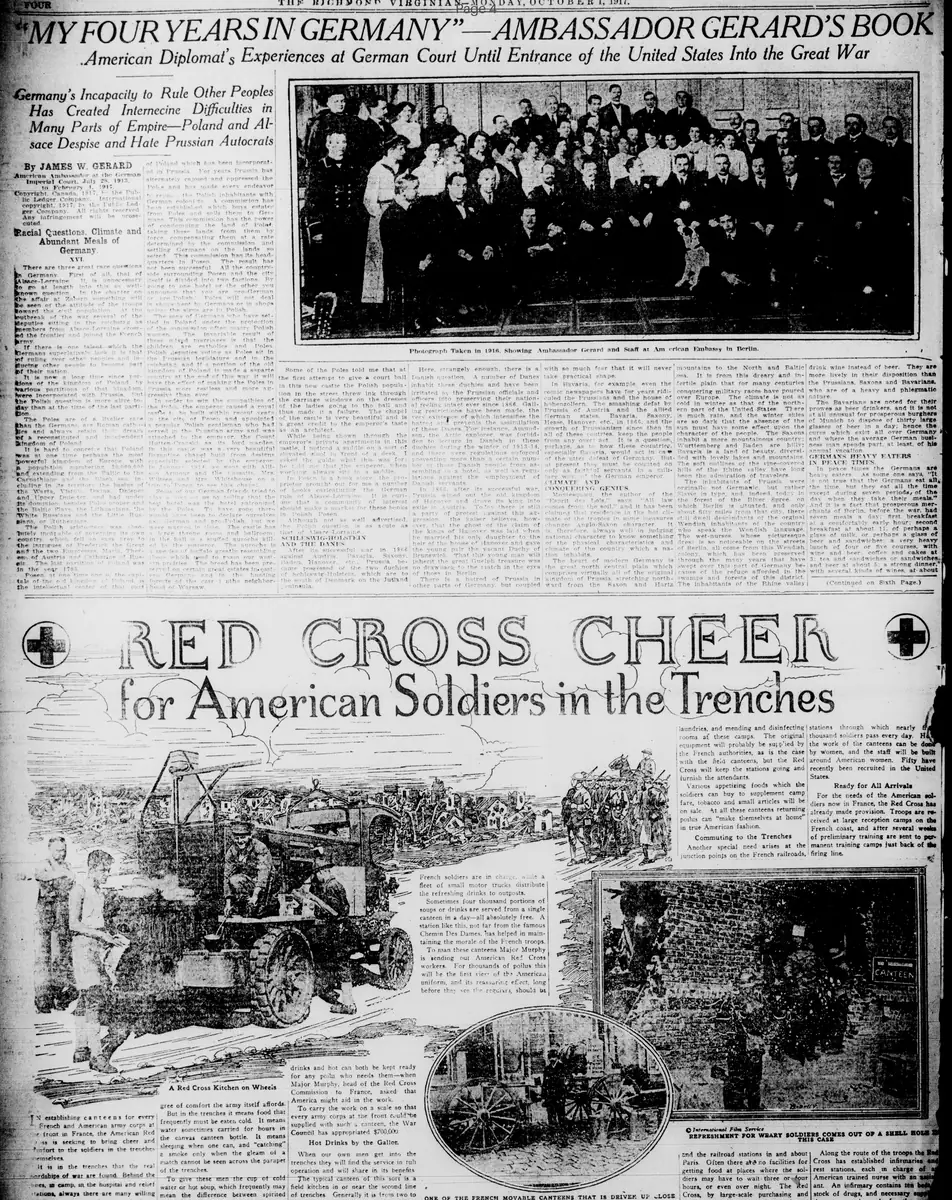
AMBASSADOR GERARD'S BOOK
American Diplomat's Experiences at German Court Until Entrance of the United States Into the Great War
Germany's Incapacity to Rule Other Peoples
Has Created Internecine Difficulties
in
Many Parts of Empire - Poland and Alsace
Despise and Hate Prussian Autocrats
By JAMES W. GERARD
American Ambassador at the German
Imperial Court, July 25, 1913,
to February 3, 1917.
Copyright, 1917, by the Public
Ledger Company. International
copyright, 1917, by the Public Ledger
Company. All rights reserved.
Any infringement will be prosecuted.
Racial Questions. Climate and
Abundant Meals of
Germany.
XVII.
There are three great race questions
in Germany.
First of all that of
Alsace-Lorraine.
It is unnecessary
to go at length
into this so well-
known question.
In the chapter on
the affair at Zabern something will
be seen of the attitude of the troops
toward the civil population. At the
outbreak of the war several of the
deputies sitting in the Reichstag as
members from Alsace-Lorraine crossed
the frontier and joined the French
army.
If there is one talent which the
German superlative lacks it is that
of ruling over other people and inducing other people to become part
of their nation.
It is now a long time since portions
of the kingdom of Poland by
various partitions of that kingdom.
Were incorporated with Prussia but
the Polish question is more alive today
than at the time of the last partition.
The Poles are of a lighter race
than the Germans are Roman Catholics and always retain the
dream
of a reconstituted and independent
"kingdom of Poland."
It is hard to conceive
that Poland
was at one time perhaps the most
powerful kingdom of Europe with
a population numbering
20,000,000
and extending from the Baltic to the
Carpathians and the
Black Sea including in its territories the basin of
the Warta, Vistula,
Dnieper
and Upper Dnieper
and had under
Its dominion, besides Poles, proper and
the Baltic Slav the Lithuanians the
White Russians and the Little Russians
or Ruthenians.
The Polish aristocracy
was
utterly incapable of governing its own
country, which fell a
prey to
the intrigues of Frederick the Great
and the two empresses
Catherine of Russia
and Maria Theresa of Austria.
The first partition of Poland was
in the year 1772.
Posen, at one time one of the capitals
of the old independent Poland is
the intellectual center of that part
of Poland which has been incorporated
in Prussia. For years Prussia has
alternately enjoyed and oppressed the
Poles and has made every endeavor
to replace the Polish inhabitants with
German colonists. A commission has
been established which buys estates
from Poles and sells them to Germans. This commission has the power
of condemning the land of Poles
taking these lands from them by
force compensating them at a rate
determined by the commission and
settling Germans on the lands so
seized. This commission has its headquarters in Posen.
The result has
not been successful.
All the countryside
surrounding Posen and the city
itself is divided into two factions. By
going to one hotel or the other you
announce that you are one (German
or pro German) or the other (pro
Polish). Poles will not deal
in hotels kept by the Germans or in shops
kept by Germans. The sons of Germans who have settled
in Poland under the protection
of the commission often marry Polish
women. The inevitable result
of
these mixed marriages is that the
children are Catholics and Poles.
Polish deputies voting as Poles sit in
the Prussian legislature and in the
Reichstag and if a portion of the old
kingdom of Poland is made a separate
country at the end of this war, it will
have the effect of making the Poles in
Prussia more restless and more aggressive than ever.
In order to win the sympathies of
the Poles the emperor caused a royal
castle to be built within recent years
in the city of Posen, and appointed
a popular Polish gentleman who had
served in the Prussian army and was
attached to the emperor, the Count
Hutten-Czapski as its lord warden.
This castle was a very beautiful
structure built from designs
selected by the emperor.
In January 1914 we went with Admiral
Armour and the Misses Armour
Whitehouse on a
train to see this castle.
Some of our German friends tried to
do us by telling that the
hotel patronized
by the Poles. If we had gone there
we would have been taken to declare ourselves
as German and pro Polish, but as
we were Baron von Gutten-Czapski's guests the castle has
splendid staterooms and ballroom.
In the hall is a stuffed aurochs killed
by the emperor. The aurochs is
a species of buffalo greatly resembling
those which used to roam our west.
The breed has been preserved
on certain great estates in East
Prussia and in the hunting
preserves in the neighborhood
of Warsaw.
Some of the Poles told me that at
the first attempt to give a court ball
in this new castle the Polish population in the street threw ink through
the carriage windows on the dresses
of the ladies going to the ball and
thus made it a failure. The chapel
of the castle is very beautiful and is
a great credit to the emperor's taste
as an architect.
While being shown through the
emperor's private apartments in this
castle, I noticed a saddle on a sort of
elevated stool in front of a desk. I
asked the guide what this was for:
he told me that the emperor, when
working always sat in a saddle.
In Posen is a book store the proprietor brought out for me a number
of books caricaturing the German
rule of Alsace-Lorraine. It is curious
that a
community
of interest
should make a market for these books
in Jewish Posen.
Although not as well
advertised
the Polish question
is
as acute as
that of Alsace-Lorraine.
SCHLESWIG-HOLSTEIN
AND THE DANES
After its successful war in 1866
against
Austria
Bavaria, Saxony,
Baden.
Hanover
etc.
Prussia became possessed of the
two duchies
of Schleswig Holstein, which are to
the south of Denmark on the Jutland
peninsula.
Here, strangely enough, there is a
Danish question. A number of Danes
inhabit these duchies and have been
irritated by the Prussian officials and
officers into preserving their national
feeling intact ever since 1866. Galling restrictions have been made, the
very existence of which intensifies the
hatred and prevents the assimilation
of these Danes. For instance, Amundsen, the Arctic explorer, was forbidden
to lecture in Danish in these
duchies during the winter of 1913-14.
and there were regulations enforced
preventing more than a certain number of these Danish people from assembling in a hotel, as well as regulations against the employment of
Danish servants.
In 1866, after its successful war,
Prussia annexed the old kingdom
of Hanover and drove its king into
exile in Austria. To day there is still
a party of protest against this aggression the kaiser believes, however, that the ghost of the claim of
the kings of Hanover was laid when
he married his only daughter to the
heir of the house of Hanover and gave
the young pair the vacant Duchy of
Brunswick. That this young man will
inherit the great Guelph treasure was
no drawback to the match in the eyes
of those in Berlin.
There is a hatred of Prussia in
other parts of Germany, but coupled
with so much fear that it will never
take practical shape.
In Bavaria, for example, even the
comic newspapers have for years ridiculed the Prussians and the house of
Hohenzollern. The smashing defeat by
Prussia of Austria and the allied
German states, Bavaria, Saxony,
Hesse, Hanover, etc. in 1866, and the
growth of Prussianism since then in
all of these countries, keep the people
from any overt act. It is a question,
perhaps, as to how these countries,
especially Bavaria, would act in case
of the utter defeat of Germany. But
at present they must be counted on
only as faithful servants, in a military way, of the German emperor.
CLIMATE AND
CONQUERING GENIUS.
Montesquieu, the author of the
"Esprit de Lois,"
says all law
comes from the soil, and it has been
claimed that residence in the hot climate of the tropics in some measure
changes Anglo-Saxon character.
It
is therefore always well in judging
national character to know something
of the physical characteristics and
climate of the country which a nation inhabits.
The heart of modern Germany is
the great north central plain which
comprises virtually all of the original
kingdom of Prussia stretching northward from the Saxon and Harz
mountains to the North and Baltic
sea. It is from this dreary and infertile plain that for many centuries
conquering military races have poured
over Europe. The climate is not as
cold in winter as that of the north
part of the United States. There
is much rain, and the winter skies
are so dark that the absence of the
sun must have some effect upon the
character of the people. The Saxons
inhabit a more mountainous country;
Wurttemberg and Baden are hilly;
Bavaria is a land of beauty, diversified with lovely lakes and mountains.
The soft outlines of the vine-covered
hills of the Rhine valley have long
been the admiration of travelers.
The inhabitants of Prussia were
originally not Germanic, but rather
Slavic in type, and, indeed today in
the forests of the River Spree, on
which Berlin is situated, and only
about fifty miles from that city, there
still dwell descendants of the original
Wendish inhabitants of the country
who speak the Wendish language.
The wet-nurses, whose picturesque
dress is so noticeable on the streets
of Berlin, all come from this Wendish
colony, which has been preserved
through the many years that have
swept over this part of Germany because of the refuge afforded in the
swamps and forests of this district.
The inhabitants of the Rhine valley
drink wine instead of beer. They are
more lively in their disposition than
the Prussians. Saxons and Bavarians,
who are of a heavy and phlegmatic
nature.
The Bavarians are noted for their
prowess as beer drinkers, and it is not
at all unusual for prosperous butchers
of Munich to dispose of thirty large
glasses of beer in a day; hence the
cures which exist all over Germany
and where the average German business man spends part, at least, of his
annual vacation.
GERMANS HEAVY EATERS
IN PEACE TIMES.
In peace times the
Germans
are
heavy eaters. As some one says,
"It
is not true that the Germans eat all
the time but they eat all the time
except during seven periods, of the
day when they take their meals."
And it is a fact that prosperous merchants of Berlin, before the war, had
seven meals a day; first breakfast
at a comfortably early hour; second
breakfast at about 11, of perhaps a
glass of milk, or perhaps a glass of
beer and sandwiches; a very heavy
lunch of four or five courses, with
wine and beer, coffee and cakes at
3; tea and sandwiches or sandwiches,
and beer at about 5; a strong dinner,
with several kinds of wines, at about
(Continued on Sixth Page.)
MY FOUR YEARS
(Continued from Page Four.)
7 or 7:30, and a substantial supper
before going to bed.
The Germans are wonderful judges
of wines, and at any formal dinner
use as many as eight varieties. The
best wine is passed in glasses on trays,
and the guests are not expected, of
course, to take this wine unless they
actually desire to drink it. I know
one American woman, who was stopping at a prince's castle in Hungary,
and who on the first night allowed
the butler to fill her glass with wine
which she did not drink. The second
evening the butler passed her sternly
by, and she was offered no more wine
during her stay in the castle.
Many of the doctors who were with
me thought that the heavy eating
and large consumption of wine and
beer had unfavorably affected the
German national character, and had
made the people more aggressive and
irritable, and consequently readier for
war. Meat-eating nations have always ruled vegetarians. The influence of diet on national character
should not be underestimated.
What sub-type of article is it?
What themes does it cover?
What keywords are associated?
What entities or persons were involved?
Literary Details
Title
Racial Questions. Climate And Abundant Meals Of Germany. Xvii.
Author
By James W. Gerard, American Ambassador At The German Imperial Court, July 25, 1913, To February 3, 1917.
Subject
American Diplomat's Experiences At German Court Until Entrance Of The United States Into The Great War
Key Lines