Thank you for visiting SNEWPapers!
Sign up free
Story
May 7, 1901
Marietta Daily Leader
Marietta, Washington County, Ohio
What is this article about?
Experiments using the ergograph demonstrate music's impact on muscle fatigue: lively harp airs increase vitality and endurance, while dreary melodies decrease it, suggesting music's rhythm can enhance physical well-being and aid in curing patients.
Clipping
OCR Quality
95%
Excellent
Full Text
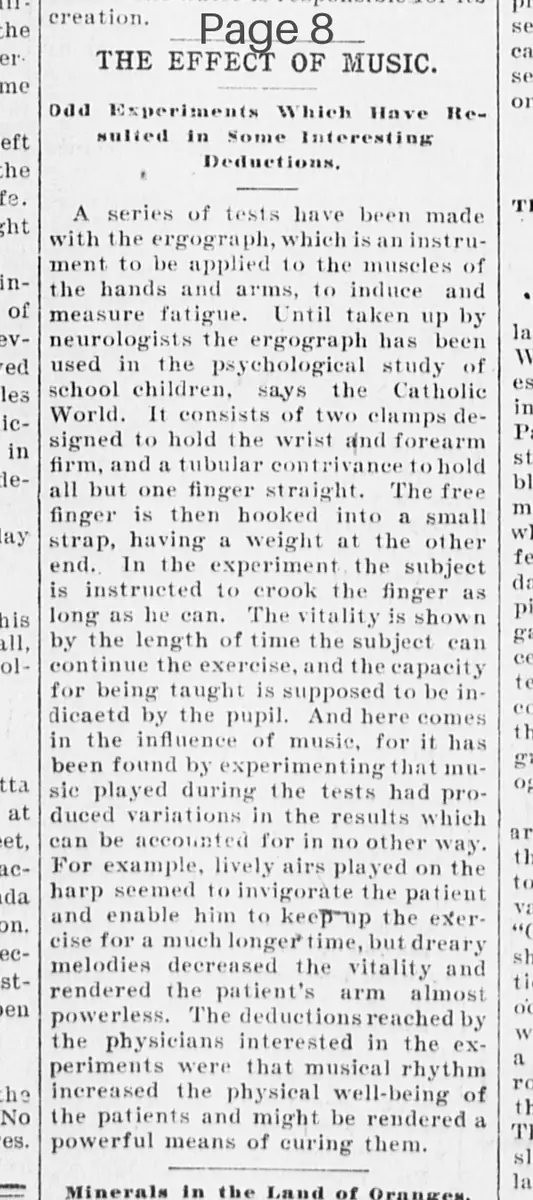
THE EFFECT OF MUSIC.
Odd Experiments Which Have Resulted in Some Interesting Deductions.
A series of tests have been made with the ergograph, which is an instrument to be applied to the muscles of the hands and arms, to induce and measure fatigue. Until taken up by neurologists the ergograph has been used in the psychological study of school children, says the Catholic World. It consists of two clamps designed to hold the wrist and forearm firm, and a tubular contrivance to hold all but one finger straight. The free finger is then hooked into a small strap, having a weight at the other end. In the experiment the subject is instructed to crook the finger as long as he can. The vitality is shown by the length of time the subject can continue the exercise, and the capacity for being taught is supposed to be indicated by the pupil. And here comes in the influence of music, for it has been found by experimenting that music played during the tests had produced variations in the results which can be accounted for in no other way. For example, lively airs played on the harp seemed to invigorate the patient and enable him to keep up the exercise for a much longer time, but dreary melodies decreased the vitality and rendered the patient's arm almost powerless. The deductions reached by the physicians interested in the experiments were that musical rhythm increased the physical well-being of the patients and might be rendered a powerful means of curing them.
Odd Experiments Which Have Resulted in Some Interesting Deductions.
A series of tests have been made with the ergograph, which is an instrument to be applied to the muscles of the hands and arms, to induce and measure fatigue. Until taken up by neurologists the ergograph has been used in the psychological study of school children, says the Catholic World. It consists of two clamps designed to hold the wrist and forearm firm, and a tubular contrivance to hold all but one finger straight. The free finger is then hooked into a small strap, having a weight at the other end. In the experiment the subject is instructed to crook the finger as long as he can. The vitality is shown by the length of time the subject can continue the exercise, and the capacity for being taught is supposed to be indicated by the pupil. And here comes in the influence of music, for it has been found by experimenting that music played during the tests had produced variations in the results which can be accounted for in no other way. For example, lively airs played on the harp seemed to invigorate the patient and enable him to keep up the exercise for a much longer time, but dreary melodies decreased the vitality and rendered the patient's arm almost powerless. The deductions reached by the physicians interested in the experiments were that musical rhythm increased the physical well-being of the patients and might be rendered a powerful means of curing them.
What sub-type of article is it?
Curiosity
Medical Curiosity
What themes does it cover?
Recovery
What keywords are associated?
Music Effects
Ergograph Experiments
Muscle Fatigue
Lively Airs
Dreary Melodies
Physical Well Being
Curing Patients
Story Details
Story Details
Tests with the ergograph show that lively music invigorates muscles and extends endurance, while dreary music weakens them, leading to deductions that musical rhythm boosts physical well-being and can aid in curing patients.