Thank you for visiting SNEWPapers!
Sign up free
The New Hampshire Gazette
Portsmouth, Rockingham County, New Hampshire
What is this article about?
Proceedings of the New Hampshire Legislature from June 10 to 16, including passage of bills for incorporations, debates on relocating judicial courts, lottery grants for bridge repair, reports on bank solvency, and adjournment to November 17.
Merged-components note: Merged multi-part report on New Hampshire Legislature proceedings, including bank asset table as part of the committee report; relabeled from 'story' to 'domestic_news' as it covers local government activities.
Clipping
OCR Quality
Full Text
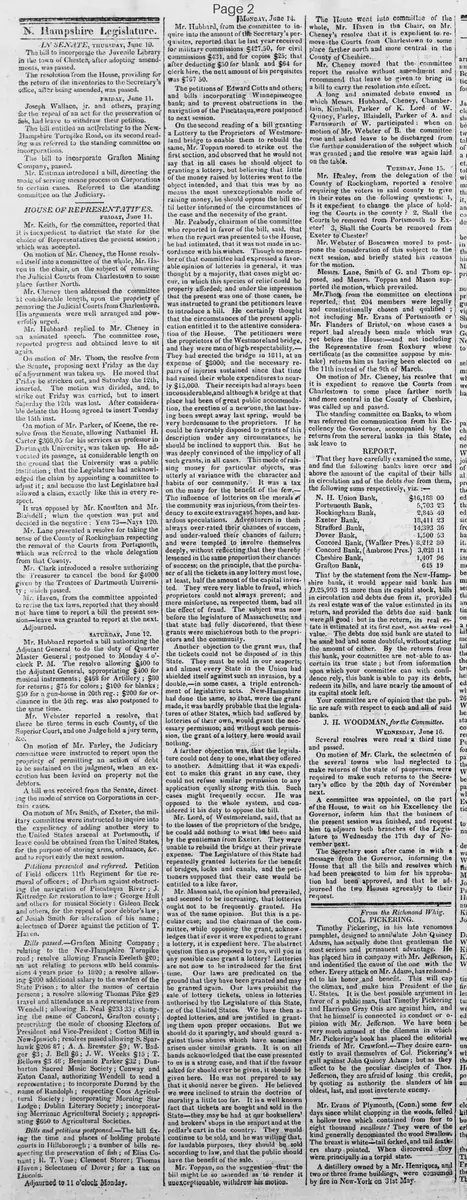
IN SENATE, THURSDAY, June 10.
The bill to incorporate the Juvenile Library in the town of Chester, after adopting amendments, was passed.
The resolution from the House, providing for the return of the inventories to the Secretary's office, after being amended, was passed.
FRIDAY, June 11.
Joseph Wallace, jr. and others, praying for the repeal of an act for the preservation of fish, had leave to withdraw their petition.
The bill entitled an act relating to the New-Hampshire Turnpike Road, on its second reading was referred to the standing committee on incorporations.
The bill to incorporate Grafton Mining Company, passed.
Mr. Eastman introduced a bill, directing the mode of serving mesne process on Corporations in certain cases. Referred to the standing committee on the Judiciary.
HOUSE OF REPRESENTATIVES.
FRIDAY, June 11.
Mr. Keith, for the committee, reported that it is inexpedient to district the state for the choice of Representatives the present session; which was accepted.
On motion of Mr. Cheney, the House resolved itself into a committee of the whole, Mr. Haven in the chair, on the subject of removing the Judicial Courts from Charlestown to some place further North.
Mr. Cheney then addressed the committee at considerable length, upon the propriety of removing the Judicial Courts from Charlestown. His arguments were well arranged and powerfully urged.
Mr. Hubbard replied to Mr. Cheney in an animated speech. The committee rose, reported progress and obtained leave to sit again.
On motion of Mr. Thom, the resolve from the Senate, proposing next Friday as the day of adjournment was taken up. He moved that Friday be stricken out, and Saturday the 12th, inserted. The motion was divided, and to strike out Friday was carried, but to insert Saturday the 12th was lost. After considerable debate the House agreed to insert Tuesday the 15th inst.
On motion of Mr. Parker, of Keene, the resolve from the Senate, allowing Nathaniel H. Carter $308.05 for his services as professor in Dartmouth University, was taken up. He advocated its passage, at considerable length on the ground that the University was a public institution: that the Legislature had acknowledged the claim by appointing a committee to adjust it; and because the last Legislature had allowed a claim, exactly like this in every respect.
It was opposed by Mr. Knowlton and Mr. Blaisdell; when the question was put and decided in the negative: Yeas 73--Nays 120.
Mr. Lane presented a resolve for taking the sense of the County of Rockingham respecting the removal of the Courts from Portsmouth, which was referred to the whole delegation from that County.
Mr. Clark introduced a resolve authorizing the Treasurer to cancel the bond for $4000 given by the Trustees of Dartmouth University; which passed.
Mr. Haven, from the committee appointed to revise the tax laws, reported that they should not have time to report a bill the present session leave was granted to report at the next.
Adjourned.
SATURDAY, June 12.
Mr. Hubbard reported a bill authorizing the Adjutant General to do the duty of Quarter Master General: postponed to Monday 4 o'clock P. M. The resolve allowing $400 to the Adjutant General, appropriating $400 for musical instruments; $468 for Artillery; $80 for returns; $75 for colors; $100 for blanks; $50 for a gun-house in 20th reg.: $200 for ordnance in the 5th reg. was also postponed to the same time.
Mr. Webster reported a resolve, that there be three terms in each County, of the Superior Court, and one Judge hold a jury term, &c.
On motion of Mr. Farley, the Judiciary committee were instructed to report upon the propriety of permitting an action of debt to be sustained on the judgment, when an execution has been levied on property not the debtors.
A bill was received from the Senate, directing the mode of service on Corporations in certain cases.
On motion of Mr. Smith, of Exeter, the military committee were instructed to inquire into the expediency of adding another story to the United States arsenal at Portsmouth, if leave could be obtained from the United States, for the purpose of storing arms, ordnance, &c. and to report early the next session.
Petitions presented and referred. Petition of Field officers 11th Regiment for the removal of officers; of Durham against obstructing the navigation of Piscataqua River; J. Kittredge for restoration to law; George Hull and others for musical Society: Gideon Beck and others, for the repeal of poor debtor's law: of Josiah Smith for alteration of his name; selectmen of Dover against the petition of T. Haven.
Bills passed.--Grafton Mining Company; relating to the New-Hampshire Turnpike road; resolve allowing Francis Eveleth $20; an act relating to persons who held commissions 4 years prior to 1820; a resolve allowing $200 additional salary to the warden of the State Prison; to alter the names of certain persons; a resolve allowing Thomas Pike $29 travel and attendance as a representative from Wendell; allowing R. Neal $233 33; changing the name of Concord, Grafton county; prescribing the mode of choosing Electors of President and Vice-President; Cotton Mill in New-Ipswich; resolves passed allowing S. Sparrowhawk $206 87; A. A. Brewster $9: W. Badger $3; J. Bell $6; J. W. Weeks $15; T. Bellows $3 48; Benjamin Parker $32: Dunbarton Sacred Music Society; Conway and Eaton Canal, authorizing Wendell to send a representative; to incorporate Durand by the name of Randolph; respecting Coos Agricultural Society; incorporating Morning Star Lodge; Dublin Literary Society; incorporating Merrimac Agricultural Society; appropriating $650 to Agricultural Societies.
Bills and petitions postponed.--The bill fixing the time and places of holding probate courts in Hillsborough; a number of bills respecting the preservation of fish; of Elias Conant; R. T. Vose; Clement Storer; Thomas Haven; Selectmen of Dover; for a tax on Lincoln.
Adjourned to 11 o'clock Monday.
MONDAY, June 14.
Mr. Hubbard, from the committee to inquire into the amount of the Secretary's perquisites, reported that he last year received for military commissions $427.50, for civil commissions $431, and for copies $25; that after deducting $50 for blank and $64 for clerk hire, the net amount of his perquisites was $767.50.
The petitions of Edward Cutts and others: and bills incorporating Winnepisseogee bank; and to prevent obstructions in the navigation of the Piscataqua, were postponed to next session.
On the second reading of a bill granting a Lottery to the Proprietors of Westmoreland bridge to enable them to rebuild the same, Mr. Toppan moved to strike out the first section, and observed that he would not say that in all cases he should object to granting a lottery, but believing that little of the money raised by lotteries went to the object intended, and that this was by no means the most unexceptionable mode of raising money, he should oppose the bill until better informed of the circumstances of the case and the necessity of the grant.
Mr. Peabody, chairman of the committee who reported in favor of the bill, said that when the report was presented to the House, he had intimated, that it was not made in accordance with his wishes. Though no member of that committee had expressed a favorable opinion of lotteries in general, it was thought by a majority, that cases might occur, in which this species of relief could be properly afforded; and under the impression that the present was one of those cases, he was instructed to grant the petitioners leave to introduce a bill. He certainly thought that the circumstances of the present application entitled it to the attentive consideration of the House. The petitioners were the proprietors of the Westmoreland bridge, and they were men of high respectability. They had erected the bridge in 1811, at an expense of $8000; and the necessary repairs of injuries sustained since that time had raised their whole expenditures to nearly $15,000. Their receipts had always been inconsiderable, and although a bridge at that place had been of great public accommodation, the erection of a new one, the last having been swept away last spring, would be very burdensome to the proprietors. If he could be favorably disposed to grants of this description under any circumstances, he should be inclined to support this. But he was deeply convinced of the impolicy of all such grants, in all cases. This mode of raising money for particular objects, was utterly at variance with the character and habits of our community. It was a tax on the many for the benefit of the few. The influence of lotteries on the morals of the community was injurious, from their tendency to excite extravagant hopes, and hazardous speculations. Adventurers in them always over-rated their chances of success, and under-valued their chances of failure: and were tempted to involve themselves deeply, without reflecting that they thereby lessened in the same proportion their chances of success; on the principle, that the purchaser of all the tickets in any lottery must lose, at least, half the amount of the capital invested. They were very liable to fraud, which proprietors could not always prevent; and mere misfortune, as respected them, had all the effect of fraud. The subject was now before the legislature of Massachusetts: and that state had fully discovered, that these grants were mischievous both to the proprietors and the community.
Another objection to the grant was, that the tickets could not be disposed of in this State. They must be sold in our seaports; and almost every State in the Union had shielded itself against such an invasion, by a double,--in some cases, a triple entrenchment of legislative acts. New-Hampshire had done the same, so that, were the grant made, it was hardly probable that the legislatures of other States, which had suffered by lotteries of their own, would grant the necessary permission; and without such permission, the grant of a lottery here would avail nothing.
A further objection was, that the legislature could not deny to one, what they offered to another. Admitting that it was expedient to make this grant in any case, they could not refuse similar permission to any application equally strong with this. Such cases might frequently occur. He was opposed to the whole system, and considered it his duty to oppose the bill.
Mr. Lord, of Westmoreland, said, that as to the losses of the proprietors of the bridge, he could add nothing to what had been said by the gentleman from Exeter. They were unable to rebuild the bridge at their private expense. The Legislature of this State had repeatedly granted lotteries for the benefit of bridges, locks and canals, and the petitioners supposed that their case would be entitled to a like favor.
Mr. Mason said, the opinion had prevailed, and seemed to be increasing, that lotteries ought not to be frequently granted. He was of the same opinion. But this is a peculiar case; and the chairman of the committee, while opposing the grant, acknowledges that if ever it were expedient to grant a lottery, it is expedient here. The abstract question then is proposed to you, will you in any possible case grant a lottery? Lotteries are not now to be introduced for the first time. Our laws are predicated on the ground that they have been granted and may be granted again. Our laws prohibit the sale of lottery tickets, unless in lotteries authorised by the Legislature of this State, or of the United States. We have then adopted lotteries, and are justified in granting them upon proper occasions. But we should do it sparingly, and should guard against those abuses which have sometimes arisen under similar grants. It is on all hands acknowledged that the case presented to us is a strong case, and that if the favour asked for should ever be given, it should be given here. He was not prepared to say that it should never be given. He believed we were inclined to strain the doctrine of morality a little too far. It is a well known fact that tickets are bought and sold in the State--they may be had at our booksellers and brokers' shops in the seaport and at the pedlar's cart in the country. They would continue to be sold, and he was willing that, for laudable purposes, they should be sold according to law, and that the public should have the benefit of the sale.
Mr. Toppan, on the suggestion that the bill might be so amended as to render it unexceptionable, withdrew his motion.
The House went into committee of the whole, Mr. Haven in the Chair, on Mr. Cheney's resolve that it is expedient to remove the Courts from Charlestown to some place further north and more central in the County of Cheshire.
Mr. Cheney moved that the committee report the resolve without amendment and recommend that leave be given to bring in a bill to carry the resolution into effect.
A long and animated debate ensued in which Messrs. Hubbard, Cheney, Chamberlain, Kimball, Parker of K. Lord of W. Quincy, Farley, Blaisdell, Parker of A. and Farnsworth of W. participated: when on motion of Mr. Webster of B. the committee rose and asked leave to be discharged from, the further consideration of the subject which was granted; and the resolve was again laid on the table.
TUESDAY, June 15.
Mr. Healey, from the delegation of the County of Rockingham, reported a resolve requiring the voters in said county to give in their votes on the following questions: 1, Is it expedient to change the place of holding the Courts in the county? 2, Shall the Courts be removed from Portsmouth to Exeter? 3. Shall the Courts be removed from Exeter to Chester?
Mr. Webster of Boscawen moved to postpone the Consideration of this subject to the next session, and briefly stated his reasons for the motion.
Messrs. Lane, Smith of G. and Thom opposed, and Messrs. Toppan and Mason supported the motion, which prevailed
Mr. Thom from the committee on elections reported, that 204 members were legally and constitutionally chosen and qualified not including Mr. Evans of Portsmouth or Mr. Flanders of Bristol,--on whose cases a report had already been made which was yet before the House:--and not including the Representative from Roxbury whose certificate (as the committee suppose by mistake) returns him as having been elected on the 11th instead of the 9th of March.
On motion of Mr. Cheney, his resolve that it is expedient to remove the Courts from Charlestown to some place further north and more central in the County of Cheshire, was called up and passed.
The standing committee on Banks, to whom was referred the communication from his Excellency the Governor, accompanied by the returns from the several banks in this State, ask leave to
REPORT,
That they have carefully examined the same, and find the following banks have over and above the amount of the capital of their bills in circulation and of the debts due from them. the following sums respectively, viz.:
That by the statement from the New-Hampshire bank, it would appear said bank has $25,993 13 more than its capital stock, bills in circulation and debts due from it, provided its real estate was of the value estimated in its return, and provided the debts due said bank were all good: but in the return, its real estate is estimated at its first cost, not at its real value. The debts due said bank are stated to be some bad and some doubtful, without stating the amount of either. By the returns from this bank, your committee are not able to ascertain its true state; but from information upon which your committee can with confidence rely, this bank is able to pay its debts, redeem its bills, and have nearly the amount of its capital stock left.
Your committee are of opinion that the public are safe with respect to each and all of said banks.
J. H. WOODMAN, for the Committee.
WEDNESDAY, June 16.
Several resolves were read a third time and passed.
On motion of Mr. Clark, the selectmen of the several towns who had neglected to make returns of the state of pauperism, were required to make such returns to the Secretary's office by the 20th day of November next.
A committee was appointed, on the part of the House, to wait on his Excellency the Governor, inform him that the business of the present session was finished, and request him to adjourn both branches of the Legislature to Wednesday the 17th day of November next.
The Secretary soon after came in with a message from the Governor, informing the House that all the bills and resolves which had been presented to him for his approbation had been approved, and that he adjourned the two Houses agreeably to their request.
| N. H. Union Bank, Portsmouth Bank, Rockingham Bank, Exeter Bank, Strafford Bank, Dover Bank, Concord Bank, (Walker Pres.) 8,212 80 Concord Bank, (Ambrose Pres.) 3,038 11 Cheshire Bank, Grafton Bank, | $16,188 00 5,703 23 2,845 40 18,411 23 14,393 36 1,500 53 |
What sub-type of article is it?
What keywords are associated?
What entities or persons were involved?
Where did it happen?
Domestic News Details
Primary Location
New Hampshire
Event Date
June 10 To June 16
Key Persons
Outcome
numerous bills passed including incorporations of companies and societies, appropriations, and name changes; resolve passed to remove courts from charlestown; lottery bill debated and outcome not specified; bank committee reported all banks solvent; session adjourned to november 17.
Event Details
The New Hampshire Legislature convened from June 10 to 16, passing bills for incorporations such as Juvenile Library in Chester and Grafton Mining Company, debating relocation of judicial courts from Charlestown and Portsmouth, considering lottery grant for Westmoreland bridge repair with speeches by Messrs. Toppan, Peabody, Lord, and Mason, reviewing bank returns deeming them safe, handling petitions and resolves on various matters including military appropriations and tax laws, and adjourning to November 17.