Thank you for visiting SNEWPapers!
Sign up free
Editorial
November 22, 1919
Harrisburg Telegraph
Harrisburg, Dauphin County, Pennsylvania
What is this article about?
The editorial discusses why city food prices like butter and eggs are higher than rural ones, attributing it to distribution costs, multiple handlers, and profits. It advocates reducing transactions between producers and consumers to lower prices and highlights the State Bureau of Markets' focus on this.
Clipping
OCR Quality
95%
Excellent
Full Text
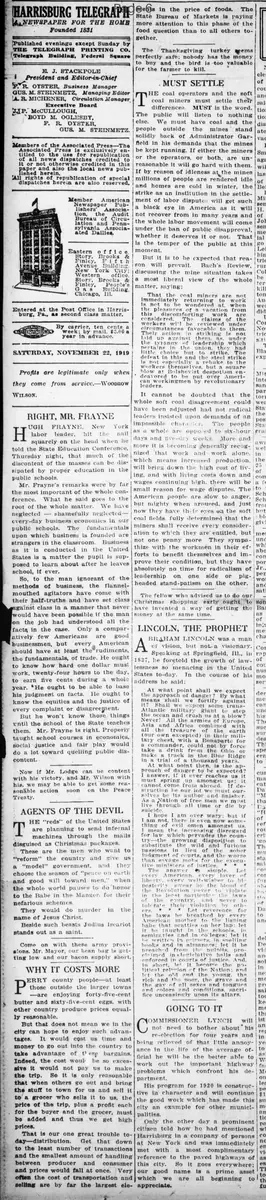
WHY IT COSTS MORE
Every country people—at least those outside the larger towns—are enjoying forty-five-cent butter and sixty-five-cent eggs, with other country produce prices equally reasonable.
But that does not mean we in the city can hope to enjoy such advantages. It would cost us time and money to go out into the country to take advantage of these bargains.
Indeed, the cost would be so excessive it would not pay us to make the trip. So it is only reasonable that when others go out and bring the stuff to town for us and sell it to a grocer who sells it to us, the price of the trip, plus a profit each for the buyer and the grocer, must be added and thus we get high prices.
That is our one great trouble to-day—distribution. Get that down to the least number of transactions and the smallest amount of handling between producer and consumer and prices would fall at once. Very often the cost of transportation and selling are by far the largest elements in the price of foods.
The State Bureau of Markets is paying more attention to this phase of the food question than to all others together.
The Thanksgiving turkey seems perfectly safe: nobody has the money to buy and the bird is too valuable for the farmer to kill.
Every country people—at least those outside the larger towns—are enjoying forty-five-cent butter and sixty-five-cent eggs, with other country produce prices equally reasonable.
But that does not mean we in the city can hope to enjoy such advantages. It would cost us time and money to go out into the country to take advantage of these bargains.
Indeed, the cost would be so excessive it would not pay us to make the trip. So it is only reasonable that when others go out and bring the stuff to town for us and sell it to a grocer who sells it to us, the price of the trip, plus a profit each for the buyer and the grocer, must be added and thus we get high prices.
That is our one great trouble to-day—distribution. Get that down to the least number of transactions and the smallest amount of handling between producer and consumer and prices would fall at once. Very often the cost of transportation and selling are by far the largest elements in the price of foods.
The State Bureau of Markets is paying more attention to this phase of the food question than to all others together.
The Thanksgiving turkey seems perfectly safe: nobody has the money to buy and the bird is too valuable for the farmer to kill.
What sub-type of article is it?
Trade Or Commerce
Economic Policy
What keywords are associated?
Food Prices
Distribution Costs
Butter Eggs
Transportation Expenses
State Bureau Of Markets
Producer Consumer
What entities or persons were involved?
State Bureau Of Markets
Editorial Details
Primary Topic
High Urban Food Prices Due To Distribution Costs
Stance / Tone
Explanatory Advocacy For Efficient Distribution
Key Figures
State Bureau Of Markets
Key Arguments
Rural Produce Is Cheaper But Urban Consumers Cannot Access It Directly Without High Travel Costs
Distribution Involves Multiple Handlers Adding Profits And Transportation Expenses
Reducing Transactions And Handling Between Producer And Consumer Would Lower Prices
Transportation And Selling Costs Are Major Factors In Food Prices
State Bureau Of Markets Focuses On Distribution Issues