Thank you for visiting SNEWPapers!
Sign up free
The Enquirer
Richmond, Henrico County, Virginia
What is this article about?
Norfolk report from London papers via Jersey: Letter from exiled Gen. Moreau detailing his regrets and Bonaparte's clemency in banishing him to the US; a fabricated letter from an unnamed French general harshly criticizing Bonaparte's tyranny and treatment of Moreau and Pichegru.
Clipping
OCR Quality
Full Text
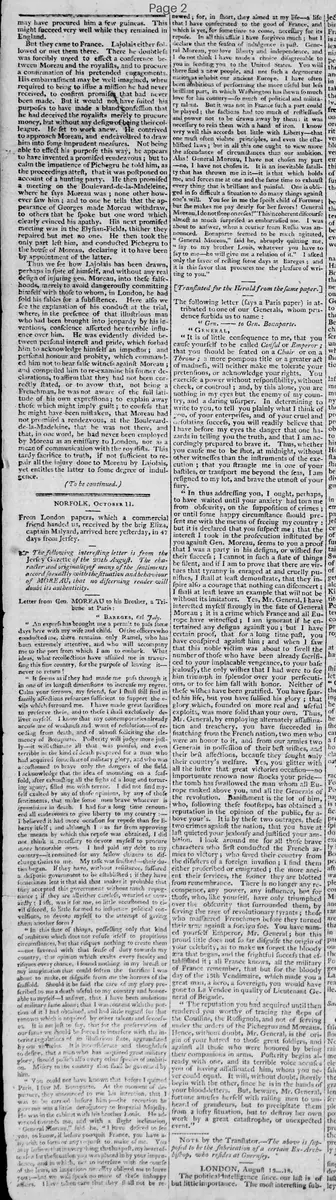
From London papers, which a commercial friend handed us, received by the brig Eliza, captain Malyard, arrived here yesterday, in 47 days from Jersey. The following interesting letter is from the Jersey Gazette of the 20th August. The character and originality of many of the sentiments accord so exactly with the situation and behaviour of MOREAU, that no discerning reader will doubt its authenticity.
Letter from Gen. MOREAU to his Brother, a Tribune at Paris:
BAREGES, 6th July.
"An express has brought me a permit to pass some days here with my wife and child." Of the officers who conducted me, there remains only Ramel, who has been extremely attentive, and who will accompany me to the port from which I am to embark. What ideas, what recollections have assailed me in traversing this fine country, for the purpose of leaving it--never to return!
"It seems as if they had made me pass through it in one of its longest dimensions to increase my regret. Calm your sorrows, my friend, for I shall still find in family affections resources sufficient to support the evils which surround me. I have made great sacrifices to preserve these, and to these I shall exclusively deliver myself. I know that my contemporaries already accuse me of weakness and want of resolution--of receding from death, and of almost soliciting the clemency of Bonaparte. Posterity will judge more justly--it will estimate all that was painful, and even terrible in the kind of death prepared for a man who had acquired so large a share of military glory, and who was accustomed to brave only the dangers of the field. I acknowledge that the idea of mounting on a scaffold, after exhausting all the sighs of a long and torturing agony, filled me with terror. I did not find myself exalted by any of those opinions, by any of those sentiments, that make some men brave whatever is ignominious in death. I had for a long time renounced all endeavours to give liberty to my country:--I believed it had more occasion for repose than for liberty itself; and although I was far from approving the means by which this repose was obtained, I did not think it necessary to devote myself to procure more honorable ones. I had paid my debt to my country--it remained for my fellow citizens to discharge theirs to me. My task was finished--their duties began. If they have, without resistance, suffered a despotic government to be established; if they have sometimes lent it that aid that makes it probable that they accepted this government without much repugnance; if they are all either careless, wearied or cowardly; I ask, was it for me, so little accustomed to civil discord, so little formed to influence political convulsions, to devote myself to the attempt of giving them another form?
"In this state of things, possessing only that kind of ambition which does not refuse itself to propitious circumstances, but that risks nothing to create them--not favored with that sense of duty towards my country, that opinion which exalts every faculty and risks every chance, I found nothing in my breast or my imagination that could soften the sacrifice I was about to make, or disguise from me the horrors of the scaffold. Should it be said the care of my glory prescribed to me a death useful to my country and honorable to myself--I answer, that I have been ambitious of military fame alone; that I was content with the portion of it I had obtained, and had little regard for that renown which is acquired by other talents and success. It is not just to say, that for the preservation of our fame we should be forced to interfere with the interior regulations of an illustrious state, aggrandized by our victories. It is inconsiderate and thoughtless to desire, that a man who has acquired great military glory, should possess also every other species of ambition. Misery to the country that shall be governed by him.
"You could not have known that before I quitted Paris, I saw M. Bonaparte. At the moment of departure, they announced to me his intention, that I was to be carried before him--the reception he gave me was a little derogatory to Imperial Majesty. He was in the cabinet with his brother Louis. He advanced towards me, and with a slight inclination, "General Moreau," said he, "I have desired to see you, to know, if before you quit France, you have anything to ask, or any request to make of me. You may believe that in every thing that has passed, my heart felt for the situation you was placed in by your imprudence, and in which, not to interfere with the course of the laws, an imperious necessity obliged me to leave you;--but we will speak no more of these unhappy affairs. I have taken care that they shall not be renewed; for, in short, they aimed at my life--a life that I have consecrated to the good of France, and which is yet, for some time to come, necessary for its repose. In all this affair I have forgiven much; but I declare that the season of indulgence is past. General Moreau, you love liberty and independence, and I do not think I have made a choice disagreeable to you in sending you to the United States. You will there find a new people, and not such a degenerate nation as inhabit our ancient Europe. I have often been ambitious of performing the more useful but less brilliant part, in which Washington has shewn so much love for his country--so much of political and military talent. But it was not in France such a part could be played; the factions had too much of restlessness and power not to be drawn away by them: it was necessary to rein them with a hand of iron. I know very well this accords but little with Liberty--that one must often violate principles, and even the established laws; but in all this one ought to view more the ascendance of circumstances than our ambition. Alas! General Moreau, I have not chosen my part--no, I have not chosen it. It is an inevitable fatality that has thrown me in it; it is that which holds me, and forces me at one and the same time to exhaust every thing that is brilliant and painful. One is obliged in so difficult a situation to do many things against one's will. You see in me the spoilt child of Fortune: but she makes me pay dearly for her favors! General Moreau, I do not sleep on roses!" This incoherent discourse almost as much surprised as embarrassed me. I was about to answer, when a courier from Russia was announced. Bonaparte seemed to be much agitated. "General Moreau," said he, abruptly quitting me, "say to my brother Louis, whatever you have to say to me--he will give me a relation of it." I asked only the favor of resting some days at Bareges; and it is this favor that procures me the pleasure of writing to you."
[Translated for the Herald from the same paper.]
The following letter (says a Paris paper) is attributed to one of our Generals, whom prudence forbids us to name:
"Gen. -- to Gen. Bonaparte.
"General,
"It is of little consequence to me, that you cause yourself to be called Consul or Emperor; that you should be seated on a Chair or on a Throne; a more pompous title or a greater act of madness, will neither make me tolerate your pretensions, or acknowledge your rights. You exercise a power without responsibility, without check, or control; and, by this alone, you are nothing in my eyes but the enemy of my country, and a daring usurper. In determining to write to you, to tell you plainly what I think of you, of your enterprises, and of your cruel and desolating success, you will readily believe that I have before my eyes the danger that one hazards in telling you the truth, and that I am accordingly prepared to brave it. Thus, whether you cause me to be shot, at midnight, without other witnesses than the instruments of the execution; that you strangle me in one of your battles, or transport me beyond the seas, I am resigned to my lot, and brave the utmost of your fury.
In thus addressing you, I ought, perhaps, to have waited until your anxiety had torn me from obscurity, on the supposition of crimes; or until some happy circumstance should present me with the means of freeing my country: but it is declared that you suspect me; that the interest I took in the prosecution instituted by you against Gen. Moreau, seems to you a proof that I was a party in his designs, or wished for their success; I cannot in such a state of things be silent, and if I am to prove that there are virtues that tyranny is enraged at and cruelly punishes, I shall at least demonstrate, that they inspire also a courage that nothing can disconcert; I shall at least leave an example that will not be without its imitators. Yes, Mr. General, I have interested myself strongly in the fate of General Moreau; it is a crime which France and all Europe have witnessed; I am ignorant if he entertained any designs against you; but I have certain proof, that for a long time past, you have conspired against him; and when I saw that this noble victim was about to swell the number of those who have been already sacrificed to your implacable vengeance, to your base jealousy, the only wishes that I had were to see him triumph in splendor over your persecutions, or to see him fall with honor. Neither of these wishes have been gratified. You have spared his life, but you have sullied his glory; that glory which, founded on more real and useful exploits, was more solid than your own. Thus, Mr. General, by employing alternately assassination and treachery, you have succeeded in snatching from the French nation, two men who were an honor to it, and from our armies two Generals in possession of their best wishes, and their best affections, because they sought only their country's welfare. Yes, you glitter with all the lustre that great victories occasion--no importunate renown now shocks your pride--the tomb has swallowed the man whom all Europe ranked above you, and all the Generals of the revolution. Banishment is the lot of him, who, following these footsteps, has obtained a reputation in the opinion of the public, far above yours. It is by these two outrages, these two crimes against the nation, that you have at last quieted your jealousy and justified your ambition. I look around me for all those brave characters who first conducted the French armies to victory; who saved their country from the disasters of a foreign invasion; I find them either proscribed or emigrated; the more ancient their services, the sooner they are blotted from remembrance. There is no longer any recompense, any power, any influence, but for those, who, like yourself, have only triumphed over the obscurity that surrounded them, by serving the rage of revolutionary tyrants; those who massacred Frenchmen before they turned their arms against a foreign foe. You have named yourself Emperor, Mr. General; but this proud title does not so far disguise the origin of your celebrity, as to make us forget the bloody era that began, and the frightful success that established it; all France knows, all the military of France remember, that but for the bloody day of the 13th Vendemiaire, which made you a great man, a hero, a sovereign, you would have gone to La Vendee in quality of Lieutenant General of Brigade.
"The reputation you had acquired until then rendered you worthy of tracing the steps of the Counlins, the Rossignols, and not of serving under the orders of the Pichegrus and Moreaus. Hence, without doubt, Mr. General, is the origin of your hatred to those great soldiers, and against all those who were honored by being their companions in arms. Posterity begins already with one, and its terrible voice accuses you of having assassinated him, whom you never could equal. It will, without doubt, shortly begin with the other, since he is in the hands of your blood-letters. But, beware, Mr. General, fortune amuses herself with raising men to unheard of grandeurs, but to precipitate them from a lofty situation, but to destroy her own work by a great catastrophe, or unexpected event."
Note by the Translator.---The above is supposed to be the fabrication of a certain Ex-Archbishop, who resides at Guernsey.
What sub-type of article is it?
What keywords are associated?
What entities or persons were involved?
Where did it happen?
Foreign News Details
Primary Location
France
Event Date
6th July
Key Persons
Outcome
gen. moreau exiled to the united states; gen. pichegru assassinated; unnamed general's letter criticizes bonaparte's tyranny and fabricated as per note.
Event Details
Letter from Gen. Moreau to his brother describes his permit to stay at Bareges before exile, regrets leaving France, conversation with Bonaparte granting clemency and banishment to US, and justifications for accepting exile over execution. Attributed letter from unnamed French general to Bonaparte denounces his usurpation, treatment of Moreau and Pichegru, and rise to power; noted as fabrication by an ex-Archbishop in Guernsey.