Thank you for visiting SNEWPapers!
Sign up free
Editorial
October 30, 1806
Alexandria Daily Advertiser
Alexandria, Virginia
What is this article about?
An editorial from a London paper advocates for naval officers at seaports to inspect merchant ships' seaworthiness, stores, and provisions to protect seamen from negligent owners. Cites the unseaworthy ship Flora's 1805 loss and a convoy incident, criticizing profit-driven neglect and calling for legislative reform.
Clipping
OCR Quality
95%
Excellent
Full Text
FROM A LONDON PAPER.
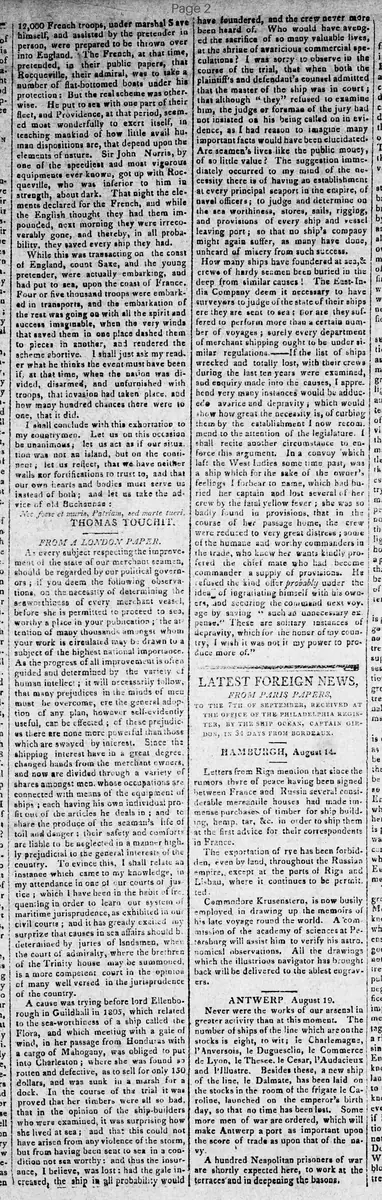
As every subject respecting the improvement of the state of our merchant seamen, should be regarded by our political governors; if you deem the following observations, on the necessity of determining the seaworthiness of every merchant vessel, before she is permitted to proceed to sea, worthy a place in your publication; the attention of many thousands amongst whom your work is circulated may be drawn to a subject of the highest national importance.
As the progress of all improvement is often guided and determined by the variety of human intellect; it will necessarily follow, that many prejudices in the minds of men must be overcome, ere the general adoption of any plan, however self-evidently useful, can be effected; of these prejudices there are none more powerful than those which are swayed by interest. Since the shipping interest have in a great degree changed hands from the merchant owners, and now are divided through a variety of shares amongst men, whose occupations are connected with means of the equipment of ships; each having his own individual profit out of the articles he deals in: and to share the produce of the seaman's life of toil and danger: their safety and comforts are liable to be neglected in a manner highly prejudicial to the general interests of the country. To evince this, I shall relate an instance which came to my knowledge, in my attendance in one of our courts of justice; which I have been in the habit of frequenting in order to learn our system of maritime jurisprudence, as exhibited in our civil courts; and it has greatly excited my surprise that causes in sea affairs should be determined by juries of landsmen, when the court of admiralty, where the brethren of the Trinity house may be summoned, is a more competent court in the opinion of many well versed in the jurisprudence of the country.
A cause was trying before Lord Ellenborough in Guildhall in 1805, which related to the sea-worthiness of a ship called the Flora, and which meeting with a gale of wind, in her passage from Honduras with a cargo of Mahogany, was obliged to put into Charleston; where she was found so rotten and defective, as to sell for only 150 dollars, and was sunk in a marsh for a dock. In the course of the trial it was proved that her timbers were all so bad, that in the opinion of the ship-builders who were examined, it was surprising how she lived at sea; and that this could not have arisen from any violence of the storm, but from having been sent to sea in a condition not sea-worthy: and thus the insurance, I believe, was lost: had the gale increased, the ship in all probability would have foundered, and the crew never more been heard of. Who would have avenged the sacrifice of so many valuable lives at the shrine of avaricious commercial speculations? I was sorry to observe in the course of the trial, that when both the plaintiff's and defendant's counsel admitted that the master of the ship was in court; that although "they" refused to examine him, the judge or foreman of the jury had not insisted on his being called on in evidence, as I had reason to imagine many important facts would have been elucidated.
Are seamen's lives like the public money, of so little value? The suggestion immediately occurred to my mind of the necessity there is of having an establishment at every principal seaport in the empire, of naval officers; to judge and determine on the sea-worthiness, stores, sails, rigging, and provisions of every ship and vessel leaving port; so that no ship's company might again suffer, as many have done, unheard of misery from such neglect.
How many ships have foundered at sea, and crews of hardy seamen been buried in the deep from similar causes! The East-India Company deem it necessary to have surveyors to judge of the state of their ships ere they are sent to sea: nor are they suffered to perform more than a certain number of voyages; surely every department of merchant shipping ought to be under similar regulations. If the list of ships wrecked and totally lost, with their crews during the last ten years were examined, and enquiry made into the causes, I apprehend very many instances would be adduced of avarice and depravity; which would show how great the necessity is, of curbing them by the establishment I now recommend to the attention of the legislature. I shall recite another circumstance to enforce this argument. In a convoy which left the West Indies some time past, was a ship which for the sake of the owner's feelings I forbear to name, which had buried her captain and lost several of her crew by the fatal yellow fever; she was so badly found in provisions, that in the course of her passage home, the crew were reduced to very great distress; some of the humane and worthy commanders in the trade, who knew her wants kindly proffered the chief mate who had become commander a supply of provisions. He refused the kind offer probably under the idea of ingratiating himself with his owners, and securing the command next voyage by saving "such an unnecessary expense." These are solitary instances of depravity, which for the honor of my country, I wish it was not in my power to produce more of.
As every subject respecting the improvement of the state of our merchant seamen, should be regarded by our political governors; if you deem the following observations, on the necessity of determining the seaworthiness of every merchant vessel, before she is permitted to proceed to sea, worthy a place in your publication; the attention of many thousands amongst whom your work is circulated may be drawn to a subject of the highest national importance.
As the progress of all improvement is often guided and determined by the variety of human intellect; it will necessarily follow, that many prejudices in the minds of men must be overcome, ere the general adoption of any plan, however self-evidently useful, can be effected; of these prejudices there are none more powerful than those which are swayed by interest. Since the shipping interest have in a great degree changed hands from the merchant owners, and now are divided through a variety of shares amongst men, whose occupations are connected with means of the equipment of ships; each having his own individual profit out of the articles he deals in: and to share the produce of the seaman's life of toil and danger: their safety and comforts are liable to be neglected in a manner highly prejudicial to the general interests of the country. To evince this, I shall relate an instance which came to my knowledge, in my attendance in one of our courts of justice; which I have been in the habit of frequenting in order to learn our system of maritime jurisprudence, as exhibited in our civil courts; and it has greatly excited my surprise that causes in sea affairs should be determined by juries of landsmen, when the court of admiralty, where the brethren of the Trinity house may be summoned, is a more competent court in the opinion of many well versed in the jurisprudence of the country.
A cause was trying before Lord Ellenborough in Guildhall in 1805, which related to the sea-worthiness of a ship called the Flora, and which meeting with a gale of wind, in her passage from Honduras with a cargo of Mahogany, was obliged to put into Charleston; where she was found so rotten and defective, as to sell for only 150 dollars, and was sunk in a marsh for a dock. In the course of the trial it was proved that her timbers were all so bad, that in the opinion of the ship-builders who were examined, it was surprising how she lived at sea; and that this could not have arisen from any violence of the storm, but from having been sent to sea in a condition not sea-worthy: and thus the insurance, I believe, was lost: had the gale increased, the ship in all probability would have foundered, and the crew never more been heard of. Who would have avenged the sacrifice of so many valuable lives at the shrine of avaricious commercial speculations? I was sorry to observe in the course of the trial, that when both the plaintiff's and defendant's counsel admitted that the master of the ship was in court; that although "they" refused to examine him, the judge or foreman of the jury had not insisted on his being called on in evidence, as I had reason to imagine many important facts would have been elucidated.
Are seamen's lives like the public money, of so little value? The suggestion immediately occurred to my mind of the necessity there is of having an establishment at every principal seaport in the empire, of naval officers; to judge and determine on the sea-worthiness, stores, sails, rigging, and provisions of every ship and vessel leaving port; so that no ship's company might again suffer, as many have done, unheard of misery from such neglect.
How many ships have foundered at sea, and crews of hardy seamen been buried in the deep from similar causes! The East-India Company deem it necessary to have surveyors to judge of the state of their ships ere they are sent to sea: nor are they suffered to perform more than a certain number of voyages; surely every department of merchant shipping ought to be under similar regulations. If the list of ships wrecked and totally lost, with their crews during the last ten years were examined, and enquiry made into the causes, I apprehend very many instances would be adduced of avarice and depravity; which would show how great the necessity is, of curbing them by the establishment I now recommend to the attention of the legislature. I shall recite another circumstance to enforce this argument. In a convoy which left the West Indies some time past, was a ship which for the sake of the owner's feelings I forbear to name, which had buried her captain and lost several of her crew by the fatal yellow fever; she was so badly found in provisions, that in the course of her passage home, the crew were reduced to very great distress; some of the humane and worthy commanders in the trade, who knew her wants kindly proffered the chief mate who had become commander a supply of provisions. He refused the kind offer probably under the idea of ingratiating himself with his owners, and securing the command next voyage by saving "such an unnecessary expense." These are solitary instances of depravity, which for the honor of my country, I wish it was not in my power to produce more of.
What sub-type of article is it?
Trade Or Commerce
Labor
Legal Reform
What keywords are associated?
Merchant Seamen
Seaworthiness
Ship Safety
Maritime Regulations
Naval Inspections
Seamen Welfare
Commercial Avarice
What entities or persons were involved?
Lord Ellenborough
Ship Flora
East India Company
Trinity House
Editorial Details
Primary Topic
Necessity Of Determining Seaworthiness Of Merchant Vessels
Stance / Tone
Advocacy For Maritime Safety Regulations
Key Figures
Lord Ellenborough
Ship Flora
East India Company
Trinity House
Key Arguments
Prejudices And Interests Of Ship Owners And Equippers Neglect Seamen's Safety
Ship Flora Was Sent To Sea Unseaworthy, Leading To Its Loss And Potential Crew Deaths
Juries Of Landsmen Are Incompetent For Maritime Cases; Court Of Admiralty Preferred
Establish Naval Officers At Seaports To Inspect Seaworthiness, Stores, And Provisions
East India Company Uses Surveyors; Similar Regulations Needed For Merchant Shipping
Many Wrecks Due To Avarice; List Of Losses Would Show Need For Regulations
Example Of Ship In Convoy Refusing Provisions, Endangering Crew