Thank you for visiting SNEWPapers!
Sign up free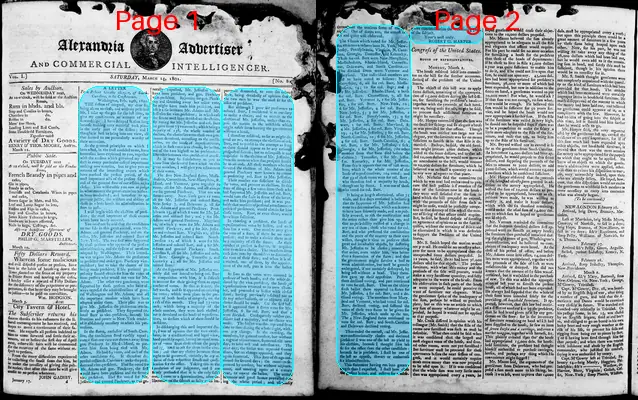
Alexandria Advertiser And Commercial Intelligencer
Alexandria, Virginia
What is this article about?
In a letter to his South Carolina constituents dated February 24, 1801, Congressman Robert Goodloe Harper recounts the 1800 presidential election, the tie between Jefferson and Burr, the House of Representatives' balloting process, his vote for Burr, and the eventual selection of Jefferson as president to preserve the Union.
Merged-components note: These components form a single continuous letter from Robert Goodloe Harper to his constituents, spanning pages 1 and 2. The fourth component was incorrectly labeled as 'story' but is part of the letter, so merged and relabeled accordingly.
Clippings
1 of 2
OCR Quality
Full Text
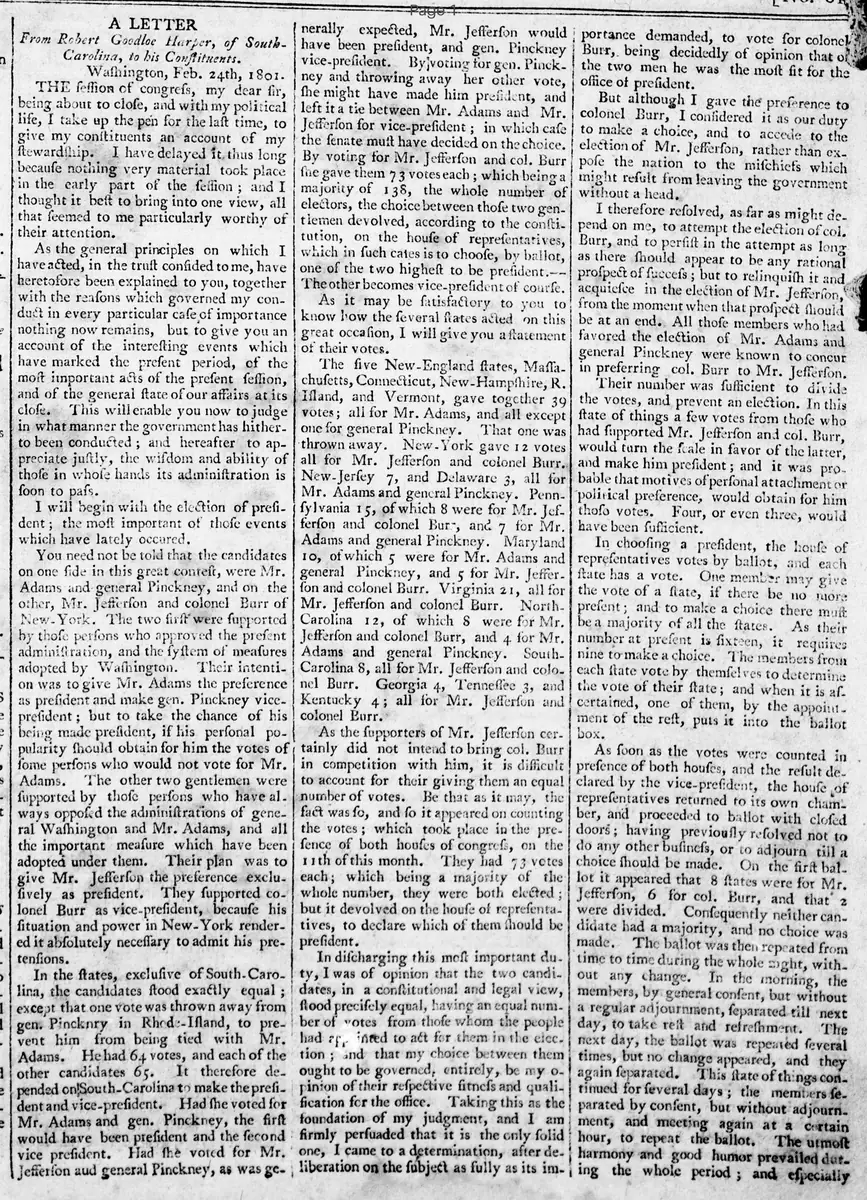
From Robert Goodloe Harper, of South-Carolina, to his Constituents.
Washington, Feb. 24th, 1801.
THE session of congress, my dear sir, being about to close, and with my political life, I take up the pen for the last time, to give my constituents an account of my stewardship. I have delayed it thus long because nothing very material took place in the early part of the session: and I thought it best to bring into one view, all that seemed to me particularly worthy of their attention.
As the general principles on which I have acted, in the trust confided to me, have heretofore been explained to you, together with the reasons which governed my conduct in every particular case of importance, nothing now remains, but to give you an account of the interesting events which have marked the present period, of the most important acts of the present session, and of the general state of our affairs at its close. This will enable you now to judge in what manner the government has hitherto been conducted; and hereafter to appreciate justly, the wisdom and ability of those in whose hands its administration is soon to pass.
I will begin with the election of president: the most important of those events which have lately occurred.
You need not be told that the candidates on one side in this great contest, were Mr. Adams and general Pinckney, and on the other, Mr. Jefferson and colonel Burr of New-York. The two first were supported by those persons who approved the present administration, and the system of measures adopted by Washington. Their intention was to give Mr. Adams the preference as president and make gen. Pinckney vice-president: but to take the chance of his being made president, if his personal popularity should obtain for him the votes of some persons who would not vote for Mr. Adams. The other two gentlemen were supported by those persons who have always opposed the administrations of general Washington and Mr. Adams, and all the important measures which have been adopted under them. Their plan was to give Mr. Jefferson the preference exclusively as president. They supported colonel Burr as vice-president, because his situation and power in New-York rendered it absolutely necessary to admit his pretensions.
In the states exclusive of South Carolina, the candidates stood exactly equal; except that one vote was thrown away from gen. Pinckney in Rhode-Island, to prevent him from being tied with Mr. Adams. He had 64 votes, and each of the other candidates 65. It therefore depended on South-Carolina to make the president and vice-president. Had she voted for Mr. Adams and gen. Pinckney, the first would have been president and the second vice president. Had she voted for Mr. Jefferson and general Pinckney, as was generally expected, Mr. Jefferson would have been president, and gen. Pinckney vice-president. By voting for gen. Pinckney and throwing away her other vote, she might have made him president, and left it a tie between Mr. Adams and Mr. Jefferson for vice-president; in which case the senate must have decided on the choice. By voting for Mr. Jefferson and col. Burr she gave them 73 votes each; which being a majority of 138, the whole number of electors, the choice between those two gentlemen devolved, according to the constitution, on the house of representatives, which in such cases is to choose, by ballot, one of the two highest to be president.-- The other becomes vice-president of course.
As it may be satisfactory to you to know how the several states acted on this great occasion, I will give you a statement of their votes.
The five New-England states, Massachusetts, Connecticut, New-Hampshire, R. Island, and Vermont, gave together 39 votes; all for Mr. Adams, and all except one for general Pinckney. That one was thrown away. New-York gave 12 votes all for Mr. Jefferson and colonel Burr. New-Jersey 7, and Delaware 3, all for Mr. Adams and general Pinckney. Pennsylvania 15, of which 8 were for Mr. Jefferson and colonel Burr, and 7 for Mr. Adams and general Pinckney. Maryland 10, of which 5 were for Mr. Adams and general Pinckney, and 5 for Mr. Jefferson and colonel Burr. Virginia 21, all for Mr. Jefferson and colonel Burr. North-Carolina 12. of which 8 were for Mr. Jefferson and colonel Burr, and 4 for Mr. Adams and general Pinckney. South-Carolina 8, all for Mr. Jefferson and colonel Burr. Georgia 4, Tennessee 3, and Kentucky 4; all for Mr. Jefferson and colonel Burr.
As the supporters of Mr. Jefferson certainly did not intend to bring col. Burr in competition with him, it is difficult to account for their giving them an equal number of votes. Be that as it may, the fact was so, and so it appeared on counting the votes; which took place in the presence of both houses of congress, on the 11th of this month. They had 73 votes each; which being a majority of the whole number, they were both elected: but it devolved on the house of representatives, to declare which of them should be president.
In discharging this most important duty, I was of opinion that the two candidates, in a constitutional and legal view, stood precisely equal, having an equal number of votes from those whom the people had intrusted to act for them in the election: and that my choice between them ought to be governed, entirely, by my opinion of their respective fitness and qualification for the office. Taking this as the foundation of my judgment, and I am firmly persuaded that it is the only solid one, I came to a determination, after deliberation on the subject as fully as its importance demanded, to vote for colonel Burr, being decidedly of opinion that of the two men he was the most fit for the office of president.
But although I gave the preference to colonel Burr, I considered it as our duty to make a choice, and to accede to the election of Mr. Jefferson, rather than expose the nation to the mischiefs which might result from leaving the government without a head.
I therefore resolved, as far as might depend on me, to attempt the election of col. Burr, and to persist in the attempt as long as there should appear to be any rational prospect of success; but to relinquish it and acquiesce in the election of Mr. Jefferson, from the moment when that prospect should be at an end. All those members who had favored the election of Mr. Adams and general Pinckney were known to concur in preferring col. Burr to Mr. Jefferson. Their number was sufficient to divide the votes, and prevent an election. In this state of things a few votes from those who had supported Mr. Jefferson and col. Burr, would turn the scale in favor of the latter, and make him president; and it was probable that motives of personal attachment or political preference, would obtain for him those votes. Four, or even three, would have been sufficient.
In choosing a president, the house of representatives votes by ballot, and each state has a vote. One member may give the vote of a state, if there be no more present; and to make a choice there must be a majority of all the states. As their number at present is sixteen, it requires nine to make a choice. The members from each state vote by themselves to determine the vote of their state; and when it is ascertained, one of them, by the appointment of the rest, puts it into the ballot box.
As soon as the votes were counted in presence of both houses, and the result declared by the vice-president, the house of representatives returned to its own chamber, and proceeded to ballot with closed doors; having previously resolved not to do any other business, or to adjourn till a choice should be made. On the first ballot it appeared that 8 states were for Mr. Jefferson, 6 for col. Burr, and that 2 were divided. Consequently neither candidate had a majority, and no choice was made. The ballot was then repeated from time to time during the whole night, without any change. In the morning, the members, by general consent, but without a regular adjournment, separated till next day, to take rest and refreshment. The next day, the ballot was repeated several times, but no change appeared, and they again separated. This state of things continued for several days: the members separated by consent, but without adjournment, and meeting again at a certain hour, to repeat the ballot. The utmost harmony and good humor prevailed during the whole period; and especially throughout the anxious scene of the first night. Out of doors too, the utmost order and quiet was observed.
The 8 states which voted for Mr. Jefferson are known to have been N. York, New-Jersey, Pennsylvania, Virginia, N. Carolina, Georgia, Tennessee, and Kentucky. Those for Col. Burr were New-Hampshire, Massachusetts, Rhode-Island, Connecticut, Delaware, and South Carolina. The divided states were Vermont and Maryland. The individual members are said to have voted as follows: New-Hampshire, 6, all for Col. Burr, Massachusetts, 14; 11 for Col. Burr; and 3 for Mr. Jefferson. Rhode-Island, 2 both for Col. Burr. Connecticut, 7, all for Col. Burr. Vermont 2, 1 for Mr. Jefferson, 1 for Col. Burr. New-York, 10; 6 for Mr. Jefferson, 4 for Col. Burr. New-Jersey, 5; 3 for Mr. Jefferson, 2 for Col. Burr. Pennsylvania, 13; 9 for Mr. Jefferson, 4 for Col. Burr. Delaware, 1 for Col. Burr. Maryland, 8: 4 Mr. Jefferson, 4 for Col. Burr. Virginia, 19; 14 for Mr. Jefferson, 5 for Col. Burr. North-Carolina, 10; 6 for Mr. Jefferson, 4 for Col. Burr. South-Carolina, 6; 4 Col. Burr, 1 for Mr. Jefferson, 1 sick. Georgia, 1 for Mr. Jefferson, (the other member from that state died before the election.) Tennessee, 1 for Mr. Jefferson. Kentucky, 2 for Mr. Jefferson.
From this it appears that out of 106 members, which is the whole number of the house of representatives, 104 voted; and that 53 of those votes were for Col. Burr: who therefore had a majority by heads, though not by states. I was one of those who voted for Col. Burr.
It being at length ascertained, after 35 trials, and five days consumed in balloting that the supporters of Mr. Jefferson had come to a determination, which was known to have been solemnly made, and was publicly avowed, to risk the constitution and the union rather than give him up, and that no probability existed of a change in any one of them; those who voted for Col. Burr, and who preferred the constitution and the peace of the country to their own wishes, thought it time to preserve those great and invaluable objects, by suffering Mr. Jefferson to be chosen; conceiving that union, even under him, was better than a separation of the states; and that the government might survive a bad or weak administration, but must be greatly endangered, if not certainly destroyed, by being left without a head. They therefore gave up their opposition. Part of them declined voting, and part continued to vote for Col. Burr. Thus on the thirty-sixth ballot there appeared 10 states for Mr. Jefferson, 4 for Col. Burr, and 2 declined voting. The members from Maryland and Vermont, who had voted for Col. Burr, declined voting, and suffered the votes of these two states to be given for Mr. Jefferson, which made up the ten. The 4 New-England states continued to vote for Col. Burr: and South-Carolina and Delaware declined voting.
Thus ended the contest, and Mr. Jefferson was constitutionally chosen and declared President I was one of the last to yield to his election, because I thought him less fit for the office than the other candidate: because he is president, I shall be one of the last to oppose, thwart or embarrass his administration.
This statement having run into greater length than I expected, I shall here close the present letter, and reserve for a subsequent communication the remaining parts of the subject.
Yours most truly,
ROBERT G. HARPER.
What sub-type of article is it?
What themes does it cover?
What keywords are associated?
What entities or persons were involved?
Letter to Editor Details
Author
Robert G. Harper
Recipient
His Constituents
Main Argument
harper provides a detailed account of the 1800 presidential election tie between jefferson and burr, explains his vote for burr as more fit for president, but ultimately supports jefferson's election by the house to avoid constitutional crisis and preserve the union.
Notable Details