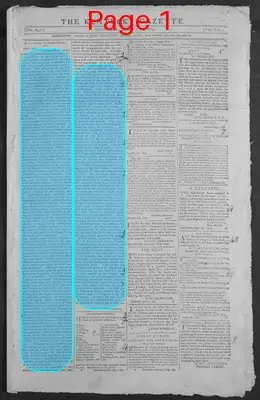
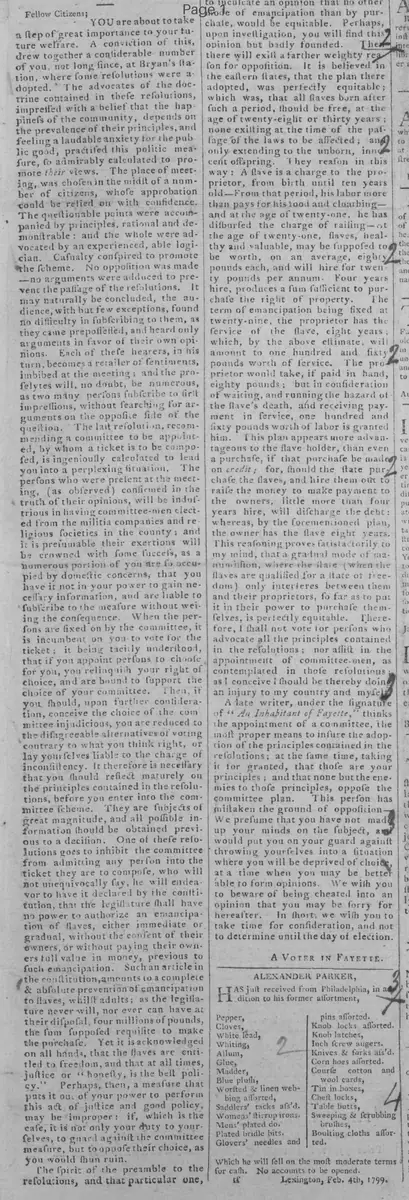
YOU are about to take a step of great importance to your future welfare. A conviction of this, drew together a considerable number of you, not long since, at Bryan's Station, where some resolutions were adopted. The advocates of the doctrine contained in these resolutions, impressed with a belief that the happiness of the community, depends on the prevalence of their principles, and feeling a laudable anxiety for the public good, practised this politic measure, so admirably calculated to promote their views. The place of meeting, was chosen in the midst of a number of citizens, whose approbation could be relied on with confidence. The questionable points were accompanied by principles, rational and demonstrable: and the whole were advocated by an experienced, able logician. Casualty conspired to promote the scheme. No opposition was made—no arguments were adduced to prevent the passage of the resolutions. It may naturally be concluded, the audience, with but few exceptions, found no difficulty in subscribing to them, as they came prepossessed, and heard only arguments in favor of their own opinions. Each of these hearers, in his turn, becomes a retailer of sentiments, imbibed at the meeting; and the proselytes will, no doubt, be numerous, as too many persons subscribe to first impressions, without searching for arguments on the opposite side of the question. The last resolution, recommending a committee to be appointed, by whom a ticket is to be composed, is ingeniously calculated to lead you into a perplexing situation. The persons who were present at the meeting, (as observed) confirmed in the truth of their opinions, will be industrious in having committee-men elected from the militia companies and religious societies in the county: and it is presumable their exertions will be crowned with some success, as a numerous portion of you are so occupied by domestic concerns, that you have it not in your power to gain necessary information, and are liable to subscribe to the measure without weighing the consequence. When the persons are fixed on by the committee, it is incumbent on you to vote for the ticket; it being tacitly understood, that if you appoint persons to choose for you, you relinquish your right of choice, and are bound to support the choice of your committee. Then, if you should, upon further consideration, conceive the choice of the committee injudicious, you are reduced to the disagreeable alternatives of voting contrary to what you think right, or lay yourselves liable to the charge of inconsistency. It therefore is necessary that you should reflect maturely on the principles contained in the resolutions, before you enter into the committee scheme. They are subjects of great magnitude, and all possible information should be obtained previous to a decision. One of these resolutions goes to inhibit the committee from admitting any person into the ticket they are to compose, who will not unequivocally say, he will endeavor to have it declared by the constitution, that the legislature shall have no power to authorize an emancipation of slaves, either immediate or gradual, without the consent of their owners, or without paying their owners full value in money, previous to such emancipation. Such an article in the constitution, amounts to a complete & absolute prevention of emancipation to slaves, whilst adults; as the legislature never will, nor ever can have at their disposal, four millions of pounds, the sum supposed requisite to make the purchase. Yet it is acknowledged on all hands, that the slaves are entitled to freedom, and that at all times, justice or honesty, is the best policy. Perhaps, then, a measure that puts it out of your power to perform this act of justice and good policy, may be improper: if, which is the case, it is not only your duty to yourselves, to guard against the committee measure, but to oppose their choice, as you would shun ruin. The spirit of the preamble to the resolutions, and that particular one, the eastern states, that the plan there adopted, was perfectly equitable; which was, that all slaves born after such a period, should be free, at the age of twenty-eight or thirty years; none existing at the time of the passage of the laws to be affected; and only extending to the unborn, innocent offspring. They reason in this way: A slave is a charge to the proprietor, from birth until ten years old—From that period, his labor more than pays for his food and cloathing— and at the age of twenty-one, he has disbursed the charge of raising— at the age of twenty-one, slaves, healthy and valuable, may be supposed to be worth, on an average, eighty pounds each, and will hire for twenty pounds per annum. Four years hire, produces a sum sufficient to purchase the right of property. The term of emancipation being fixed at twenty-nine, the proprietor has the service of the slave, eight years; which by the above estimate, will amount to one hundred and sixty pounds worth of service. The proprietor would take, if paid in hand, eighty pounds; but in consideration of waiting, and running the hazard of the slave's death, and receiving payment in service, one hundred and sixty pounds worth of labor is granted him. This plan appears more advantageous to the slave holder, than even a purchase, if that purchase be made on credit; for, should the state purchase the slaves, and hire them out to raise the money to make payment to the owners, little more than four years hire, will discharge the debt: whereas, by the aforementioned plan, the owner has the slave eight years. This reasoning proves satisfactorily to my mind, that a gradual mode of manumission, where the slaves are qualified for a state of freedom, only interferes between them and their proprietors, so far as to put it in their power to purchase themselves, is perfectly equitable. Therefore, I shall not vote for persons who advocate all the principles contained in the resolutions: nor assist in the appointment of committee-men, as contemplated in those resolutions as I conceive I should be thereby doing an injury to my country and myself A late writer, under the signature of "An Inhabitant of Fayette," thinks the appointment of a committee, the most proper means to insure the adoption of the principles contained in the resolutions; at the same time, taking it for granted, that those are your principles; and that none but the enemies to those principles, oppose the committee plan. This person has mistaken the ground of opposition— We presume that you have not made up your minds on the subject, and would put you on your guard against throwing yourselves into a situation where you will be deprived of choice, at a time when you may be better able to form opinions. We wish you to beware of being cheated into an opinion that you may be sorry for hereafter. In short, we wish you to take time for consideration, and not to determine until the day of election.
A VOTER IN FAYETTE.