Thank you for visiting SNEWPapers!
Sign up free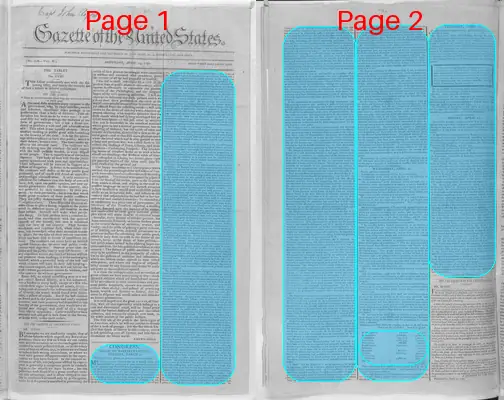
Gazette Of The United States
New York, New York County, New York
What is this article about?
Transcript of U.S. House of Representatives debates from March 30 to April 23, 1790, primarily on assuming state debts and funding public credit, featuring speeches by Williamson, Sedgwick, and others; includes resolutions on debt assumption limits, mourning for Benjamin Franklin, and various petitions and bills.
Merged-components note: This is a continuation of the congressional proceedings on assuming state debts from page 1 to page 2. The text flows directly from one component to the next, and the table provides supporting data on state debts discussed in the debate, with spatial overlap indicating it is embedded within the article.
Clippings
1 of 2
OCR Quality
Full Text
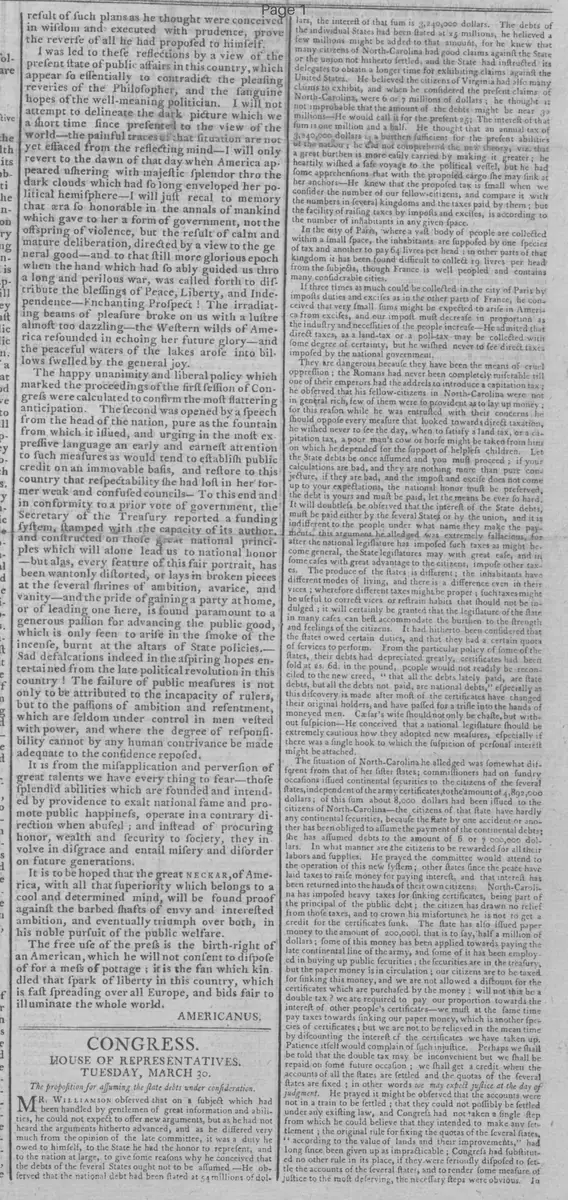
HOUSE OF REPRESENTATIVES.
TUESDAY, MARCH 30.
The proposition for assuming the state debts under consideration.
Mr. Williamson observed that on a subject which had been handled by gentlemen of great information and abilities, he could not expect to offer new arguments, but as he had not heard the arguments hitherto advanced, and as he differed very much from the opinion of the late committee, it was a duty he owed to himself, to the State he had the honor to represent, and to the nation at large, to give some reasons why he conceived that the debts of the several States ought not to be assumed—He observed that the national debt had been stated at 54 millions of dollars, the interest of that sum is 3,240,000 dollars. The debts of the individual States had been stated at 25 millions, he believed a few millions might be added to that amount, for he knew that many citizens of North-Carolina had good claims against the State or the union not hitherto settled, and the State had instructed its delegates to obtain a longer time for exhibiting claims against the United States. He believed the citizens of Virginia had also many claims to exhibit, and when he considered the present claims of North-Carolina, were 6 or 7 millions of dollars; he thought it not improbable that the amount of the debts might be near 30 millions—He would call it for the present 25; The interest of that sum is one million and a half. He thought that an annual tax of 3,240,000 dollars is a burthen sufficient for the present abilities of the nation; he could not comprehend the new theory, viz. that a great burthen is more easily carried by making it greater; he heartily wished a safe voyage to the political vessel, but he had some apprehensions that with the proposed cargo she may sink at her anchors—He knew that the proposed tax is small when we consider the number of our fellow-citizens, and compare it with the numbers in several kingdoms and the taxes paid by them; but the facility of raising taxes by imposts and excises, is according to the number of inhabitants in any given space.
In the city of Paris, where a vast body of people are collected within a small space, the inhabitants are supposed by one species of tax and another to pay 64 livres per head; in other parts of that kingdom it has been found difficult to collect 18 livres per head from the subjects, though France is well peopled and contains many considerable cities. If three times as much could be collected in the city of Paris by impost duties and excises as in the other parts of France, he conceived that very small sums might be expected to arise in America from excises, and our impost must decrease in proportion as the industry and necessities of the people increase—He admitted that direct taxes, as a land-tax or a poll-tax may be collected with some degree of certainty, but he wished never to see direct taxes imposed by the national government.
They are dangerous because they have been the means of cruel oppression; the Romans had never been completely miserable till one of their emperors had the address to introduce a capitation tax; he observed that his fellow-citizens in North-Carolina were not in general rich, few of them were so provident as to lay up money; for this reason while he was entrusted with their concerns he should oppose every measure that looked towards direct taxation, he wished never to see the day, when to satisfy a land tax, or a capitation tax, a poor man's cow or horse might be taken from him on which he depended for the support of helpless children. Let the State debts be once assumed and you must proceed; if your calculations are bad, and they are nothing more than pure conjecture, if they are bad, and the impost and excise does not come up to your expectations, the national honor must be preserved, the debt is yours and must be paid, let the means be ever so hard.
It will doubtless be observed that the interest of the State debts, must be paid either by the several States or by the union, and it is indifferent to the people under what name they make the payments. this argument he alleged was extremely fallacious, for after the national legislature has imposed such taxes as might become general, the State legislatures may with great ease, and in some cases with great advantage to the citizens, impose other taxes. The produce of the states is different; the inhabitants have different modes of living, and there is a difference even in their vices; wherefore different taxes might be proper; such taxes might be useful to correct vices or restrain habits that should not be indulged; it will certainly be granted that the legislature of the state in many cases can best accommodate the burthen to the strength and feelings of the citizens.
It had hitherto been considered that the states owed certain duties, and that they had a certain quota of services to perform. From the particular policy of some of the states, their debts had depreciated greatly, certificates had been sold at 6s. 6d. in the pound, people would not readily be reconciled to the new creed, "that all the debts lately paid, are state debts, but all the debts not paid, are national debts," especially as this discovery is made after most of the certificates have changed their original holders, and have passed for a trifle into the hands of moneyed men. Caesar's wife should not only be chaste, but without suspicion—He conceived that a national legislature should be extremely cautious how they adopted new measures, especially if there was a single hook to which the suspicion of personal interest might be attached.
The situation of North-Carolina he alleged was somewhat different from that of her sister states; commissioners had on sundry occasions issued continental securities to the citizens of the several states, independent of the army certificates, to the amount of 4,892,000 dollars; of this sum about 800,000 dollars had been issued to the citizens of North-Carolina—the citizens of that state have hardly any continental securities, because the state by one accident or another has been obliged to assume the payment of the continental debts: she has assumed debts to the amount of 6 or 700,000 dollars. In what manner are the citizens to be rewarded for all their labors and supplies. He prayed the committee would attend to the operation of this new system; other states since the peace have laid taxes to raise money for paying interest, and that interest has been returned into the hands of their own citizens. North-Carolina has imposed heavy taxes for sinking certificates, being part of the principal of the public debt; the citizen has drawn no relief from those taxes, and to crown his misfortunes he is not to get a credit for the certificates sunk. The state has also issued paper money to the amount of 200,000l. that is to say, half a million of dollars; some of this money has been applied towards paying the late continental line of the army, and some of it has been employed in buying up public securities; the securities are in the treasury, but the paper money is in circulation; our citizens are to be taxed for sinking this money, and we are not allowed a discount for the certificates which are purchased by the money: will not this be a double tax? we are required to pay our proportion towards the interest of other people's certificates—we must at the same time pay taxes towards sinking our paper money, which is another species of certificates; but we are not to be relieved in the mean time by discounting the interest of the certificates we have taken up. Patience itself would complain of such injustice. Perhaps we shall be told that the double tax may be inconvenient but we shall be repaid on some future occasion; we shall get a credit when the accounts of all the states are settled and the quotas of the several states are fixed; in other words we may expect justice at the day of judgment. He prayed it might be observed that the accounts were not in a train to be settled; that they could not possibly be settled under any existing law, and Congress had not taken a single step from which he could believe that they intended to make any settlement; the original rule for fixing the quotas of the several states, "according to the value of lands and their improvements," had long since been given up as impracticable; Congress had substituted no other rule in its place, if they were seriously disposed to settle the accounts of the several states, and to render some measure of justice to the most deserving, the necessary steps were obvious. In
forming a rule for settling the accounts, he was persuaded that North-Carolina would not appear to be illiberal, he presumed also that she would be disposed to make a generous allowance to the several states for all services that had usually been called military; but he could not reconcile himself to this system of assuming the debt first, and talking afterwards concerning its origin. It has been observed that the state debts are not to be funded immediately; how shall we account for this extraordinary zeal in declaring absolutely that they shall be assumed? Are we afraid that the next Congress will refuse to do justice? Are we desirous to cut off the possibility of returning if we should change our minds on better information? One obvious benefit will arise from this sudden adoption, a few men who chanced to be near the seat of government, and were first possessed of the scheme, who flew to Carolina, and there bought up securities at 3s. in the pound; those men will be liberally rewarded, while his unfortunate fellow citizens are left to pay a second tax for the same object, and to complain of the injustice of government.
On this occasion he said he was not left to conjecture what would be the sense of his constituents; the late convention had expressed it fully in one of the amendments they had forwarded to Congress, in the following words: "Congress shall not directly or indirectly, either by themselves or through the judiciary interfere with any one of the States in the redemption of paper money, already emitted and now in circulation, or in liquidating and discharging the public securities of any one of the States, but each and every State shall have the exclusive right of making such laws and regulations for the above purposes as they shall think proper."
In this amendment the convention had been unanimous. On this occasion he was not only pursuing a measure that accorded with the sense of his constituents, but it was a measure that had perfect justice for its object. North-Carolina asked for no favors, she sought for no advantages under cover of general resolves, she was ready to account according to the spirit of the original contract, a contract that had not been altered by the new form of government, for justice was immutable. The new government could not be strengthened by hasty measures, much less by any departure from justice.
Mr. Sedgwick said it had been reported abroad, and declared in the house that those gentlemen who were in favor of the assumption, meant to prevent a settlement of the accounts of the individual states, with the United States: To remove every objection arising from that source, he would take the liberty of declaring once for all, and that in the most unequivocal and positive language, that he did not now, nor ever had entertained such an intention, and that he had the fullest confidence that the same declaration might be applied to every gentleman in favor of the measure.
Mr. Sedgwick said that the house after having exhausted the subject in a most deliberate discussion, had again resolved themselves into a committee, in consequence of the gentleman from N. C. (Mr. W.) having pledged himself, in five minutes to demonstrate that by the assumption, the state he represented would be defrauded of half a million of dollars. That he had attended very carefully to the process of this demonstration, and perhaps it might not be altogether time misspent in communicating to the committee the observations which had occurred to him upon it.
That he understood the gentleman to have declared that N. C. had rendered services beyond her proportion, that her debt created for national purposes, and part of which had been actually assumed, was also beyond her proportion, that the accounts of the individual states with the United States, would never be adjusted, and more, that there was an intention with the majority of Congress to prevent it; what conclusion was to be drawn from this? North Carolina would sustain an injury from the circumstances stated, if the debt shall not be assumed; common sense would then dictate that justice to N. C. required that the debts should be assumed. This consequence however, was not deduced from the premises: the gentleman had agreed that as N.C. independent of the assumption would sustain an injury against which she could by no other means be relieved, therefore he had wisely concluded that by the assumption she would be defrauded.
Mr. Sedgwick said the gentleman had further stated that N. C. had been so unfortunate, that some of her confidential officers had issued fraudulently 300,000 dollars in certificates; which certificates, if the debt of that state should be assumed, must be paid by this government. If so, there could be no doubt but this government would indeed be defrauded, and N. C. would of course be subjected to her proportion of the burden resulting from it: But he wished the gentleman to consider whether the national councils might not, aided by his wisdom and experience, be supposed to possess nearly as much sagacity in detecting frauds and guarding against their effects, as the government of N. C.
The next argument of the gentleman, Mr. S. observed was still more extraordinary, and indeed greatly beyond his comprehension. That he had stated to the committee that N. C. had issued paper money to a certain amount, with this money they had purchased certificates; here then he concludes the state had made one purchase for which it should have a credit; still, however, this money is to be reduced, which will be an additional burden on the people. Here then it is supposed to have been proved a double payment has been made, and yet it is justly concluded that only a single credit is proposed to be given for this wonderful operation. Mr. Sedgwick said he would illustrate the ingenious argument of the gentleman by an example exactly similar, "I borrow," said he "of my friend an hundred pounds for which I pay him by my bond, the man at the time agreed upon for the payment of the money, applies for it, whereupon I with a sober face tell him, that when I received his money he was paid for it by my bond and should he be so unconscionable as to insist on his money, he would receive double payment. Surely any reasonable man would be convinced by the argument. Just so N. C. purchased certificates with her valuable paper promises, this is one payment, she performs her promises—there are now double payments.
Mr. Sedgwick observed that the gentleman had said, that while some states had made provision for the payment of the interest of the debt, N. C. had not done so, she had redeemed the principal, He said if indeed N. C. had neglected to make any provision for the payment of the interest, and had caused the immense depreciation which would unavoidably arise from that source, and had then laid a specific tax payable in the principal, it was an argument infinitely stronger than any he had heard in favor of discrimination; but how it could operate against the proposed assumption was beyond the powers of his mind to discover.
He further observed that the gentleman had produced the N. C. amendment, as a reason against the assumption, that it had also been declared to be a substantial argument against the measure that the idea had never been contemplated by any body in the Southern States until since the report of the Secretary. He said he could not very well understand how the convention of N. C. could propose an amendment with an intention to prevent a measure they had never thought of.
The gentleman from North-Carolina had said he was sensible some of the states were unduly and unequally burdened, and that he was willing to afford them relief when the accounts should be settled. At the same time he was so candid as to declare that he did not believe those accounts ever would be settled. He said that if the gentleman had possessed less confidence in his own powers of persuasion, he would perhaps have permitted at least one day to intervene between the one of those declarations and the other.
"These," said Mr. Sedgwick "are the arguments, the weighty arguments, which the gentleman pledged himself should have all the force of demonstration, and in expectation of hearing which the majority considered themselves authorized to suspend a determination on a question the most important that ever came before this house; a determination on which, the public mind has long expected with an anxiety proportioned to its magnitude."
Mr. Sedgwick concluded by observing that if the majority of the committee was influenced in their determination on this important question by an enlarged, liberal and extended national policy, there could be no doubt of the result, but on the contrary, if local and narrow ideas should prevail, he should despair of success, and with it of those benefits which he had fondly hoped would attend the administration of this government.
Mr. Williamson, in reply to Mr. Sedgwick said that he had not asserted that North-Carolina had paid more than her proportion; the gentleman does not hear well; he had said (he observed) that North-Carolina had assumed to herself, more than her proportion of the continental debt. He repeated his remark that there was a design to prevent a settlement. Let the settlement first be made; and North-Carolina will cheerfully concur in assuming the balances which may appear to be due from the United States—but the present plan is to get the whole funded, and let the settlement come on as it will.
Mr. Page in opposition to assumption said, it was a measure which did not meet the approbation of the creditors themselves. Some of the debts were contracted for purposes in which the rest were no more interested than a foreign nation. He then repeated the observations respecting consolidation; the measure would tend to that, and from that to monarchy. He enlarged on the idea of a spirit of rivalry's giving rise to the debts of the separate States; they were free, sovereign and independent—were at liberty to contract what debts they pleased and the United States were not bound to pay debts contracted from such motives; he hoped the committee would abandon the proposition and go on to consider the rest, which are totally independent of it.
Mr. Goodhue, after observing that, the comparative view of the merits and services of the several States has nothing to do with the present question, said, the war commenced when there was no legislative body to represent the Union; it was carried on by paper money; when that ceased, and the credit of the United States was gone—they applied to the individual States; Congress depended on the credit of the States, separately: hence arose the debts of the States—and thus it appears demonstratively, that those debts are the debts of the United States; contracted on their account and which they are bound by every principle of justice and policy to provide for. This obligation it appears is greatly enhanced by this consideration that the funds on which these debts were dependant, and from which the interest on them was paid, is now assumed by the United States. The impost and excise under the management of the individual States was barely sufficient for this purpose; they have now nothing left, but the excise, which is found to be very unproductive—the consequences of direct taxation have been severely felt. I am clearly of opinion that if we do not make this assumption, the very existence of this government will be endangered; the competition for revenue will excite such heats and animosities, as will destroy the revenue altogether.
He concluded by wishing that the subject might be taken up on fair and equal principles—and from thence he doubted not, it would appear a measure of indispensable necessity and justice to adopt the proposition for the assumption.
WEDNESDAY, APRIL 20.
Sundry petitions were read.
A committee was appointed on Col. Ely's memorial.
In committee of the whole on the Report of the Secretary of the Treasury for the support of the public credit.
The 2d alternative, in the following words was read, viz. -
To have the whole sum funded at an annuity or yearly interest of 4 per cent. irredeemable by any payment exceeding five dollars pr. annum, on account both of principal and interest, and to receive as a compensation for the reduction of interest, fifteen dollars and eighty cents, payable in lands as in the preceding case.
It was moved to strike out "five dollars" in order to admit a larger sum, so that the redemption of the principal should take place at an earlier period than that proposed. This was agreed to, and Six inserted.
The following proposition, To have 66 2/3 dollars funded immediately at an annuity or yearly interest of 6 per cent. irredeemable by any payment exceeding four dollars and two thirds of a dollar, pr. annum, on account both of principal and interest; and to have at the expiration of ten years 26 dollars, and 88 cents, funded at the like interest and rate of redemption." The proposition being amended to read as follows, was agreed to.
"To have 66 dollars funded immediately at an annuity or yearly interest of six per cent. irredeemable by any payment exceeding six dollars and two thirds of a dollar per annum, on account both of principal and interest; and to have, at the end of seven years, thirty-three dollars and one third of a dollar funded at the like interest and rate of redemption."
Mr. Sherman then proposed to modify the resolution so as to admit of the following proposition-"That the debts contracted by the Several states for the common defence and benefit of the union, ought to be considered as a part of the domestic debt of the United States: That proper provision ought to be made for the immediate debt of the United States; and that the faith of government ought to be pledged to make provision, at the next session, for so much of the debts of the respective states as shall have been subscribed upon any of the terms expressed in the last resolution; provided that subscriptions shall not be received for a greater amount, than the following sums, viz.
Here the names of the several states were inserted without any sums.]
That the remainder ought to be left to the respective states to provide for, until a final settlement of their accounts with the United States, for which settlement effectual provision ought now to be made.
Provided that no debts be assumed but such as have been liquidated in specie value, and evidenced by notes or certificates issued by authority of the respective States, before the -day of -1790.
And if the creditors of any state shall not subscribe to the amount of the debt of such state to be assumed as aforesaid, such state shall receive interest at the rate of 4 per cent per annum, on the remainder of said sum, until a final settlement of its accounts with the United States, to be applied to the payment of interest to its non-subscribing creditors, for which, and for the sums that may be assumed, the respective states shall be accountable to the United States.
Mr. Sherman being called upon to ascertain in what proportion he meant to fill up the blanks, read the following as a statement of the debts owing by the states, and the proportions he wanted to have assumed.
Assumption of the State Debts, not exceeding the sums in the last column.
Due as per Sec'ry's Report. Sums to be assumed.
These resolutions were opposed with as much spirit as the original proposition for the assumption. The Committee rose without coming to a vote on them.
* In our last we stated that the second alternative was acceded to: this was an error; it was proposed to restore it, but the proposition was not then decided upon.
THURSDAY, APRIL 22.
Reports on sundry memorials and petitions from the Secretary at War were read.
Mr. Madison made the following motion: Mr. Speaker As we have been informed not only through the channel of the newspapers but by a more direct communication, of the decease of an illustrious character, whose native genius has rendered distinguished services to the cause of science and of mankind in general; and whose patriotic exertions have contributed in a high degree to the independence and prosperity of this country in particular—the occasion seems to call upon us to pay some tribute to his memory expressive of the tender veneration his country feels for such distinguished merit—I therefore move the following resolution:
"The house being informed of the decease of Benjamin Franklin, a citizen whose native genius was not more an ornament to human nature, than his various exertions of it have been precious to science, to freedom, and to his country, do resolve, as a mark of the veneration due to his memory, that the members wear the customary badge of mourning for one month."
On the question, this motion passed without a division.
Mr. PARTRIDGE brought in a bill for allowing compensation to John Ely, which was read a first time.
Mr. Gilman of the committee of enrolment, reported that the committee had examined the bill entitled an act for the punishment of certain crimes against the United States; whereupon, the speaker signed the said bill.
In committee of the whole on the report of the Secretary of the Treasury, Mr. Sherman's resolutions were again read, and a interesting debate ensued but no decision took place.
FRIDAY, APRIL 23.
The bill for granting compensation to Col. John Ely, for his services and expenses as a surgeon to the prisoners on Long Island during the late war, was read the second time, and referred to a committee of the whole, to be taken into consideration this day week.
A report from the Secretary of the Treasury pursuant to order of the house on the 10th January last, respecting any difficulties attending the execution of the revenue laws was read, and referred to a committee, consisting of Mr. Goodhue, Mr. Fitzsimons, Mr. Lawrence, Mr. Boudinot, and Mr. Lee.
Sundry reports from the Secretary of the department of war, on petitions and memorials were read.
A petition and remonstrance from the merchants of Georgetown on Potomac, concerned in shipping, was presented by Mr. Carroll, and read.
The report of the Secretary of the Treasury on the memorial of General James Warren, was read—this report being against the prayer of the petition Mr. Partridge after stating the circumstances on which the application to the house was founded, moved that the sum of 80l. be granted to General James Warren, in full for so much short paid him on a warrant drawn in his favor on the state of Massachusetts; this motion was seconded by Mr. Gerry, who likewise spoke to the merits of the petition.
The question being taken, the motion was negatived.
Mr. Ames said, that previous to taking up the order of the day, he wished to introduce a motion for the consideration of the house; he observed that it had been asserted in the course of the debates on the assumption of the State debts, that the State of Virginia had advanced for the common defence, beyond her proportion; advantage appeared to be taken of such assertions; he thought it necessary that facts should be known—that the committee might act with certainty in conducting this important question; he therefore moved the following in substance, viz. That the Secretary for the department of war be directed to lay before the house a statement of the troops including the militia, and ordnance stores furnished by the respective States for the general defence, during the late war.—This motion was opposed as tending to procrastinate the funding business, and as leading to excite invidious comparisons respecting the relative merits and exertions of the several States
It was however carried in the affirmative, with this addition proposed by Mr. Bland, "and that the Commissioners of accounts between the United States and individual states, be directed to furnish an abstract of the claims of the several states against the United States, specifying the principles on which the claims are founded. On the above motion, the previous question was called for by Mr. Lee, which was lost, and the main question agreed to, 28 to 26.
directed to report to the house a statement of all payments made of Indents and other paper, as well as specie which have been made by the Several states to Congress from the commencement to the end of the late war. This was agreed to.
Mr Madison moved that a statement of the unliquidated claims of the several states against the United States, should be furnished by the Commissioners—this was also agreed to.
motions employed the whole day—so that the House did not go into Committee.
The above report of the Secretary of the Treasury is very minute and lengthy—the reading of it and the debates on the several
(Adjourned till Monday.)
| N. Hampshire. | 300,000 | 300,000 |
| Massachusetts | 5,226,801 | 4,000,000 |
| Connecticut | 1,951,173 | 1,600,000 |
| New-York | 1,167,575 | 1,000,000 |
| New-Jersey | 788,680 | 750,000 |
| Pennsylvania | 2,200,000 | 3,000,000 |
| Delaware | 100,000 | |
| Maryland | 800,000 | 750,000 |
| Virginia | 3,600,743 | 3,000,000 |
| N. Carolina | 1,600,000 | |
| S. Carolina | 5,386,232 | 4,000,000 |
| Georgia | 200,000 |
What sub-type of article is it?
What keywords are associated?
What entities or persons were involved?
Domestic News Details
Event Date
March 30 To April 23, 1790
Key Persons
Outcome
debates ongoing without final vote on debt assumption; resolution passed to mourn benjamin franklin; various motions and bills referred or negatived.
Event Details
House of Representatives debates proposition to assume state debts, with Mr. Williamson opposing due to tax burdens and injustice to North Carolina; Mr. Sedgwick defends and refutes; further discussions on funding alternatives, Sherman's modified resolutions limiting assumption amounts per state; motion to mourn Benjamin Franklin's death passes; petitions and bills on compensations handled.