Thank you for visiting SNEWPapers!
Sign up free
Letter to Editor
August 8, 1811
Virginia Argus
Richmond, Virginia
What is this article about?
A letter defending William Pinkney, the former U.S. minister to London, against criticisms of his unpopularity, attributing it to a British faction in America that hindered diplomacy. The author, VINDEX, praises Pinkney's shift to support democratic principles after witnessing foreign corruptions and domestic betrayals.
Clipping
OCR Quality
98%
Excellent
Full Text
August 2.
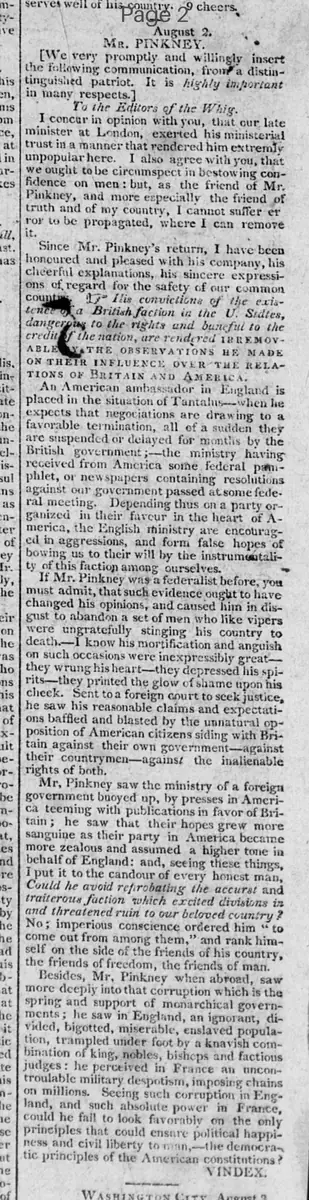
MR. PINKNEY.
[We very promptly and willingly insert the following communication, from a distinguished patriot. It is highly important in many respects.]
To the Editors of the Whig
I concur in opinion with you, that our late minister at London, exerted his ministerial trust in a manner that rendered him extremely unpopular here. I also agree with you, that we ought to be circumspect in bestowing confidence on men: but, as the friend of Mr. Pinkney, and more especially the friend of truth and of my country, I cannot suffer error to be propagated, where I can remove it.
Since Mr. Pinkney's return, I have been honoured and pleased with his company, his cheerful explanations, his sincere expressions of regard for the safety of our common country. His convictions of the existence of a British faction in the U. States, dangerous to the rights and baneful to the credit of the nation, are rendered IRREMOVABLE BY THE OBSERVATIONS HE MADE ON THEIR INFLUENCE OVER THE RELATIONS OF BRITAIN AND AMERICA.
An American ambassador in England is placed in the situation of Tantalus—when he expects that negociations are drawing to a favorable termination, all of a sudden they are suspended or delayed for months by the British government;—the ministry having received from America some federal pamphlet, or newspapers containing resolutions against our government passed at some federal meeting. Depending thus on a party organized in their favour in the heart of America, the English ministry are encouraged in aggressions, and form false hopes of bowing us to their will by the instrumentality of this faction among ourselves.
If Mr. Pinkney was a federalist before, you must admit, that such evidence ought to have changed his opinions, and caused him in disgust to abandon a set of men who like vipers were ungratefully stinging his country to death. I know his mortification and anguish on such occasions were inexpressibly great—they wrung his heart—they depressed his spirits—they printed the glow of shame upon his cheek. Sent to a foreign court to seek justice, he saw his reasonable claims and expectations baffled and blasted by the unnatural opposition of American citizens siding with Britain against their own government—against their countrymen—against the inalienable rights of both.
Mr. Pinkney saw the ministry of a foreign government buoyed up, by presses in America teeming with publications in favor of Britain; he saw that their hopes grew more sanguine as their party in America became more zealous and assumed a higher tone in behalf of England: and, seeing these things, I put it to the candour of every honest man, Could he avoid reprobating the accurst and traitorous faction which excited divisions in and threatened ruin to our beloved country? No; imperious conscience ordered him "to come out from among them," and rank himself on the side of the friends of his country, the friends of freedom, the friends of man.
Besides, Mr. Pinkney when abroad, saw more deeply into that corruption which is the spring and support of monarchical governments; he saw in England, an ignorant, divided, bigotted, miserable, enslaved population, trampled under foot by a knavish combination of king, nobles, bishops and factious judges: he perceived in France an uncontrollable military despotism, imposing chains on millions. Seeing such corruption in England, and such absolute power in France, could he fail to look favourably on the only principles that could ensure political happiness and civil liberty to man,—the democratic principles of the American constitutions?
VINDEX.
MR. PINKNEY.
[We very promptly and willingly insert the following communication, from a distinguished patriot. It is highly important in many respects.]
To the Editors of the Whig
I concur in opinion with you, that our late minister at London, exerted his ministerial trust in a manner that rendered him extremely unpopular here. I also agree with you, that we ought to be circumspect in bestowing confidence on men: but, as the friend of Mr. Pinkney, and more especially the friend of truth and of my country, I cannot suffer error to be propagated, where I can remove it.
Since Mr. Pinkney's return, I have been honoured and pleased with his company, his cheerful explanations, his sincere expressions of regard for the safety of our common country. His convictions of the existence of a British faction in the U. States, dangerous to the rights and baneful to the credit of the nation, are rendered IRREMOVABLE BY THE OBSERVATIONS HE MADE ON THEIR INFLUENCE OVER THE RELATIONS OF BRITAIN AND AMERICA.
An American ambassador in England is placed in the situation of Tantalus—when he expects that negociations are drawing to a favorable termination, all of a sudden they are suspended or delayed for months by the British government;—the ministry having received from America some federal pamphlet, or newspapers containing resolutions against our government passed at some federal meeting. Depending thus on a party organized in their favour in the heart of America, the English ministry are encouraged in aggressions, and form false hopes of bowing us to their will by the instrumentality of this faction among ourselves.
If Mr. Pinkney was a federalist before, you must admit, that such evidence ought to have changed his opinions, and caused him in disgust to abandon a set of men who like vipers were ungratefully stinging his country to death. I know his mortification and anguish on such occasions were inexpressibly great—they wrung his heart—they depressed his spirits—they printed the glow of shame upon his cheek. Sent to a foreign court to seek justice, he saw his reasonable claims and expectations baffled and blasted by the unnatural opposition of American citizens siding with Britain against their own government—against their countrymen—against the inalienable rights of both.
Mr. Pinkney saw the ministry of a foreign government buoyed up, by presses in America teeming with publications in favor of Britain; he saw that their hopes grew more sanguine as their party in America became more zealous and assumed a higher tone in behalf of England: and, seeing these things, I put it to the candour of every honest man, Could he avoid reprobating the accurst and traitorous faction which excited divisions in and threatened ruin to our beloved country? No; imperious conscience ordered him "to come out from among them," and rank himself on the side of the friends of his country, the friends of freedom, the friends of man.
Besides, Mr. Pinkney when abroad, saw more deeply into that corruption which is the spring and support of monarchical governments; he saw in England, an ignorant, divided, bigotted, miserable, enslaved population, trampled under foot by a knavish combination of king, nobles, bishops and factious judges: he perceived in France an uncontrollable military despotism, imposing chains on millions. Seeing such corruption in England, and such absolute power in France, could he fail to look favourably on the only principles that could ensure political happiness and civil liberty to man,—the democratic principles of the American constitutions?
VINDEX.
What sub-type of article is it?
Persuasive
Political
Reflective
What themes does it cover?
Politics
Constitutional Rights
What keywords are associated?
Pinkney Defense
British Faction
Federalists
American Diplomacy
Democratic Principles
Political Corruption
What entities or persons were involved?
Vindex
To The Editors Of The Whig
Letter to Editor Details
Author
Vindex
Recipient
To The Editors Of The Whig
Main Argument
defends mr. pinkney's unpopularity as resulting from a british faction in america that sabotaged diplomacy; argues his experiences abroad converted him to support american democratic principles over federalist influences.
Notable Details
Analogy To Tantalus For Diplomatic Frustrations
Vipers Metaphor For Federalists
Observations On Corruption In England And France
Quote: 'To Come Out From Among Them'