Thank you for visiting SNEWPapers!
Sign up free
Editorial
April 2, 1841
Richmond Enquirer
Richmond, Richmond County, Virginia
What is this article about?
Editorial criticizes Whig efforts in extra congressional session to establish a National Bank, quoting supportive presses and warning of its dangers, advocating for Sub-Treasury and free trade instead.
Clipping
OCR Quality
95%
Excellent
Full Text
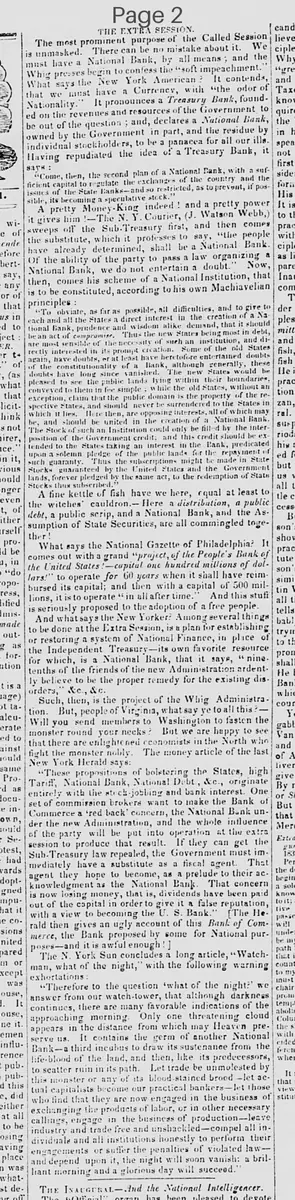
THE EXTRA SESSION.
The most prominent purpose of the Called Session is unmasked. There can be no mistake about it. We must have a National Bank, by all means; and the Whig presses begin to confess the "soft impeachment."
What says the New York American? It contends, that we must have a Currency, with "the odor of Nationality." It pronounces a Treasury Bank, founded on the revenues and resources of the Government to be out of the question; and, declares a National Bank, owned by the Government in part, and the residue by individual stockholders, to be a panacea for all our ills.
Having repudiated the idea of a Treasury Bank, it says:
"Come, then, the second plan of a National Bank, with a sufficient capital to regulate the exchanges of the country and the issues of the State Banks—and so restricted, as to prevent, if possible, its becoming a speculative stock."
A pretty Money-King indeed! and a pretty power it gives him!—The N. Y. Courier, (J. Watson Webb, sweeps off the Sub-Treasury first, and then comes the substitute, which it professes to say, "the people have already determined, shall be a National Bank."
Of the ability of the party to pass a law organizing a National Bank, we do not entertain a doubt." Now, then, comes his scheme of a National Institution, that is to be constituted, according to his own Machiavelian principles:
"To obviate, as far as possible, all difficulties, and to give to each and all the States a direct interest in the creation of a National Bank, prudence and wisdom alike demand, that it should be an act of compromise. Thus the new States being most in debt, are most sensible of the necessity of such an institution, and directly interested in its prompt creation. Some of the old States again, have doubts, or at least have heretofore entertained doubts of the constitutionality of a Bank, although generally, these doubts have long since vanished. The new States would be pleased to see the public lands lying within their boundaries. conveyed to them in fee simple: while the old States, without an exception, claim that the public domain is the property of the respective States, and should never be surrendered to the States in which it lies. Here then, are opposing interests, all of which may be, and should be united in the creation of a National Bank. The Stock of such an Institution could only be filled by the interposition of the Government credit. and this credit should be extended to the States taking an interest in the Bank, predicated upon a solemn pledge of the public lands for the repayment of such guaranty. Thus the subscriptions might be made in State Stocks guaranteed by the United States and the Government lands, forever pledged by the same act, to the redemption of State Stocks thus subscribed."
A fine kettle of fish have we here, equal at least to the witches' cauldron.—Here a distribution, a public debt, a public scrip, and a National Bank, and the Assumption of State Securities, are all commingled together!
What says the National Gazette of Philadelphia: It comes out with a grand "project, of the People's Bank of the United States!—capital one hundred millions of dollars!" to operate for 50 years when it shall have reimbursed its capital; and then with a capital of 500 millions, it is to operate "in all after time." And this stuff is seriously proposed to the adoption of a free people.
And what says the New Yorker? Among several things to be done at the Extra Session, is a plan for establishing or restoring a system of National Finance, in place of the Independent Treasury—its own favorite resource for which, is a National Bank, that it says, "nine tenths of the friends of the new Administration ardently believe to be the proper remedy for the existing disorders,"&c.&c.
Such, then, is the project of the Whig Administration. But, people of Virginia, what say ye to all this?-
Will you send members to Washington to fasten the monster round your necks? But we are happy to see that there are enlightened economists in the North who fight the monster nobly. The money article of the last New York Herald says:
"These propositions of bolstering the States, high Tariff, National Bank, National Debt, &c., originate entirely with the stock-jobbing and bank interest. One set of commission brokers want to make the Bank of Commerce a 'red back' concern, the National Bank under the new Administration, and the whole influence of the party will be put into operation at the extra session to produce that result. If they can get the Sub-Treasury law repealed, the Government must immediately have a substitute as a fiscal agent. That agent they hope to become, as a prelude to their acknowledgment as the National Bank. That concern is now losing money, that is, dividends have been paid out of the capital in order to give it a false reputation, with a view to becoming the U. S. Bank." The Herald then gives an ugly account of this Bank of Commerce, the Bank proposed by some for National purposes—and it is awful enough! ]
The N. York Sun concludes a long article, "Watchman, what of the night," with the following warning exhortations.
"Therefore to the question 'what of the night?' we answer from our watch-tower, that although darkness continues, there are many favorable indications of the approaching morning.
Only one threatening cloud appears in the distance from which may Heaven preserve us. It contains the germ of another National Bank—a third incubus to draw its sustenance from the life-blood of the land, and then, like its predecessors, to scatter ruin in its path. Let trade be unmolested by this monster or any of its blood-stained brood -let actual capitalists become our practical bankers—let those who find that they are now engaged in the business of exchanging the products of labor, or in other necessary callings, engage in the business of production—leave industry and trade free and unshackled—compel all individuals and all institutions honestly to perform their engagements or suffer the penalties of violated law— and depend upon it, the night will soon vanish: a brilliant morning and a glorious day will succeed."
The most prominent purpose of the Called Session is unmasked. There can be no mistake about it. We must have a National Bank, by all means; and the Whig presses begin to confess the "soft impeachment."
What says the New York American? It contends, that we must have a Currency, with "the odor of Nationality." It pronounces a Treasury Bank, founded on the revenues and resources of the Government to be out of the question; and, declares a National Bank, owned by the Government in part, and the residue by individual stockholders, to be a panacea for all our ills.
Having repudiated the idea of a Treasury Bank, it says:
"Come, then, the second plan of a National Bank, with a sufficient capital to regulate the exchanges of the country and the issues of the State Banks—and so restricted, as to prevent, if possible, its becoming a speculative stock."
A pretty Money-King indeed! and a pretty power it gives him!—The N. Y. Courier, (J. Watson Webb, sweeps off the Sub-Treasury first, and then comes the substitute, which it professes to say, "the people have already determined, shall be a National Bank."
Of the ability of the party to pass a law organizing a National Bank, we do not entertain a doubt." Now, then, comes his scheme of a National Institution, that is to be constituted, according to his own Machiavelian principles:
"To obviate, as far as possible, all difficulties, and to give to each and all the States a direct interest in the creation of a National Bank, prudence and wisdom alike demand, that it should be an act of compromise. Thus the new States being most in debt, are most sensible of the necessity of such an institution, and directly interested in its prompt creation. Some of the old States again, have doubts, or at least have heretofore entertained doubts of the constitutionality of a Bank, although generally, these doubts have long since vanished. The new States would be pleased to see the public lands lying within their boundaries. conveyed to them in fee simple: while the old States, without an exception, claim that the public domain is the property of the respective States, and should never be surrendered to the States in which it lies. Here then, are opposing interests, all of which may be, and should be united in the creation of a National Bank. The Stock of such an Institution could only be filled by the interposition of the Government credit. and this credit should be extended to the States taking an interest in the Bank, predicated upon a solemn pledge of the public lands for the repayment of such guaranty. Thus the subscriptions might be made in State Stocks guaranteed by the United States and the Government lands, forever pledged by the same act, to the redemption of State Stocks thus subscribed."
A fine kettle of fish have we here, equal at least to the witches' cauldron.—Here a distribution, a public debt, a public scrip, and a National Bank, and the Assumption of State Securities, are all commingled together!
What says the National Gazette of Philadelphia: It comes out with a grand "project, of the People's Bank of the United States!—capital one hundred millions of dollars!" to operate for 50 years when it shall have reimbursed its capital; and then with a capital of 500 millions, it is to operate "in all after time." And this stuff is seriously proposed to the adoption of a free people.
And what says the New Yorker? Among several things to be done at the Extra Session, is a plan for establishing or restoring a system of National Finance, in place of the Independent Treasury—its own favorite resource for which, is a National Bank, that it says, "nine tenths of the friends of the new Administration ardently believe to be the proper remedy for the existing disorders,"&c.&c.
Such, then, is the project of the Whig Administration. But, people of Virginia, what say ye to all this?-
Will you send members to Washington to fasten the monster round your necks? But we are happy to see that there are enlightened economists in the North who fight the monster nobly. The money article of the last New York Herald says:
"These propositions of bolstering the States, high Tariff, National Bank, National Debt, &c., originate entirely with the stock-jobbing and bank interest. One set of commission brokers want to make the Bank of Commerce a 'red back' concern, the National Bank under the new Administration, and the whole influence of the party will be put into operation at the extra session to produce that result. If they can get the Sub-Treasury law repealed, the Government must immediately have a substitute as a fiscal agent. That agent they hope to become, as a prelude to their acknowledgment as the National Bank. That concern is now losing money, that is, dividends have been paid out of the capital in order to give it a false reputation, with a view to becoming the U. S. Bank." The Herald then gives an ugly account of this Bank of Commerce, the Bank proposed by some for National purposes—and it is awful enough! ]
The N. York Sun concludes a long article, "Watchman, what of the night," with the following warning exhortations.
"Therefore to the question 'what of the night?' we answer from our watch-tower, that although darkness continues, there are many favorable indications of the approaching morning.
Only one threatening cloud appears in the distance from which may Heaven preserve us. It contains the germ of another National Bank—a third incubus to draw its sustenance from the life-blood of the land, and then, like its predecessors, to scatter ruin in its path. Let trade be unmolested by this monster or any of its blood-stained brood -let actual capitalists become our practical bankers—let those who find that they are now engaged in the business of exchanging the products of labor, or in other necessary callings, engage in the business of production—leave industry and trade free and unshackled—compel all individuals and all institutions honestly to perform their engagements or suffer the penalties of violated law— and depend upon it, the night will soon vanish: a brilliant morning and a glorious day will succeed."
What sub-type of article is it?
Economic Policy
Partisan Politics
What keywords are associated?
National Bank
Whig Policy
Sub Treasury
Currency Reform
State Debts
Public Lands
Fiscal Agent
What entities or persons were involved?
Whig Administration
New York American
N.Y. Courier
National Gazette Of Philadelphia
New Yorker
New York Herald
N. York Sun
Editorial Details
Primary Topic
Opposition To Whig Proposals For A National Bank
Stance / Tone
Strongly Critical Of National Bank And Whig Schemes
Key Figures
Whig Administration
New York American
N.Y. Courier
National Gazette Of Philadelphia
New Yorker
New York Herald
N. York Sun
Key Arguments
Whig Presses Advocate For A National Bank As Solution To Currency Issues
Rejects Treasury Bank, Proposes Government Part Owned National Bank
Suggests Compromising With States Using Public Lands And Government Credit
Proposes Massive People's Bank Of The United States With $100 Million Capital
Northern Economists And Papers Warn Against Bank As Benefiting Stock Jobbers
Urges Repeal Of Sub Treasury For National Bank Substitute
Calls For Free Trade And Industry Without Banking Monsters