Thank you for visiting SNEWPapers!
Sign up free
Story
January 4, 1848
The Northern Galaxy
Middlebury, Addison County, Vermont
What is this article about?
The Boston Traveller explains the electric telegraph's workings via an analogy: a stretched cord with hammers creating dots and dashes for signals, powered by electricity instead of manual motion for rapid message transmission.
Clipping
OCR Quality
92%
Excellent
Full Text
NEWS BY TELEGRAPH
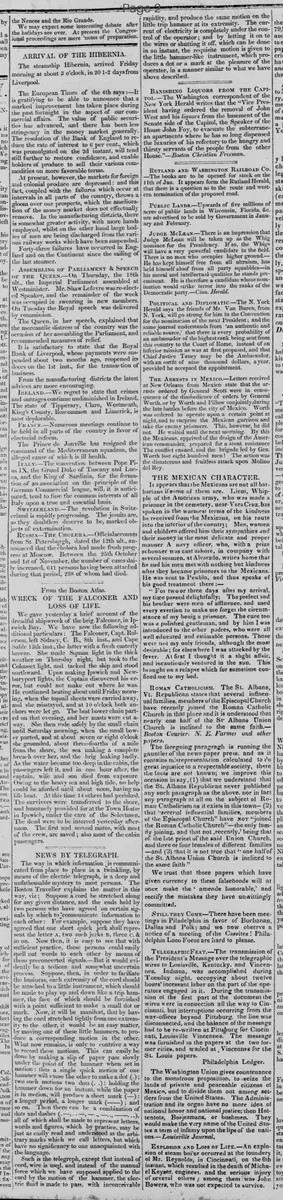
The way in which information is communicated from place to place in a twinkling, by means of the electric telegraph, is a deep and unfathomable mystery to most persons. The Boston Traveller explains the matter in this way, viz: Suppose a cord be stretched along for any given distance, and the ends held by two persons who have agreed on certain signals by which to "communicate information to each other: For example, suppose they have agreed that one short quick jerk shall represent the letter A, two such jerks B, three C, & so on. Now then, it is easy to see that with sufficient practice, these persons could easily spell out words to each other by means of these preconcerted signals. But it would evidently be a tedious and somewhat uncertain process. Suppose, then, in order to facilitate the business, each extremity of the cord should be attached to a little instrument, which should be made to play up and down like a trip hammer, the face of which should be furnished with a point sufficient to make a small dot or mark. Now, it will be manifest, that by having the cord stretched tightly from one extremity to the other, it would be an easy matter, by moving one of these little hammers, to produce a corresponding motion in the other.
What now remains, is only to contrive a way to record these motions. This can easily be done by making a slip of paper pass slowly under the point of the hammer when set in motion: thus a single quick motion of one hammer will cause the other to make a dot (.): two such motions two dots (. .): holding the hammer down for an instant, while the paper is in motion, will produce a short mark (-): a longer period, a longer mark (--); and so on. Then there can be a combination of dots and dashes (.-. . . -,- ., -.., --. ..), all of which shall be made to represent letters, words and figures, which by practice, may be just as easily read and understood as the arbitrary marks which we call letters, but which have no significancy to one unacquainted with the language.
Such is the telegraph, except that instead of cord, wire is used, and instead of the manual force which we have supposed applied to the cord by the motion of the hammer, the electric fluid is made to pass, with inconceivable rapidity, and produce the same motion on the little trip hammer at its extremity. The current of electricity is completely under the control of the operator; and by letting it on to the wires or shutting it off, which can be done in an instant, the requisite motion is given to the little hammer-like instrument, which produces a dot or a mark at the pleasure of the operator, in a manner similar to what we have above described.
The way in which information is communicated from place to place in a twinkling, by means of the electric telegraph, is a deep and unfathomable mystery to most persons. The Boston Traveller explains the matter in this way, viz: Suppose a cord be stretched along for any given distance, and the ends held by two persons who have agreed on certain signals by which to "communicate information to each other: For example, suppose they have agreed that one short quick jerk shall represent the letter A, two such jerks B, three C, & so on. Now then, it is easy to see that with sufficient practice, these persons could easily spell out words to each other by means of these preconcerted signals. But it would evidently be a tedious and somewhat uncertain process. Suppose, then, in order to facilitate the business, each extremity of the cord should be attached to a little instrument, which should be made to play up and down like a trip hammer, the face of which should be furnished with a point sufficient to make a small dot or mark. Now, it will be manifest, that by having the cord stretched tightly from one extremity to the other, it would be an easy matter, by moving one of these little hammers, to produce a corresponding motion in the other.
What now remains, is only to contrive a way to record these motions. This can easily be done by making a slip of paper pass slowly under the point of the hammer when set in motion: thus a single quick motion of one hammer will cause the other to make a dot (.): two such motions two dots (. .): holding the hammer down for an instant, while the paper is in motion, will produce a short mark (-): a longer period, a longer mark (--); and so on. Then there can be a combination of dots and dashes (.-. . . -,- ., -.., --. ..), all of which shall be made to represent letters, words and figures, which by practice, may be just as easily read and understood as the arbitrary marks which we call letters, but which have no significancy to one unacquainted with the language.
Such is the telegraph, except that instead of cord, wire is used, and instead of the manual force which we have supposed applied to the cord by the motion of the hammer, the electric fluid is made to pass, with inconceivable rapidity, and produce the same motion on the little trip hammer at its extremity. The current of electricity is completely under the control of the operator; and by letting it on to the wires or shutting it off, which can be done in an instant, the requisite motion is given to the little hammer-like instrument, which produces a dot or a mark at the pleasure of the operator, in a manner similar to what we have above described.
What sub-type of article is it?
Explanatory Article
Scientific Analogy
What keywords are associated?
Electric Telegraph
Communication
Dots Dashes
Electricity
Analogy
Story Details
Story Details
Explanation of electric telegraph using analogy of stretched cord with hammers producing dots and dashes for letters; electricity replaces manual force to transmit signals rapidly.