Thank you for visiting SNEWPapers!
Sign up free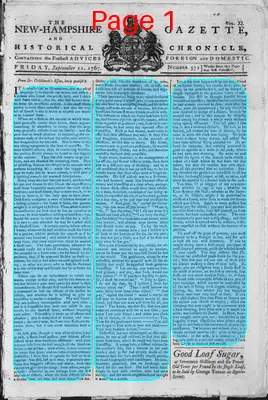
Literary
September 11, 1767
The New Hampshire Gazette And Historical Chronicle
Portsmouth, Greenland, Rockingham County, New Hampshire
What is this article about?
This essay satirically observes that concealing one's needs preserves esteem and increases chances of aid, while revealing poverty invites contempt. Through anecdotes of a once-wealthy man's downfall, it critiques how favors favor the rich and advises hiding misfortune to appeal to vanity or self-interest rather than pity.
Clipping
OCR Quality
98%
Excellent
Full Text
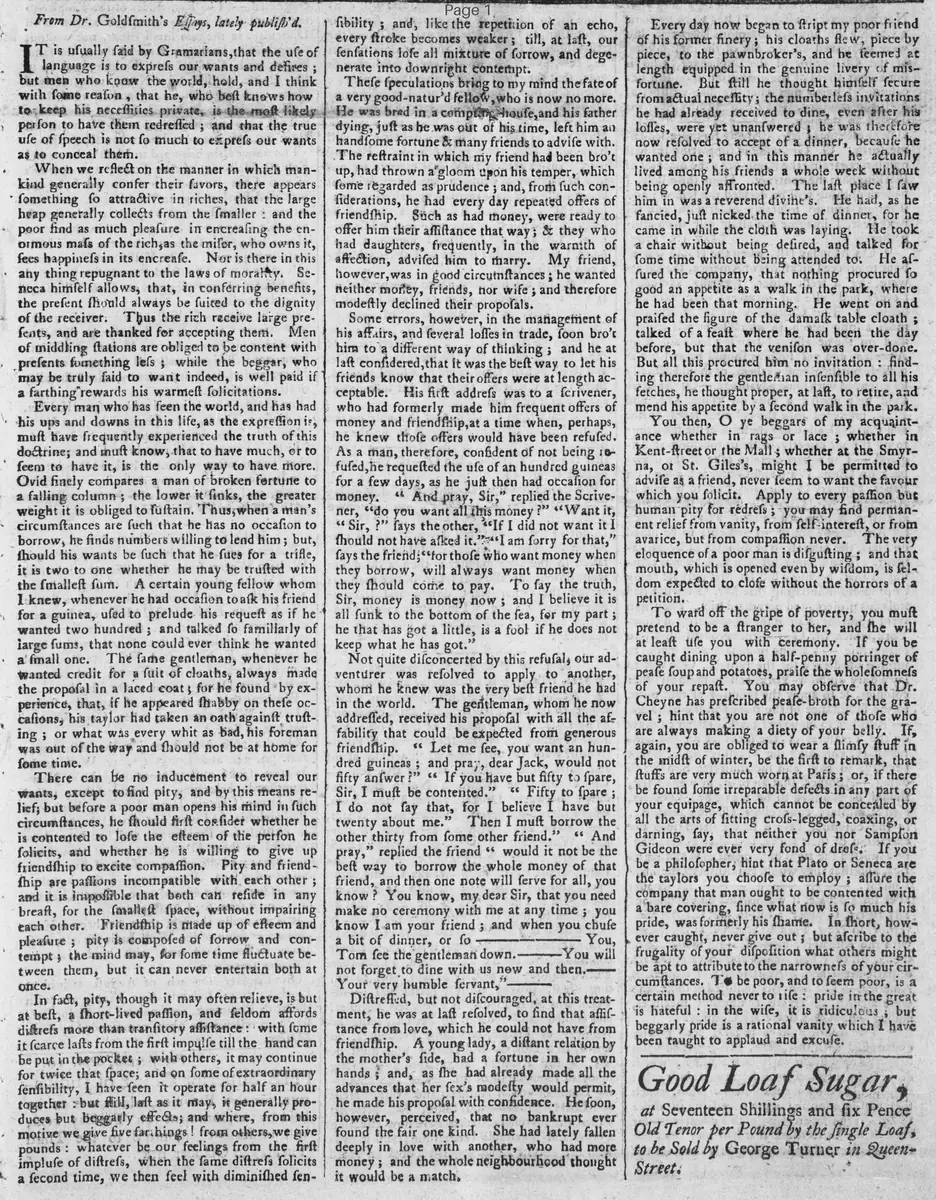
It is usually said by Grammarians, that the use of
language is to express our wants and desires; but men
who know the world, hold, and I think with some reason,
that he, who best knows how to keep his necessities
private, is the most likely person to have them redressed;
and that the true use of speech is not so much to express
our wants as to conceal them.
When we reflect on the manner in which mankind
generally confer their favors, there appears something so
attractive in riches, that the large heap generally
collects from the smaller: and the poor find as much
pleasure in increasing the enormous mass of the rich, as
the miser who owns it, feels happiness in its increase.
Nor is there in this any thing repugnant to the laws of
morality. Seneca himself allows, that, in conferring
benefits, the present should always be suited to the
dignity of the receiver: Thus the rich receive large
presents, and are thanked for accepting them. Men of
middling stations are obliged to be content with presents
something less; while the beggar, who may be truly said
to want indeed, is well paid if a farthing rewards his
warmest solicitations.
Every man who has seen the world, and has had his
ups and downs in this life, as the expression is, must
have frequently experienced the truth of this doctrine:
and must know, that to have much, or to seem to have it,
is the only way to have more. Ovid finely compares a man
of broken fortune to a falling column: the lower it sinks,
the greater weight it is obliged to sustain. Thus, when a
man's circumstances are such that he has no occasion to
borrow, he finds numbers willing to lend him; but, should
his wants be such that he sues for a trifle, it is two to
one whether he may be trusted with the smallest sum. A
certain young fellow whom I knew, whenever he had
occasion to ask his friend for a guinea, used to prelude
his request as if he wanted two hundred: and talked so
familiarly of large sums, that none could ever think he
wanted a small one. The same gentleman, whenever he
wanted credit for a suit of clothes, always made the
proposal in a laced coat; for he found by experience,
that, if he appeared shabby on these occasions, his
tailor had taken an oath against trusting; or what was
every whit as bad, his foreman was out of the way and
should not be at home for some time.
There can be no inducement to reveal our wants,
except to find pity, and by this means relief: but before a
poor man opens his mind in such circumstances, he should
first consider whether he is contented to lose the esteem
of those persons he solicits, and whether he is willing to
give up friendship to excite compassion. Pity and
friendship are passions incompatible with each other; and
it is impossible that both can reside in any breast, for the
smallest space, without impairing each other.
Friendship is made up of esteem and pleasure; pity is
composed of sorrow and contempt; the mind may, for
some time fluctuate between them, but it can never
entertain both at once.
In fact, pity, though it may often relieve, is but at
best, a short-lived passion, and seldom affords distress
more than transitory assistance: with some it scarce lasts
from the first impulse till the hand can be put in the
pocket; with others, it may continue for twice that space;
and on some of extraordinary sensibility, I have seen it
operate for half an hour together: but still, last as it may,
it generally produces but beggarly effects; and where,
from this motive we give five farthings! from others, we
give pounds: whatever be our feelings from the first
impulse of distress, when the same distress solicits a
second time, we then feel with diminished sensibility;
and, like the repetition of an echo, every stroke becomes
weaker; till, at last, our sensations lose all mixture of
sorrow, and degenerate into downright contempt:
These speculations bring to my mind the fate of a
very good-natur'd fellow, who is now no more. He was
bred in a counting house, and his father dying, just as he
was out of his time, left him a handsome fortune & many
friends to advise with. The restraint in which my friend
had been bro't up, had thrown a gloom upon his temper,
which some regarded as prudence; and, from such
considerations, he had every day repeated offers of
friendship. Such as had money, were ready to offer him
their assistance that way; & they who had daughters,
frequently, in the warmth of affection, advised him to
marry. My friend, however, was in good circumstances:
he wanted neither money, friends, nor wife: and therefore
modestly declined their proposals.
Some errors, however, in the management of his
affairs, and several losses in trade, soon bro't him to a
different way of thinking: and he at last considered, that
it was the best way to let his friends know that their
offers were at length acceptable. His first address was to
a scrivener, who had formerly made him frequent offers
of money and friendship, at a time when, perhaps, he
knew those offers would have been refused. As a man,
therefore, confident of not being refused, he requested
the use of an hundred guineas for a few days, as he just
then had occasion for money. "And pray, Sir," replied the
Scrivener, "do you want all this money?" "Want it, Sir?"
says the other. "If I did not want it I should not have
asked it." "I am sorry for that," says the friend: "for those
who want money when they borrow, will always want
money when they should come to pay. To say the truth,
Sir, money is money now: and I believe it is all sunk to
the bottom of the sea, for my part; he that has got a little,
is a fool if he does not keep what he has got."
Not quite disconcerted by this refusal, our
adventurer was resolved to apply to another, whom he
knew was the very best friend he had in the world. The
gentleman, whom he now addressed, received his proposal
with all the affability that could be expected from
generous friendship. "Let me see, you want an hundred
guineas: and pray, dear Jack, would not fifty answer?"
"If you have but fifty to spare, Sir, I must be contented."
"Fifty to spare: I do not say that, for I believe I have but
twenty about me." Then I must borrow the other thirty
from some other friend." "And pray," replied the friend
"would it not be the best way to borrow the whole money
of that friend, and then one note will serve for all, you
know? You know, my dear Sir, that you need make no
ceremony with me at any time; you know I am your
friend; and when you chuse a bit of dinner, or so
You, Tom see the gentleman down.-- You will not
forget to dine with us now and then.-- Your very humble
servant,
Distressed, but not discouraged, at this treatment, he
was at last resolved, to find that assistance from love,
which he could not have from friendship. A young lady, a
distant relation by the mother's side, had a fortune in her
own hands; and, as she had already made all the advances
that her sex's modesty would permit, he made his proposal
with confidence. He soon, however, perceived, that no
bankrupt ever found the fair one kind. She had lately
fallen deeply in love with another, who had more money;
and the whole neighbourhood thought it would be a
match.
Every day now began to strip my poor friend of his
former finery; his cloaths flew, piece by piece, to the
pawnbroker's, and he seemed at length equipped in the
genuine livery of misfortune. But till he thought himself
secure from actual necessity; the numberless invitations
he had already received to dine, even after his losses,
were yet unanswered; he was therefore now resolved to
accept of a dinner, because he wanted one; and in this
manner he actually lived among his friends a whole week
without being openly affronted. The last place I saw him
in was a reverend divine's. He had, as he fancied, just
icked the time of dinner, for he came in while the cloth
was laying. He took a chair without being desired, and
talked for some time without being attended to: He
assured the company, that nothing procured so good an
appetite as a walk in the park, where he had been that
morning. He went on and praised the figure of the
damask table cloth: talked of a feast where he had been
the day before, but that the venison was over-done. But
all this procured him no invitation: finding therefore the
gentleman insensible to all his fetches, he thought proper,
at last, to retire, and mend his appetite by a second walk
in the park.
You then, O ye beggars of my acquaintance whether
in rags or lace; whether in Kent-street or the Mall;
whether at the Smyrna, or St. Giles's, might I be
permitted to advise as a friend, never seem to want the
favour which you solicit. Apply to every passion but
human pity for redress; -you may find permanent relief
from vanity, from self-interest, or from avarice, but from
compassion never. The very eloquence of a poor man is
disgusting; and that mouth, which is opened even by
wisdom, is seldom expected to close without the horrors of
a petition.
To ward off the gripe of poverty, you must pretend to
be a stranger to her, and she will at least use you with
ceremony. If you be caught dining upon a half-penny
porringer of pease soup and potatoes, praise the
wholesomeness of your repast. You may observe that Dr.
Cheyne has prescribed pease-broth for the gravel; hint
that you are not one of those who are always making a
diety of your belly. If, again, you are obliged to wear a
filmy stuff in the midst of winter, be the first to remark,
that stuffs are very much worn at Paris: or, if there be
found some irreparable defects in any part of your
equipage, which cannot be concealed by all the arts of
sitting cross-legged, 'coaxing, or darning, say; that
neither you nor Sampson Gideon were ever very fond of
dress. If you be a philosopher; hint that Plato or Seneca
are the taylors you chuse to employ; assure the company
that man ought to be contented with a bare covering,
since what now is so much his pride, was formerly his
shame. In short, however caught, never give out; but
ascribe to the frugality of your disposition what others
might be apt to attribute to the narrowness of your
circumstances. To be poor, and to seem poor, is a certain
method never to rise: pride in the great is hateful: in the
wise, it is ridiculous; but beggarly pride is a rational
vanity which I have been taught to applaud and excuse.
language is to express our wants and desires; but men
who know the world, hold, and I think with some reason,
that he, who best knows how to keep his necessities
private, is the most likely person to have them redressed;
and that the true use of speech is not so much to express
our wants as to conceal them.
When we reflect on the manner in which mankind
generally confer their favors, there appears something so
attractive in riches, that the large heap generally
collects from the smaller: and the poor find as much
pleasure in increasing the enormous mass of the rich, as
the miser who owns it, feels happiness in its increase.
Nor is there in this any thing repugnant to the laws of
morality. Seneca himself allows, that, in conferring
benefits, the present should always be suited to the
dignity of the receiver: Thus the rich receive large
presents, and are thanked for accepting them. Men of
middling stations are obliged to be content with presents
something less; while the beggar, who may be truly said
to want indeed, is well paid if a farthing rewards his
warmest solicitations.
Every man who has seen the world, and has had his
ups and downs in this life, as the expression is, must
have frequently experienced the truth of this doctrine:
and must know, that to have much, or to seem to have it,
is the only way to have more. Ovid finely compares a man
of broken fortune to a falling column: the lower it sinks,
the greater weight it is obliged to sustain. Thus, when a
man's circumstances are such that he has no occasion to
borrow, he finds numbers willing to lend him; but, should
his wants be such that he sues for a trifle, it is two to
one whether he may be trusted with the smallest sum. A
certain young fellow whom I knew, whenever he had
occasion to ask his friend for a guinea, used to prelude
his request as if he wanted two hundred: and talked so
familiarly of large sums, that none could ever think he
wanted a small one. The same gentleman, whenever he
wanted credit for a suit of clothes, always made the
proposal in a laced coat; for he found by experience,
that, if he appeared shabby on these occasions, his
tailor had taken an oath against trusting; or what was
every whit as bad, his foreman was out of the way and
should not be at home for some time.
There can be no inducement to reveal our wants,
except to find pity, and by this means relief: but before a
poor man opens his mind in such circumstances, he should
first consider whether he is contented to lose the esteem
of those persons he solicits, and whether he is willing to
give up friendship to excite compassion. Pity and
friendship are passions incompatible with each other; and
it is impossible that both can reside in any breast, for the
smallest space, without impairing each other.
Friendship is made up of esteem and pleasure; pity is
composed of sorrow and contempt; the mind may, for
some time fluctuate between them, but it can never
entertain both at once.
In fact, pity, though it may often relieve, is but at
best, a short-lived passion, and seldom affords distress
more than transitory assistance: with some it scarce lasts
from the first impulse till the hand can be put in the
pocket; with others, it may continue for twice that space;
and on some of extraordinary sensibility, I have seen it
operate for half an hour together: but still, last as it may,
it generally produces but beggarly effects; and where,
from this motive we give five farthings! from others, we
give pounds: whatever be our feelings from the first
impulse of distress, when the same distress solicits a
second time, we then feel with diminished sensibility;
and, like the repetition of an echo, every stroke becomes
weaker; till, at last, our sensations lose all mixture of
sorrow, and degenerate into downright contempt:
These speculations bring to my mind the fate of a
very good-natur'd fellow, who is now no more. He was
bred in a counting house, and his father dying, just as he
was out of his time, left him a handsome fortune & many
friends to advise with. The restraint in which my friend
had been bro't up, had thrown a gloom upon his temper,
which some regarded as prudence; and, from such
considerations, he had every day repeated offers of
friendship. Such as had money, were ready to offer him
their assistance that way; & they who had daughters,
frequently, in the warmth of affection, advised him to
marry. My friend, however, was in good circumstances:
he wanted neither money, friends, nor wife: and therefore
modestly declined their proposals.
Some errors, however, in the management of his
affairs, and several losses in trade, soon bro't him to a
different way of thinking: and he at last considered, that
it was the best way to let his friends know that their
offers were at length acceptable. His first address was to
a scrivener, who had formerly made him frequent offers
of money and friendship, at a time when, perhaps, he
knew those offers would have been refused. As a man,
therefore, confident of not being refused, he requested
the use of an hundred guineas for a few days, as he just
then had occasion for money. "And pray, Sir," replied the
Scrivener, "do you want all this money?" "Want it, Sir?"
says the other. "If I did not want it I should not have
asked it." "I am sorry for that," says the friend: "for those
who want money when they borrow, will always want
money when they should come to pay. To say the truth,
Sir, money is money now: and I believe it is all sunk to
the bottom of the sea, for my part; he that has got a little,
is a fool if he does not keep what he has got."
Not quite disconcerted by this refusal, our
adventurer was resolved to apply to another, whom he
knew was the very best friend he had in the world. The
gentleman, whom he now addressed, received his proposal
with all the affability that could be expected from
generous friendship. "Let me see, you want an hundred
guineas: and pray, dear Jack, would not fifty answer?"
"If you have but fifty to spare, Sir, I must be contented."
"Fifty to spare: I do not say that, for I believe I have but
twenty about me." Then I must borrow the other thirty
from some other friend." "And pray," replied the friend
"would it not be the best way to borrow the whole money
of that friend, and then one note will serve for all, you
know? You know, my dear Sir, that you need make no
ceremony with me at any time; you know I am your
friend; and when you chuse a bit of dinner, or so
You, Tom see the gentleman down.-- You will not
forget to dine with us now and then.-- Your very humble
servant,
Distressed, but not discouraged, at this treatment, he
was at last resolved, to find that assistance from love,
which he could not have from friendship. A young lady, a
distant relation by the mother's side, had a fortune in her
own hands; and, as she had already made all the advances
that her sex's modesty would permit, he made his proposal
with confidence. He soon, however, perceived, that no
bankrupt ever found the fair one kind. She had lately
fallen deeply in love with another, who had more money;
and the whole neighbourhood thought it would be a
match.
Every day now began to strip my poor friend of his
former finery; his cloaths flew, piece by piece, to the
pawnbroker's, and he seemed at length equipped in the
genuine livery of misfortune. But till he thought himself
secure from actual necessity; the numberless invitations
he had already received to dine, even after his losses,
were yet unanswered; he was therefore now resolved to
accept of a dinner, because he wanted one; and in this
manner he actually lived among his friends a whole week
without being openly affronted. The last place I saw him
in was a reverend divine's. He had, as he fancied, just
icked the time of dinner, for he came in while the cloth
was laying. He took a chair without being desired, and
talked for some time without being attended to: He
assured the company, that nothing procured so good an
appetite as a walk in the park, where he had been that
morning. He went on and praised the figure of the
damask table cloth: talked of a feast where he had been
the day before, but that the venison was over-done. But
all this procured him no invitation: finding therefore the
gentleman insensible to all his fetches, he thought proper,
at last, to retire, and mend his appetite by a second walk
in the park.
You then, O ye beggars of my acquaintance whether
in rags or lace; whether in Kent-street or the Mall;
whether at the Smyrna, or St. Giles's, might I be
permitted to advise as a friend, never seem to want the
favour which you solicit. Apply to every passion but
human pity for redress; -you may find permanent relief
from vanity, from self-interest, or from avarice, but from
compassion never. The very eloquence of a poor man is
disgusting; and that mouth, which is opened even by
wisdom, is seldom expected to close without the horrors of
a petition.
To ward off the gripe of poverty, you must pretend to
be a stranger to her, and she will at least use you with
ceremony. If you be caught dining upon a half-penny
porringer of pease soup and potatoes, praise the
wholesomeness of your repast. You may observe that Dr.
Cheyne has prescribed pease-broth for the gravel; hint
that you are not one of those who are always making a
diety of your belly. If, again, you are obliged to wear a
filmy stuff in the midst of winter, be the first to remark,
that stuffs are very much worn at Paris: or, if there be
found some irreparable defects in any part of your
equipage, which cannot be concealed by all the arts of
sitting cross-legged, 'coaxing, or darning, say; that
neither you nor Sampson Gideon were ever very fond of
dress. If you be a philosopher; hint that Plato or Seneca
are the taylors you chuse to employ; assure the company
that man ought to be contented with a bare covering,
since what now is so much his pride, was formerly his
shame. In short, however caught, never give out; but
ascribe to the frugality of your disposition what others
might be apt to attribute to the narrowness of your
circumstances. To be poor, and to seem poor, is a certain
method never to rise: pride in the great is hateful: in the
wise, it is ridiculous; but beggarly pride is a rational
vanity which I have been taught to applaud and excuse.
What sub-type of article is it?
Essay
Satire
What themes does it cover?
Social Manners
Commerce Trade
Moral Virtue
What keywords are associated?
Concealing Wants
Social Hypocrisy
Wealth Disparity
Pity Vs Friendship
Poverty Advice
Literary Details
Key Lines
It Is Usually Said By Grammarians, That The Use Of Language Is To Express Our Wants And Desires; But Men Who Know The World, Hold, And I Think With Some Reason, That He, Who Best Knows How To Keep His Necessities Private, Is The Most Likely Person To Have Them Redressed; And That The True Use Of Speech Is Not So Much To Express Our Wants As To Conceal Them.
To Have Much, Or To Seem To Have It, Is The Only Way To Have More.
Pity And Friendship Are Passions Incompatible With Each Other; And It Is Impossible That Both Can Reside In Any Breast, For The Smallest Space, Without Impairing Each Other.
Apply To Every Passion But Human Pity For Redress; You May Find Permanent Relief From Vanity, From Self Interest, Or From Avarice, But From Compassion Never.
To Be Poor, And To Seem Poor, Is A Certain Method Never To Rise: Pride In The Great Is Hateful: In The Wise, It Is Ridiculous; But Beggarly Pride Is A Rational Vanity Which I Have Been Taught To Applaud And Excuse.