Thank you for visiting SNEWPapers!
Sign up free
Story
February 6, 1899
The Topeka State Journal
Topeka, Shawnee County, Kansas
What is this article about?
Affidavits filed for new trial in James S. Collins murder case detail a witness overhearing Johnson Jordan plotting the killing with accomplices in Topeka, May 1898, and multiple claims of juror misconduct during son John Collins' trial.
Clipping
OCR Quality
95%
Excellent
Full Text
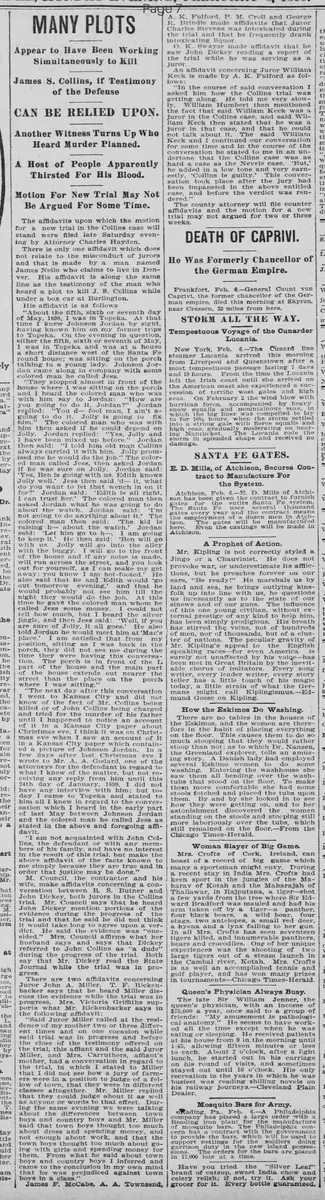
MANY PLOTS
Appear to Have Been Working
Simultaneously to Kill
James S. Collins, if Testimony
of the Defense
CAN BE RELIED UPON.
Another Witness Turns Up Who
Heard Murder Planned.
A Host of People Apparently
Thirsted For His Blood.
Motion For New Trial May Not
Be Argued For Some Time.
The affidavits upon which the motion
for a new trial in the Collins case will
stand were filed late Saturday even-
ing by Attorney Charles Hayden.
There is only one affidavit which does
not relate to the misconduct of jurors
and that is made by a man named
James Nello who claims to live in Den-
ver. His affidavit is along the same
line as the testimony of the man who
heard a plot to kill J. S. Collins while
under a box car at Burlington.
His affidavit is as follows
"About the fifth, sixth or seventh day
of May, 1898, I was in Topeka. At that
time I knew Johnson Jordan by sight,
having known him on my former trips
to Topeka. On the evening in question,
either the fifth, sixth or seventh of May,
I was in Topeka and was at a house
a short distance west of the Santa Fe
round house: was sitting on the porch
talking to a young lady. Johnson Jor-
dan came along in company with some
colored man he called Jess.
"They stopped almost in front of the
house where I was sitting on the porch
and I heard the colored man who was
with him say to Jordan: "How are
you going to do it, Jordan?" Jordan
replied: "You d- fool man. I ain't a-
going to do it. Jolly is going to fix
him."
The colored man who was with
him then asked if he could depend on
Jolly. Jordan replied: "Yes, Jolly and
I have been mixed up before." Jordan
then said: "I told him old man Collins
always carried it with him. Jolly prom-
ised me he would do the job." The color-
ed man called Jess. then asked Jordan
if he was sure on Jolly. Jordan said:
'Yes. Ben is going with us. Edith knows
Jolly well.' Jess then said 'd it. what
do you want to let that wench in on it
for?' Jordan said: Edith is all right,
I can trust her.' The colored man then
asked Jordan what he was going to do
about the watch. Jordan said: 'I'm
not going to do anything about it.' The
colored man then said: The kid is
raising h- about the watch.' Jordan
said: 'Let him go to h-. I am going
to keep it.' He then said: Ben will go
with us. Jolly will go into the alley
with the buggy. I will go to the front
of the house and if any noise is made,
will run across the street, and you look
out for yourself, as I can make my get
away; you know I am hot-footed.' He
also said that he and Edith would 'go
out tomorrow evening,' and that he
would probably not see him till the
night they would do the job. At this
time he gave the colored man whom he
called Jess some money. I could not
tell how much, but I heard the silver
jingle, and then Jess said: 'Well, if you
are sure of Jolly, it all goes.' He also
told Jordan he would meet him at 'Mac's
place.' I am satisfied that from my
position, sitting as I was back in the
porch, they did not see me during the
time they were having this conversa-
tion. The porch is in front of the L
part of the house and the main part
of the house extends out nearer the
street than the place on the
.porch
where I was sitting."
"The next day after this conversation
I went to Kansas City and did not
know of the fact of Mr. Collins being
killed or of John Collins being charged
and tried for the murder of his father
until I happened to notice an account
of it in a Kansas City paper about
Christmas eve. I think it was on Christ-
mas eve when I saw an account of it
in a Kansas City paper which contain-
ed a picture of Johnson Jordan. In a
few days after last Christmas eve I
wrote to Mr. A. A. Godard. one of the
attorneys for the defendant in regard to
what I knew of the matter. but not re
ceiving any reply from him until this
24th day of January. 1899. I did not
have any interview with him; but to-
day I came to Topeka and stated to
him all I knew in regard to the conver-
sation which I heard in the early part
of last May between Johnson Jordan
and the colored man he called Jess as
stated in the above and foregoing affi-
davit.
"I am not acquainted with John Col-
lins, the defendant or with any mem-
bers of his family. and have no interest
in the result of this trial. but make the
above affidavit of the facts known to
me simply because they are true and in
order that justice may be done."
M. Council. the contractor and his
wife, make affidavits concerning a con-
versation between R. S. Butner and
John Dickey, both jurors in the Collins
trial. Mr. Council says that he heard
John Dickey mention portions of the
evidence during the progress of the
trial and that he said he did not think
it would take long to agree upon a ver-
dict. He said the evidence was "one-
sided." Mrs. Council affirms what her
husband says and says that Dickey
referred to John Collins as "a dude"
during the progress of the trial. Both
say that Mr. Dickey read the State
Journal while the trial was in pro-
gress.
There are two affidavits concerning
Juror John A. Miller. T. F. Ricken-
backer says that he heard Miller dis-
cuss the evidence while the trial was in
progress. Mrs. Victoria Griffiths sup-
ports what Mr. Rickenbacker says in
the following affidavit:
"Said Juror Miller called at the resi-
dence of my mother two or three differ-
ent times and on one cocasion while
said trial was in progress and before
the close of the testimony offered on
the trial. this affiant and the said Juror
Miller. and Mrs. Carruthers. affiant's
mother, had a conversation in regard to
the trial, in which I stated to Miller
that I did not see how a jury of farm-
ers were in a position to judge of a fel-
low of town, that they were in different
classes altogether. Mr. Miller replied
that they could judge about it as well
as anyone or words to that effect. Dur-
ing the same evening we were talking
about the differences between town
boys and country boys and Mr. Miller
said that town boys thought too much
about dress and spending money, and
not enough about work, and that the
town boys thought too much about go-
ing with girls and spending money for
them. From what he said about town
boys and country boys I inferred and
came to the conclusion in my own mind
that he was prejudiced against town
boys in a class."
James F. McCabe, A. A. Townsend
A. K. Fulford. P. M. Croll and George
R. Brindle made affidavits that Juror
Charles Stevens was intoxicated during
the trial and that he frequently drank
intoxicating liquor.
O. K. Swayze made afidavit that he
saw John Dickey reading a report of
the trial while he was serving as a
juror.
An affidavit concerning Juror William
Keck is made by A. K. Fulford as fol-
lows:
"In the course of said conversation I
asked him how the Collins trial was
getting along. He told me very slow-
ly. William Humbert then mentioned
the fact that said William Keck was a
juror in the Collins case. and said Wil-
liam Keck then stated that he was a
juror in that case, and that he could
not talk about it. The said William
Keck and I continued our conversation
for some time and in the course of the
conversation he stated to me in an un-
dertone that the Collins case was as
hard a case as the Nevels case. 'But, '
he added in a low tone and very earn-
estly. 'Collins is guilty.' This conver-
sation took place after the jury had
been impaneled in the above entitled
case, and before the verdict was ren-
dered."
The county attorney will file counter
affidavits and the motion for a new
trial may not argued for two or three
weeks.
Appear to Have Been Working
Simultaneously to Kill
James S. Collins, if Testimony
of the Defense
CAN BE RELIED UPON.
Another Witness Turns Up Who
Heard Murder Planned.
A Host of People Apparently
Thirsted For His Blood.
Motion For New Trial May Not
Be Argued For Some Time.
The affidavits upon which the motion
for a new trial in the Collins case will
stand were filed late Saturday even-
ing by Attorney Charles Hayden.
There is only one affidavit which does
not relate to the misconduct of jurors
and that is made by a man named
James Nello who claims to live in Den-
ver. His affidavit is along the same
line as the testimony of the man who
heard a plot to kill J. S. Collins while
under a box car at Burlington.
His affidavit is as follows
"About the fifth, sixth or seventh day
of May, 1898, I was in Topeka. At that
time I knew Johnson Jordan by sight,
having known him on my former trips
to Topeka. On the evening in question,
either the fifth, sixth or seventh of May,
I was in Topeka and was at a house
a short distance west of the Santa Fe
round house: was sitting on the porch
talking to a young lady. Johnson Jor-
dan came along in company with some
colored man he called Jess.
"They stopped almost in front of the
house where I was sitting on the porch
and I heard the colored man who was
with him say to Jordan: "How are
you going to do it, Jordan?" Jordan
replied: "You d- fool man. I ain't a-
going to do it. Jolly is going to fix
him."
The colored man who was with
him then asked if he could depend on
Jolly. Jordan replied: "Yes, Jolly and
I have been mixed up before." Jordan
then said: "I told him old man Collins
always carried it with him. Jolly prom-
ised me he would do the job." The color-
ed man called Jess. then asked Jordan
if he was sure on Jolly. Jordan said:
'Yes. Ben is going with us. Edith knows
Jolly well.' Jess then said 'd it. what
do you want to let that wench in on it
for?' Jordan said: Edith is all right,
I can trust her.' The colored man then
asked Jordan what he was going to do
about the watch. Jordan said: 'I'm
not going to do anything about it.' The
colored man then said: The kid is
raising h- about the watch.' Jordan
said: 'Let him go to h-. I am going
to keep it.' He then said: Ben will go
with us. Jolly will go into the alley
with the buggy. I will go to the front
of the house and if any noise is made,
will run across the street, and you look
out for yourself, as I can make my get
away; you know I am hot-footed.' He
also said that he and Edith would 'go
out tomorrow evening,' and that he
would probably not see him till the
night they would do the job. At this
time he gave the colored man whom he
called Jess some money. I could not
tell how much, but I heard the silver
jingle, and then Jess said: 'Well, if you
are sure of Jolly, it all goes.' He also
told Jordan he would meet him at 'Mac's
place.' I am satisfied that from my
position, sitting as I was back in the
porch, they did not see me during the
time they were having this conversa-
tion. The porch is in front of the L
part of the house and the main part
of the house extends out nearer the
street than the place on the
.porch
where I was sitting."
"The next day after this conversation
I went to Kansas City and did not
know of the fact of Mr. Collins being
killed or of John Collins being charged
and tried for the murder of his father
until I happened to notice an account
of it in a Kansas City paper about
Christmas eve. I think it was on Christ-
mas eve when I saw an account of it
in a Kansas City paper which contain-
ed a picture of Johnson Jordan. In a
few days after last Christmas eve I
wrote to Mr. A. A. Godard. one of the
attorneys for the defendant in regard to
what I knew of the matter. but not re
ceiving any reply from him until this
24th day of January. 1899. I did not
have any interview with him; but to-
day I came to Topeka and stated to
him all I knew in regard to the conver-
sation which I heard in the early part
of last May between Johnson Jordan
and the colored man he called Jess as
stated in the above and foregoing affi-
davit.
"I am not acquainted with John Col-
lins, the defendant or with any mem-
bers of his family. and have no interest
in the result of this trial. but make the
above affidavit of the facts known to
me simply because they are true and in
order that justice may be done."
M. Council. the contractor and his
wife, make affidavits concerning a con-
versation between R. S. Butner and
John Dickey, both jurors in the Collins
trial. Mr. Council says that he heard
John Dickey mention portions of the
evidence during the progress of the
trial and that he said he did not think
it would take long to agree upon a ver-
dict. He said the evidence was "one-
sided." Mrs. Council affirms what her
husband says and says that Dickey
referred to John Collins as "a dude"
during the progress of the trial. Both
say that Mr. Dickey read the State
Journal while the trial was in pro-
gress.
There are two affidavits concerning
Juror John A. Miller. T. F. Ricken-
backer says that he heard Miller dis-
cuss the evidence while the trial was in
progress. Mrs. Victoria Griffiths sup-
ports what Mr. Rickenbacker says in
the following affidavit:
"Said Juror Miller called at the resi-
dence of my mother two or three differ-
ent times and on one cocasion while
said trial was in progress and before
the close of the testimony offered on
the trial. this affiant and the said Juror
Miller. and Mrs. Carruthers. affiant's
mother, had a conversation in regard to
the trial, in which I stated to Miller
that I did not see how a jury of farm-
ers were in a position to judge of a fel-
low of town, that they were in different
classes altogether. Mr. Miller replied
that they could judge about it as well
as anyone or words to that effect. Dur-
ing the same evening we were talking
about the differences between town
boys and country boys and Mr. Miller
said that town boys thought too much
about dress and spending money, and
not enough about work, and that the
town boys thought too much about go-
ing with girls and spending money for
them. From what he said about town
boys and country boys I inferred and
came to the conclusion in my own mind
that he was prejudiced against town
boys in a class."
James F. McCabe, A. A. Townsend
A. K. Fulford. P. M. Croll and George
R. Brindle made affidavits that Juror
Charles Stevens was intoxicated during
the trial and that he frequently drank
intoxicating liquor.
O. K. Swayze made afidavit that he
saw John Dickey reading a report of
the trial while he was serving as a
juror.
An affidavit concerning Juror William
Keck is made by A. K. Fulford as fol-
lows:
"In the course of said conversation I
asked him how the Collins trial was
getting along. He told me very slow-
ly. William Humbert then mentioned
the fact that said William Keck was a
juror in the Collins case. and said Wil-
liam Keck then stated that he was a
juror in that case, and that he could
not talk about it. The said William
Keck and I continued our conversation
for some time and in the course of the
conversation he stated to me in an un-
dertone that the Collins case was as
hard a case as the Nevels case. 'But, '
he added in a low tone and very earn-
estly. 'Collins is guilty.' This conver-
sation took place after the jury had
been impaneled in the above entitled
case, and before the verdict was ren-
dered."
The county attorney will file counter
affidavits and the motion for a new
trial may not argued for two or three
weeks.
What sub-type of article is it?
Crime Story
Mystery
Historical Event
What themes does it cover?
Crime Punishment
Justice
Deception
What keywords are associated?
Murder Plot
New Trial
Juror Misconduct
Collins Case
Topeka
Affidavits
Johnson Jordan
What entities or persons were involved?
James S. Collins
John Collins
Johnson Jordan
James Nello
Charles Hayden
John Dickey
John A. Miller
Charles Stevens
William Keck
Where did it happen?
Topeka
Story Details
Key Persons
James S. Collins
John Collins
Johnson Jordan
James Nello
Charles Hayden
John Dickey
John A. Miller
Charles Stevens
William Keck
Location
Topeka
Event Date
May 1898
Story Details
Affidavits for new trial in Collins murder case include James Nello's account of overhearing Johnson Jordan and Jess plotting to kill J.S. Collins involving Jolly, Ben, and Edith; plus multiple affidavits alleging juror misconduct such as discussing evidence, prejudice, intoxication, and reading newspapers during trial.