Thank you for visiting SNEWPapers!
Sign up free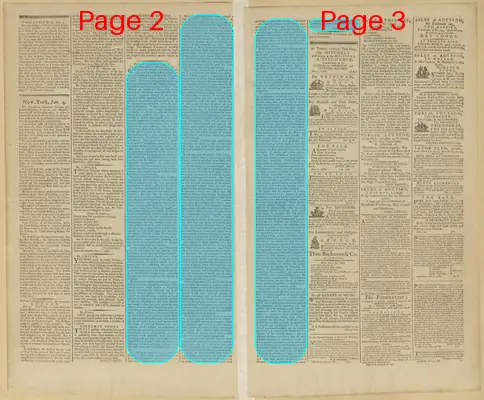
The Daily Advertiser
New York, New York County, New York
What is this article about?
A collective response from New England, published in the Connecticut Courant, to Richard Henry Lee's 'Federal Farmer' essays opposing the U.S. Constitution. It defends the proposed government, accuses Lee of hypocrisy, envy of Washington, and ties to New York interests, while emphasizing New England's strength, contributions to independence, and desire for federal unity against foreign powers.
Merged-components note: This is a continuation of the same long letter to the editor from the Connecticut Courant, spanning pages 2 and 3.
Clippings
1 of 2
OCR Quality
Full Text
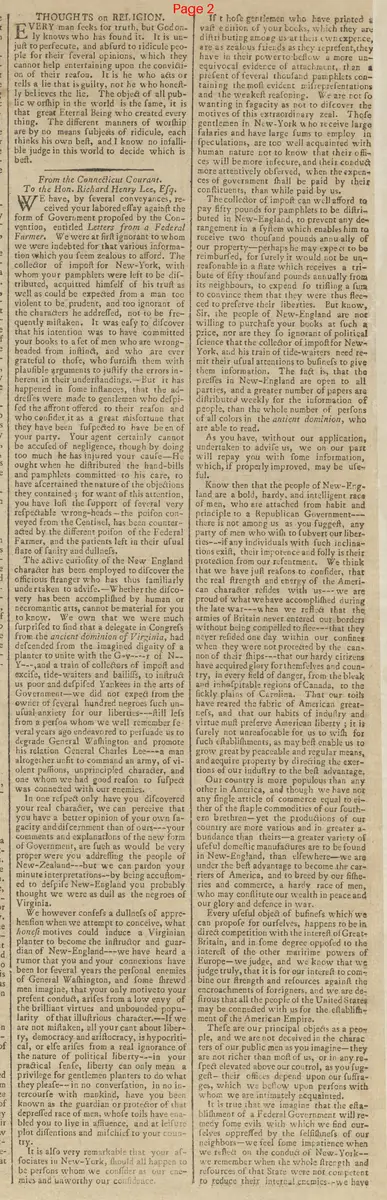
To the Hon. Richard Henry Lee, Esq.
We have, by several conveyances, received your labored essay against the form of Government proposed by the Convention, entitled Letters from a Federal Farmer. We were at first ignorant to whom we were indebted for that various information which you seem zealous to afford. The collector of impost for New-York, with whom your pamphlets were left to be distributed, acquitted himself of his trust as well as could be expected from a man too violent to be prudent, and too ignorant of the characters he addressed, not to be frequently mistaken. It was easy to discover that his intention was to have committed your books to a set of men who are wrong-headed from instinct, and who are ever grateful to those, who furnish them with plausible arguments to justify the errors inherent in their understandings. But it has happened in some instances, that the addresses were made to gentlemen who despised the affront offered to their reason and who consider it as a great misfortune that they have been suspected to have been of your party. Your agent certainly cannot be accused of negligence, though by doing too much he has injured your cause. He ought when he distributed the hand-bills and pamphlets committed to his care, to have ascertained the nature of the objections they contained; for want of this attention, you have lost the support of several very respectable wrong-heads. The poison conveyed from the Centinel, has been counteracted by the different poison of the Federal Farmer, and the patients left in their usual state of sanity and dullness.
The active curiosity of the New England character has been employed to discover the officious stranger who has thus familiarly undertaken to advise. Whether the discovery has been accomplished by human or necromantic arts, cannot be material for you to know. We own that we were much surprised to find that a delegate in Congress from the ancient dominion of Virginia, had descended from the imagined dignity of a planter to unite with the G-y----r of N-- Y---. and a train of collectors of impost and excis, tide-waiters and bailiffs, to instruct us poor and despised Yankees in the arts of Government. We did not expect from the owner of several hundred negroes such unusual anxiety for our liberties---still less from a person whom we well remember several years ago endeavored to persuade us to degrade General Washington and promote his relation General Charles Lee---a man altogether unfit to command an army, of violent passions, unprincipled character, and one whom we had good reason to suspect was connected with our enemies.
In one respect only have you discovered your real character, we can perceive that you have a better opinion of your own sagacity and discernment than of ours---your comments and explanations of the new form of Government, are such as would be very proper were you addressing the people of New-Zealand---but we can pardon your minute interpretations. By being accustomed to despise New-England you probably thought we were as dull as the negroes of Virginia.
We however confess a dullness of apprehension when we attempt to conceive, what honest motives could induce a Virginian planter to become the instructor and guardian of New-England---we have heard a rumor that you and your connexions have been for several years the personal enemies of General Washington, and some shrewd men imagine, that your only motive to your present conduct, arises from a low envy of the brilliant virtues and unbounded popularity of that illustrious character. If we are not mistaken, all your cant about liberty, democracy and aristocracy, is hypocritical, or else arises from a real ignorance of the nature of political liberty---in your practical sense, liberty can only mean a privilege for gentlemen planters to do what they please. In no conversation, in no intercourse with mankind, have you been known as the guardian or protector of that depressed race of men, whose toils have enabled you to live in affluence, and at leisure plot disensions and mischief to your country.
It is also very remarkable that your associates in New-York, should all happen to be persons whom we consider as our enemies and unworthy our confidence.
If those gentlemen who have printed vast edition of your books, which they are distributing among us at their own expence, are as zealous friends as they represent, they have in their power to bestow a more unequivocal evidence of attachment, than a present of several thousand pamphlets containing the most evident misrepresentations and the weakest reasoning. We are not so wanting in sagacity as not to discover the motives of this extraordinary zeal. Those gentlemen in New-York who receive large salaries and have large sums to employ in peculations, are too well acquainted with human nature not to know that their offices will be more insecure, and their conduct more attentively observed, when the expences of government shall be paid by their constituents, than while paid by us.
The collector of impost can well afford to pay fifty pounds for pamphlets to be distributed in New-England, to prevent any derangement in a system which enables him to receive two thousand pounds annually of our property. Perhaps he may expect to be reimbursed, for surely it would not be unreasonable in a state which receives a tribute of fifty thousand pounds annually from its neighbours, to expend so trifling a sum to convince them that they were thus fleeced to preserve their liberties. But know, Sir, the people of New-England are not so willing to purchase your books at such a price, nor are they so ignorant of political science that the collector of impost for New-York, and his train of tide-waiters need remit their usual attentions to business to give them information. The fact is, that the presses in New-England are open to all parties, and a greater number of papers are distributed weekly for the information of people, than the whole number of persons of all colors in the ancient dominion, who are able to read.
As you have, without our application, undertaken to advise us, we on our part will repay you with some information, which, if properly improved, may be useful.
Know then that the people of New-England are a bold, hardy, and intelligent race of men, who are attached from habit and principle to a Republican Government---there is not among us as you suggest, any party of men who wish to subvert our liberties---if any individuals with such inclinations exist, their impotence and folly is their protection from our resentment. We think that we have just reasons to consider, that the real strength and energy of the American character resides with us---we are proud of what we have accomplished during the late war---when we reflect that the armies of Britain never entered our borders without being compelled to flee---that they never resided one day within our confines when they were not protected by the cannon of their ships---that our hardy citizens have acquired glory for themselves and country, in every field of danger, from the bleak and inhospitable regions of Canada, to the sickly plains of Carolina. That our toils have reared the fabric of American greatness, and that our habits of industry and virtue must preserve American liberty; it is surely not unreasonable for us to wish for such establishments, as may best enable us to grow great by peaceable and regular means, and acquire property by directing the exertions of our industry to the best advantage.
Our country is more populous than any other in America, and though we have not any single article of commerce equal to either of the staple commodities of our southern brethren---yet the productions of our country are more various and in greater abundance than theirs---a greater variety of useful domestic manufactures are to be found in New-England, than elsewhere---we are under the best advantage to become the carriers of America, and to breed by our fisheries and commerce, a hardy race of men, who may constitute our wealth in peace and our glory and defence in war.
Every useful object of business which we can propose for ourselves, happens to be in direct competition with the interest of Great-Britain, and in some degree opposed to the interest of the other maritime powers of Europe---we judge, and we know that we judge truly, that it is for our interest to combine our strength and resources against the encroachments of foreigners, and we are desirous that all the people of the United States may be connected with us for the establishment of the American Empire.
These are our principal objects as a people, and we are not deceived in the characters of our public men as you imagine---they are not richer than most of us, or in any respect elevated above our control, as you suggest---their offices depend upon our suffrages, which we bestow upon persons with whom we are intimately acquainted.
It is true that we imagine that the establishment of a Federal Government will remedy some evils with which we find ourselves oppressed by the selfishness of our neighbors---we feel some impatience when we reflect on the conduct of New-York---we remember when the whole strength and resources of that State were not competent to reduce their internal enemies---we have not forgotten the assistance we afforded them—the immense property which they acquired by our exertions, and which has been converted to their particular benefit—the extensive region of new country which they claimed without title, and which we have tacitly conceded to them—we thought would sufficiently evince the generosity of our dispositions, and that we did not fight for plunder, but for liberty.
When the misguided State of Rhode-Island refused to grant an Impost to Congress upon the first requisition, we well remember the curses which some of the first characters in New-York vented against that State—we admitted the absurdity of the conduct of Rhode-Island—but what shall we now say of the conduct of New-York, a State famed for political knowledge, a State under the highest obligations of gratitude to New-England, who have since the peace been invariably pursuing a system founded in the most unjustifiable selfishness—a system which increases their relative importance only by weakening and depressing their neighbors,
We mean not to be too general and severe in our censures—we believe that the people of that State are as honestly disposed as any other, but, we can by no means admit this to be true, as respects a majority of their present rulers—we have waited for the moment of calm conviction, and we trust the period has nearly arrived, when that people will be willing to combine their strength with ours, and grow great by the means of regular industry, under the protection of an equal and just Government.
If we should be disappointed in this respect, we shall certainly examine the justice of those measures, by which our labors are rendered conducive to their benefit. If, then, we are told, as at present, that the Port of New-York is their property, and that they have a right to improve their natural advantages to their best particular advantage, we shall certainly reply, that the principles of reason and justice require, that States and individuals should so exercise their rights, as not to injure and depress their neighbors. If this should not induce them to adopt a proper mode of conduct, we have no doubt but arguments derived from our natural strength, operating on their natural weakness, will produce the desired conviction—the opinion of any statesman is not much to be regarded, who supposes that a powerful and enlightened people, uncontrolled by any tie of Government, will consent to become perpetual tributaries to a weaker neighbor.
We admit that the adoption of a new form of Government, is a matter of great importance, and we pretend not to foresee all the consequences which may follow, from its reception by the people. When we review the history of human events, we are disposed to acknowledge, that the most momentous affairs of society have owed their origin to accident—the best formed projects of the benevolent mind, have originated systems of persecution and tyranny, and what was intended for mischief, or a gratification of passion, has established the empire of reason—the mad resentment of Luther, first enabled science to triumph over superstition—the benevolent exertions of Las Casas, in favor of liberty, have entailed slavery on one quarter of mankind!
All that we can know, is, that the new plan of Government appears to be well calculated to secure our liberty, and promote our happiness—that the characters who framed it, have given the most unequivocal evidence of their abilities and integrity—they are the ornaments of our country and of human nature—from what has already been accomplished, we believe the people of America are capable of arranging the powers of Government, from a rational conviction of its necessity; and such is our patriotism, that we are willing to run the small risque, occasioned by our ignorance of future events, for the sake of an experiment, which if successful, must greatly advance the dignity of human nature.
Your essay on the new Constitution, is doubtless the utmost effort of your art, assisted by several persons of reputed good sense in New-York; it contains many eulogiums on the plan of Government proposed, joined with much insinuation against the characters of its authors—it may possibly alarm the timorous, and those unacquainted with the nature of Government—indeed it much resembles your former productions, which were designed to traduce the illustrious Washington, but it will not, on that account, be more likely to gain our confidence—the ideas which you have suggested on the powers proposed to be vested in the Senate and Judiciary of the United States—are too distorted and erroneous for a man of your abilities seriously to entertain.—As we know your representations to be uncandid, we shall leave you to correct your errors by that reason which we suppose you to possess, and when you shall next publish your objections against the new form of Government, in case they are fairly communicated, and with that candor which becomes a freeman, when he addresses freemen, as enlightened as himself, your arguments will be refuted, or their force admitted by the people of NEW-ENGLAND.
What sub-type of article is it?
What themes does it cover?
What keywords are associated?
What entities or persons were involved?
Letter to Editor Details
Author
From The Connecticut Courant
Recipient
The Hon. Richard Henry Lee, Esq.
Main Argument
the proposed federal constitution is well-calculated to secure liberty and promote happiness; lee's opposition stems from hypocrisy, envy of washington, and ties to self-interested new york officials who benefit from the current weak system, while new england seeks unity for strength against foreign powers and to remedy neighborly selfishness.
Notable Details