Thank you for visiting SNEWPapers!
Sign up free
Vermont Watchman And State Journal
Montpelier, Washington County, Vermont
What is this article about?
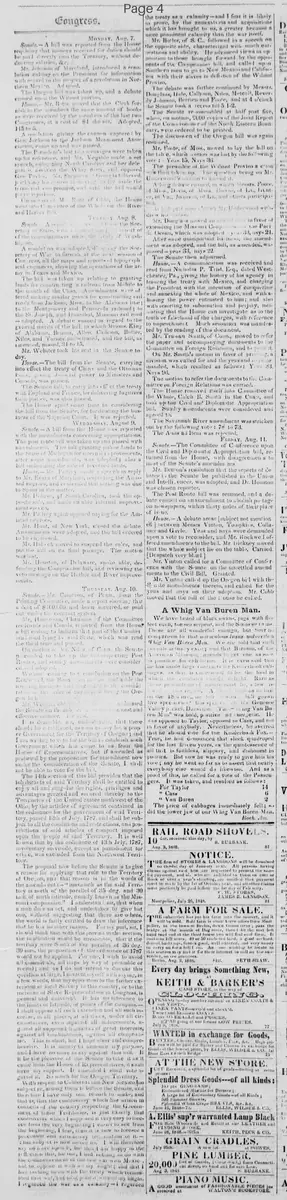
Detailed reports of U.S. Congress sessions from August 7-11, including Senate and House debates on the Oregon bill with Wilmot Proviso, appropriations, treaties with China and England, post routes, internal improvements, and speeches by figures like Calhoun, Benton, and Webster.
Clipping
OCR Quality
Full Text
Monday, Aug. 7.
Senate.— A bill was reported from the House requiring that moneys received for duties should be paid directly into the Treasury, without deducting salaries, &c.
Mr. Johnson of Maryland, introduced a resolution calling on the President for information with regard to the project of a revolution in Northern Mexico. Adopted.
The Oregon bill was taken up, and a debate ensued upon the Wilmot proviso.
House.— Mr. B. moved that the Clerk furnish to the members the same amount of books as were received by the members of the last two Congresses, at a cost of $1 the set. Adopted. 115 to 5.
A resolution giving the cannon captured by Gen. Jackson to the Jackson Monument Association, came up and was passed.
The President's last messages were taken up for reference, and Mr. Venable made a set speech, eulogizing North Carolina and her delegation, assailed the Whig party, and opposed Gen. Taylor. Mr. Stephens replied, in justification of the course made the compromise, and said the bill would carry M. R. to the White House on the shoulders of the River and Harbor men. Thursday night.
Senate.— The Secretary of State, Mr. Buchanan, communicated to the Senate a report of the commissioners on the northeastern boundary.
A resolution was adopted, directing the Secretary of War to furnish, at the next session of Congress, all the maps and reports of the topographical engineers, showing the operations of the army in Texas and Mexico.
The bill was taken up relating to granting lands for constructing a railroad from Mobile to the mouth of the Ohio. Amendments were offered making similar grants for constructing railroads from Jackson, Miss. to the Alabama river; to the Montgomery and Westfield railroad; to the St. Joseph and Weston, Missouri railroad—adopted. A debate ensued in regard to the general merits of the bill, in which Messrs. King of Alabama, Benton, Allen, Calhoun, Butler, Niles, and Turney participated, and the bill, as amended, passed, 31 to 15.
Mr. Webster took his seat in the Senate today.
House.—The bill from the Senate, carrying into effect the treaty of China and the Ottoman Empire, giving consular power to Ministers and Consuls, was passed.
The Senate bill, to carry into effect the treaty with England and France, for extradition of fugitives for justice, was also passed.
The House spent some time in considering the bill from the Senate, for facilitating the business of the Supreme Court. It was rejected.
Wednesday, August 9.
Senate—A bill from the House was reported with the usual amendments concerning appropriations.
The post route bill was taken up and passed with amendments. The bill granting public lands to the State of Michigan for internal improvements, after some amendment, was adopted; also a bill appropriating $500,000 for the suppression of the slave trade.
House.—Mr. Bayly made a speech in reply to Mr. Brooks of Maryland, setting forth the alias and negroes, and exhibited that the drought was due to rain in the matter.
Mr. Poinsett, of South Carolina, took the opposite side, and made an able internal improvements speech.
Mr. Bayly again opposed paying for the Alabama regiment.
Mr. Hunt, of New York, closed the debate.
Amendments were adopted, and the bill ordered to be engrossed.
Mr. Job Ticknor moved to suspend the rules, and put the bill on its final passage. The motion was lost.
Mr. Houston, of Delaware, spoke ably, defending the Compromise bill, and reviewing the veto message on the harbor and river improvements.
Thursday, Aug. 10.
Senate—Mr. Cameron, of Pennsylvania, from the Printing Committee, made a report showing that a debt of $6000 had been incurred, or paid out under the contract system.
Mr. Hale, Chairman of the Committee on Roads and Canals, reported from the House a bill ceding to Indiana that portion of the Cumberland land road lying in that State, which was read the second time and passed.
The Senate acceded to take up the bill reorganizing Post Office Rules, and sundry disagreements were considered and adopted.
Washington came to a conclusion on the Post Office bill.
The Oregon bill was addressed to the Senate on the whole.
It is desirable that there should be established, as soon as may be, a proper Government for the Territory of Oregon; and I am willing to vote for the bill to establish such Government which has come to us from the House of Representatives, but if amended as proposed by the proposition for amendment now under the consideration of the Senate, I shall not be able to vote for the bill.
The 14th section of this bill provides that the inhabitants of said Territory shall be entitled to enjoy all and singular the rights, privileges and advantages granted and secured thereby to the Territories of the United States northwest of the Ohio, by the articles of agreement contained in the ordinance for the government of said Territory, passed 13th of July, 1787, and shall be subject to all the conditions and restrictions, and prohibitions of said articles of compact imposed upon the people of said Territory. It is well known that by the ordinance of 13th July, 1787, involuntary servitude, except as punishment for crime, was excluded from the Northwest Territory.
The proposal now before the Senate is to give a reason for applying that rule to the Territory of Oregon, and that reason is in the words of the amendment:—'inasmuch as the said Territory is north of the parallel of 36 deg. 30 min. north latitude, usually known as the Missouri compromise.' I understand, sir, that when a man does an act, and undertakes to give but one reason, without suggesting that there are others, the world is fairly entitled to draw the inference that he has no other reason. For my part, sir, I should think that with this proviso in the section, the implication would be irresistible, that if the territory were south of the parallel of 36 deg. 30 min. the proposition of the ordinance of 1787 would not be applied. For one, I wish to avoid all cavils, all traps by way of preamble or recital; and as I do not intend to discuss this question at large, I content myself with saying, a few words, that my opposition to the further extension of local slavery in this country, or to the increase of Slave Representation in Congress, is general and universal. It has no reference to the points of latitude, or points of the compass.— I shall oppose all such extension and all such increase, in all places, at all times, under all circumstances, even against all inducements, against all combinations, against all compromise. This is short, but I hope clear and comprehensive. It is merely to announce my purpose, and I have no more to say against this bill. If it be the pleasure of the Senate to take it as it came from the House of Representatives, it shall have my support. If amended I shall vote against it. So much for the Oregon Territory.
With respect to California and New Mexico—no subject regarding them is now before the Senate, and therefore I have only one remark to make, and that is, that the controversy which has arisen in the councils of the country respecting the Government of those Territories, is just exactly that controversy which I supposed it very easy to foresee from the very beginning; Easier to see from the beginning, I fear, than it is now to foresee a peaceable and satisfactory termination of it.— That subject is now before us. I will therefore say no more upon it, but that I am happy in the conclusion that, for me, I had nothing to do with the commencement of the Mexican war when Mexico, but to oppose it with all my might; and that I had nothing to do with the treaty which terminated that war, but to oppose it with all my might. I regarded the war as a calamity—I regarded the treaty as a calamity—and I fear it is likely to prove, by the annexations and acquisitions which it has brought to us, a greater because a more prominent calamity than the war itself.
Mr. Butler, of S. C., followed in a speech on the opposite side, characterized with much earnestness and ability. He advanced views in opposition to those brought forward by the opponents of the Compromise bill, and called upon Southern men to go to New Mexico and California with their slaves in defiance of the Wilmot Proviso.
The debate was further continued by Messrs. Douglas, Hale, Calhoun, Niles, Metcalfe, Reverdy Johnson, Berrien and Foote, and at 4 o'clock the Senate took a recess til 5 1-2.
The Senate re-assembled at half past five, when, on motion, 5000 copies of the Joint Report of the Commissioners of the North Eastern Boundary, were ordered to be printed.
The discussion of the Oregon bill was again resumed.
Mr. Foote, of Miss., moved to lay the bill on the table, which motion was lost by the following vote: — Yeas 15, Nays 36.
The preamble of the Wilmot Proviso section was then taken up. The question being on Mr. Underwood's motion to amend it.
A long debate ensued, in which Messrs. Foote of Miss., Davis, of Mass., Jones, of La., Hunter, of Va., Jonas, of La., and others participated.
Mr. Douglas moved an amendment in favor of extending the Missouri Compromise to the Pacific Ocean, which was adopted—yeas 33, nays 21.
After some unimportant business, the amendment was adopted, and the bill, as amended, was passed—yeas 33, nays 22.
The Senate then adjourned.
House.—A Communication was received and read from Nicholas P. Trist, Esq., dated West Chester, Pa., giving the history of his agency in framing the treaty with Mexico, and charging the President with the intention of conquering and annexing the whole of Mexico, and with abusing the power entrusted to him; and also with resorting to subornation and perjury, intimating that the House can investigate as to the truth or falsehood of the charges, with reference to impeachment. Much sensation was manifested by the reading of this document.
Mr. Truman Smith, of Conn., moved to refer the paper and accompanying documents to the Committee on Foreign Relations, and to print it.
On Mr. Smith's motion in favor of printing, a division was called for and the yeas and nays demanded, which resulted as follows: Yeas 33, Nays 96.
The motion to refer the documents to the Committee on Foreign Relations was carried.
The House resolved itself into Committee of the Whole, Caleb B. Smith in the Chair, and took up the Civil and Diplomatic Appropriation bill. Sundry amendments were considered and agreed to.
The Savannah River amendment was stricken out by the following vote: 78 to 73.
The Army and Navy Item was rejected.
Friday, Aug. 11.
Senate—The Committee of Conference upon the Civil and Diplomatic Appropriation bill, returned from the House, with disagreements as to most of the Senate's amendments.
Mr. Benton's resolution that the reports of debates in the Senate be published in the Union and Intelligencer, was adopted, and Dr. Houston was chosen reporter.
The Post Route bill was resumed, and a debate ensued on an amendment to abolish postage on newspapers, within thirty miles of their place of issue.
House.— A debate arose [subject not mentioned] between Messrs. Vinton, Tompkins, Collamer and Gayle. Yeas and nays were demanded upon a vote to reconsider, and Mr. Rockwell offered amendments to the bill. Mr. Dickey moved that the whole subject lie on the table. Carried.
[Despatch very blind.]
Mr. Vinton called for a Committee of Conference with the Senate on the unsettled amendments to the Civil Bill. Granted.
Mr. Vinton called up the Oregon bill with the Senate amendments thereto, and called for the yeas and nays on their adoption. Mr. Cobb moved that the roll of the House be called.
What sub-type of article is it?
What keywords are associated?
What entities or persons were involved?
Where did it happen?
Domestic News Details
Primary Location
Washington
Event Date
August 7 11
Key Persons
Outcome
various bills passed or rejected, including oregon bill (33-22), railroad land grants (31-15), treaties with china and ottoman empire passed, extradition treaty passed, supreme court bill rejected, post route bill passed with amendments, michigan lands granted, $500,000 for slave trade suppression, trist communication referred to committee (printing rejected 33-96).
Event Details
Congressional proceedings over several days involved debates and votes on bills related to treasury duties, Mexican revolution info, Oregon territorial government with Wilmot Proviso and slavery extensions, railroad land grants, treaties, appropriations, post routes, internal improvements, and a communication from Nicholas P. Trist accusing the President.