Thank you for visiting SNEWPapers!
Sign up free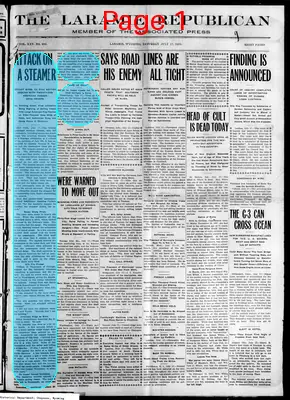
The Laramie Republican
Laramie, Albany County, Wyoming
What is this article about?
On July 9, 1915, a German U-boat attacked the British liner Orduna, carrying 21 Americans, without warning off the Atlantic. A torpedo and seven shells missed; the sub gave up chase. No injuries. Reported in NY July 17; shocks US officials amid Lusitania tensions.
Merged-components note: Continuation of the article on the German submarine attack on the British steamer Orduna.
Clipping
OCR Quality
Full Text
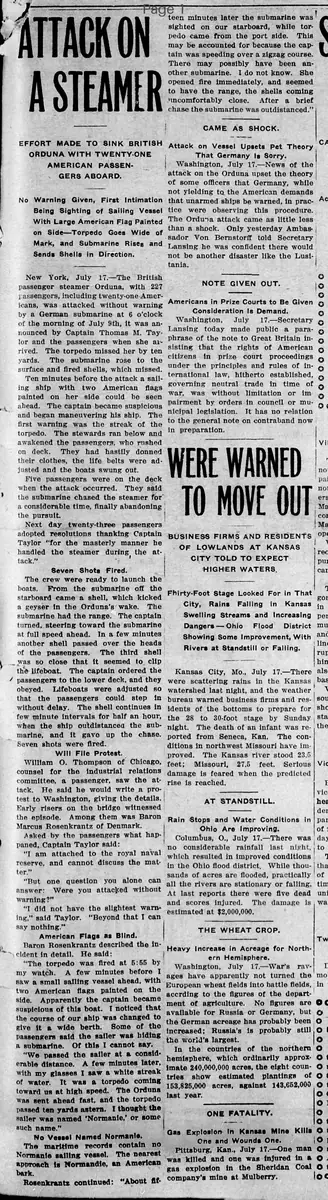
EFFORT MADE TO SINK BRITISH ORDUNA WITH TWENTY-ONE AMERICAN PASSENGERS ABOARD.
No Warning Given, First Intimation Being Sighting of Sailing Vessel With Large American Flag Painted on Side—Torpedo Goes Wide of Mark, and Submarine Rises and Sends Shells in Direction.
New York, July 17.—The British passenger steamer Orduna, with 227 passengers, including twenty-one Americans, was attacked without warning by a German submarine at 6 o'clock of the morning of July 9th, it was announced by Captain Thomas M. Taylor and the passengers when she arrived. The torpedo missed her by ten yards. The submarine rose to the surface and fired shells, which missed.
Ten minutes before the attack a sailing ship with two American flags painted on her side could be seen ahead. The captain became suspicious and began maneuvering his ship. The first warning was the streak of the torpedo. The stewards ran below and awakened the passengers, who rushed on deck. They had hastily donned their clothes, the life belts were adjusted and the boats swung out.
Five passengers were on the deck when the attack occurred. They said the submarine chased the steamer for a considerable time, finally abandoning the pursuit.
Next day twenty-three passengers adopted resolutions thanking Captain Taylor "for the masterly manner he handled the steamer during the attack."
Seven Shots Fired.
The crew were ready to launch the boats. From the submarine off the starboard came a shell, which kicked a geyser in the Orduna's wake. The submarine had the range. The captain turned, steering toward the submarine at full speed ahead. In a few minutes another shell passed over the heads of the passengers. The third shell was so close that it seemed to clip the lifeboat. The captain ordered the passengers to the lower deck, and they obeyed. Lifeboats were adjusted so that the passengers could step in without delay. The shells continued in few minute intervals for half an hour, when the ship outdistanced the submarine, and it gave up the chase.
Seven shots were fired.
Will File Protest.
William O. Thompson of Chicago, counsel for the industrial relations committee, a passenger, saw the attack. He said he would write a protest to Washington, giving the details.
Early risers on the bridge witnessed the episode. Among them was Baron Marcus Rosenkrantz of Denmark.
Asked by the passengers what happened, Captain Taylor said:
"I am attached to the royal naval reserve, and cannot discuss the matter."
"But one question you alone can answer: Were you attacked without warning?"
"I did not have the slightest warning," said Taylor. "Beyond that I can say nothing."
American Flags as Blind.
Baron Rosenkrantz described the incident in detail. He said:
"The torpedo was fired at 5:55 by my watch. A few minutes before I saw a small sailing vessel ahead, with two American flags painted on the side. Apparently the captain became suspicious of this boat. I noticed that the course of our ship was changed to give it a wide berth. Some of the passengers said the sailer was hiding a submarine. Of this I cannot say.
"We passed the sailer at a considerable distance. A few minutes later, with my glasses I saw a white streak of water. It was a torpedo coming toward us at high speed. The Orduna was sent ahead fast, and the torpedo passed ten yards astern. I thought the sailer was named 'Normanie,' or some such name."
No Vessel Named Normanie.
The maritime records contain no Normanie sailing vessel. The nearest approach is Normandie, an American bark.
Rosenkrantz continued: "About fifteen minutes later the submarine was sighted on our starboard, while torpedo came from the port side. This may be accounted for because the captain was speeding over a zigzag course. There may possibly have been another submarine. I do not know. She opened fire immediately, and seemed to have the range, the shells coming uncomfortably close. After a brief chase the submarine was outdistanced."
CAME AS SHOCK.
Attack on Vessel Upsets Pet Theory That Germany Is Sorry.
Washington, July 17.—News of the attack on the Orduna upset the theory of some officers that Germany, while not yielding to the American demands that unarmed ships be warned, in practice were observing this procedure.
The Orduna attack came as little less than a shock. Only yesterday Ambassador Von Bernstorff told Secretary Lansing he was confident there would not be another disaster like the Lusitania.
What sub-type of article is it?
What keywords are associated?
What entities or persons were involved?
Foreign News Details
Event Date
July 9th
Key Persons
Outcome
torpedo missed by ten yards; seven shells fired, all missed; no casualties; submarine abandoned pursuit after half an hour.
Event Details
The British passenger steamer Orduna, carrying 227 passengers including twenty-one Americans, was attacked without warning by a German submarine at 6 a.m. on July 9th. A suspicious sailing vessel with two American flags painted on its side was sighted ten minutes prior. The torpedo missed astern, after which the submarine surfaced and fired seven shells that also missed. Captain Taylor maneuvered the ship at full speed, zigzagging, and outdistanced the submarine. Passengers prepared lifeboats but were unharmed. The incident was reported upon arrival in New York on July 17th, prompting a passenger to file a protest and upsetting theories about German adherence to warnings for unarmed ships.