Thank you for visiting SNEWPapers!
Sign up free
Editorial
August 18, 1890
The Indianapolis Journal
Indianapolis, Marion County, Indiana
What is this article about?
Article quotes President Harrison's inaugural and congressional message advocating federal supervision of elections to ensure free ballot and fair count, especially protecting colored voters' rights, and affirms his unchanged support for an election bill.
Clipping
OCR Quality
98%
Excellent
Full Text
In Favor of a Free Ballot.
Special to the Indianapolis Journal.
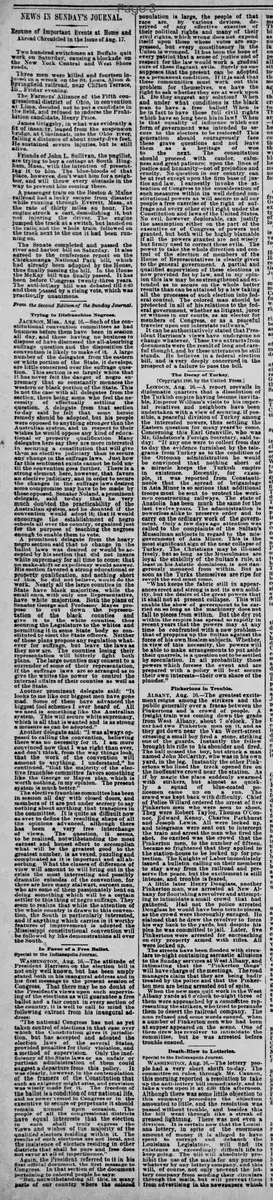
WASHINGTON, Aug. 16.—The attitude of President Harrison on the election bill is not only well known, but has been amply stated both in his inaugural address and in his first message to the present session of Congress. That there may be no doubt of the President's views upon such supervising of the elections as will guarantee a free ballot and a fair count in every section of the country, it is well to call to mind the following extract from his inaugural address:
"The national Congress has not as yet taken control of elections in that case over which the Constitution gives it jurisdiction, but has accepted and adopted the election laws of the several States, provided penalties for their violation, and a method of supervision. Only the inefficiency of the State laws or an unfair or partisan administration of them could suggest a departure from this policy. It was clearly, however, in the contemplation of the framers of the Constitution that such an exigency might arise, and provision was wisely made for it. The freedom of the ballot is a condition of our national life. and no power vested in Congress or in the executive to secure or perpetuate it should remain unused upon occasion. The people of all the congressional districts have equal interests that the election in each shall truly express the views and wishes of the majority of the qualified electors residing within it. The results of such elections are not local, and the insistence of electors residing in other districts that shall be pure and free does not savor at all of impertinence."
Again, the President referred to it in his first official document, the first message to Congress. In that section of the document pertaining to colored people he says:
"But, notwithstanding all this, in many parts of our country where the colored population is large, the people of that race are, by various devices, deprived of any effective exercise of their political rights and many of their civil rights, which wrong does not expend itself upon those whose votes are suppressed, but every constituency in the Union is wronged. It has been the hope of every patriot that a sense of justice and of respect for the law would work a gradual cure of these flagrant evils. Surely no one supposes that the present can be adopted as a permanent condition. If it is said that these communities must work out this problem for themselves, we have the right to ask whether they are at work upon it. Do they suggest any solution? When and under what conditions is the black man to have a free ballot? When is he in fact to have those full civil rights which have so long been his in law? When is that equality of influence which our form of government was intended to secure to the electors to be restored? This generation should courageously face these grave questions and not leave them as a heritage of woe to the next. The consultation should proceed with candor, calmness and great patience; upon the lines of justice and humanity—not of prejudice and cruelty. No question in our country can be at rest except upon the firm base of justice and law. I earnestly invoke the attention of Congress to the consideration of such measures within its well defined constitutional powers as will secure to all our people a free exercise of the right of suffrage and every other civil right under the Constitution and laws of the United States. No evil, however deplorable, can justify the assumption either on the part of the executive or of Congress of powers not granted, but both will be highly blamable if all the powers granted are not wisely but firmly used to correct these evils. The power to take the whole direction and control of the election of members of the House of Representatives is clearly given to the general government. A partial and qualified supervision of these elections is now provided for by law, and in my opinion this law may be so strengthened and extended as to secure on the whole better results than can be attained by a law taking all the processes of such election into federal control. The colored man should be protected in all of his relations to the federal government, whether as litigant, juror or witness in our courts, as an elector for members of Congress, or as a peaceful traveler upon our interstate railways."
It can be authoritatively stated that President Harrison's views have undergone no change whatever. These two extracts from documents were the result of long and careful thought, and by these utterances he still stands. He believes in a federal election bill, and is very deeply concerned in the prospect of a failure to pass the bill.
Special to the Indianapolis Journal.
WASHINGTON, Aug. 16.—The attitude of President Harrison on the election bill is not only well known, but has been amply stated both in his inaugural address and in his first message to the present session of Congress. That there may be no doubt of the President's views upon such supervising of the elections as will guarantee a free ballot and a fair count in every section of the country, it is well to call to mind the following extract from his inaugural address:
"The national Congress has not as yet taken control of elections in that case over which the Constitution gives it jurisdiction, but has accepted and adopted the election laws of the several States, provided penalties for their violation, and a method of supervision. Only the inefficiency of the State laws or an unfair or partisan administration of them could suggest a departure from this policy. It was clearly, however, in the contemplation of the framers of the Constitution that such an exigency might arise, and provision was wisely made for it. The freedom of the ballot is a condition of our national life. and no power vested in Congress or in the executive to secure or perpetuate it should remain unused upon occasion. The people of all the congressional districts have equal interests that the election in each shall truly express the views and wishes of the majority of the qualified electors residing within it. The results of such elections are not local, and the insistence of electors residing in other districts that shall be pure and free does not savor at all of impertinence."
Again, the President referred to it in his first official document, the first message to Congress. In that section of the document pertaining to colored people he says:
"But, notwithstanding all this, in many parts of our country where the colored population is large, the people of that race are, by various devices, deprived of any effective exercise of their political rights and many of their civil rights, which wrong does not expend itself upon those whose votes are suppressed, but every constituency in the Union is wronged. It has been the hope of every patriot that a sense of justice and of respect for the law would work a gradual cure of these flagrant evils. Surely no one supposes that the present can be adopted as a permanent condition. If it is said that these communities must work out this problem for themselves, we have the right to ask whether they are at work upon it. Do they suggest any solution? When and under what conditions is the black man to have a free ballot? When is he in fact to have those full civil rights which have so long been his in law? When is that equality of influence which our form of government was intended to secure to the electors to be restored? This generation should courageously face these grave questions and not leave them as a heritage of woe to the next. The consultation should proceed with candor, calmness and great patience; upon the lines of justice and humanity—not of prejudice and cruelty. No question in our country can be at rest except upon the firm base of justice and law. I earnestly invoke the attention of Congress to the consideration of such measures within its well defined constitutional powers as will secure to all our people a free exercise of the right of suffrage and every other civil right under the Constitution and laws of the United States. No evil, however deplorable, can justify the assumption either on the part of the executive or of Congress of powers not granted, but both will be highly blamable if all the powers granted are not wisely but firmly used to correct these evils. The power to take the whole direction and control of the election of members of the House of Representatives is clearly given to the general government. A partial and qualified supervision of these elections is now provided for by law, and in my opinion this law may be so strengthened and extended as to secure on the whole better results than can be attained by a law taking all the processes of such election into federal control. The colored man should be protected in all of his relations to the federal government, whether as litigant, juror or witness in our courts, as an elector for members of Congress, or as a peaceful traveler upon our interstate railways."
It can be authoritatively stated that President Harrison's views have undergone no change whatever. These two extracts from documents were the result of long and careful thought, and by these utterances he still stands. He believes in a federal election bill, and is very deeply concerned in the prospect of a failure to pass the bill.
What sub-type of article is it?
Suffrage
Constitutional
Social Reform
What keywords are associated?
Free Ballot
Election Bill
Federal Supervision
Civil Rights
Suffrage
Colored Voters
President Harrison
What entities or persons were involved?
President Harrison
Congress
Colored People
Editorial Details
Primary Topic
Support For Federal Election Supervision To Ensure Free Ballot
Stance / Tone
Strongly Supportive Of Federal Election Bill
Key Figures
President Harrison
Congress
Colored People
Key Arguments
National Congress Should Supervise Elections Where Constitution Gives Jurisdiction To Guarantee Free Ballot And Fair Count
Inefficiency Or Partisan Administration Of State Laws Justifies Federal Intervention
Freedom Of The Ballot Is Essential To National Life And Must Be Secured
Colored People Are Deprived Of Political And Civil Rights In Many Areas, Wronging The Entire Union
Federal Government Has Power To Control House Elections And Should Strengthen Supervision Laws
Colored Man Should Be Protected In Relations To Federal Government Including As Elector