Thank you for visiting SNEWPapers!
Sign up free
Story
August 12, 1854
Sunbury American
Sunbury, Northumberland County, Pennsylvania
What is this article about?
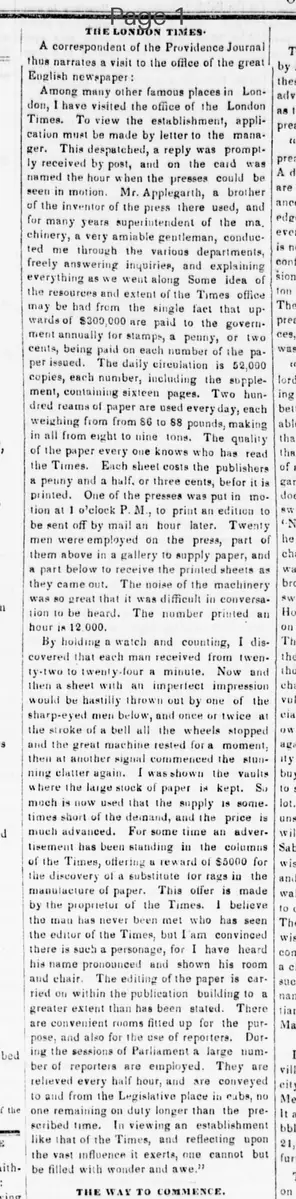
A correspondent visits the London Times office, guided by Mr. Applegarth, describing its vast operations: 52,000 daily copies, massive paper usage, printing presses producing 12,000 sheets per hour, reporter systems during Parliament, and the paper's influential awe.
Clipping
OCR Quality
95%
Excellent
Full Text
The London Times:
A correspondent of the Providence Journal
thus narrates a visit to the office of the great
English newspaper:
Among many other famous places in London,
I have visited the office of the London
Times. To view the establishment, application
must be made by letter to the manager. This despatched, a reply was promptly
received by post, and on the card was
named the hour when the presses could be
seen in motion. Mr. Applegarth, a brother
of the inventor of the press there used, and
for many years superintendent of the
machinery, a very amiable gentleman, conducted
me through the various departments,
freely answering inquiries, and explaining
everything as we went along. Some idea of
the resources and extent of the Times office
may be had from the single fact that upwards
of $300,000 are paid to the government
annually for stamps, a penny, or two
cents, being paid on each number of the paper
issued. The daily circulation is 52,000
copies, each number, including the supplement,
containing sixteen pages. Two hundred
reams of paper are used every day, each
weighing from 86 to 88 pounds, making
in all from eight to nine tons. The quality
of the paper every one knows who has read
the Times. Each sheet costs the publishers
a penny and a half, or three cents, before it is
printed. One of the presses was put in motion
at 1 o'clock P. M., to print an edition to
be sent off by mail an hour later. Twenty
men were employed on the press, part of
them above in a gallery to supply paper, and
a part below to receive the printed sheets as
they came out. The noise of the machinery
was so great that it was difficult in conversation
to be heard. The number printed an
hour is 12,000.
By holding a watch and counting, I discovered
that each man received from twenty-two
to twenty-four a minute. Now and
then a sheet with an imperfect impression
would be hastily thrown out by one of the
sharp-eyed men below, and once or twice at
the stroke of a bell all the wheels stopped
and the great machine rested for a moment,
then at another signal commenced the stunning
clatter again. I was shown the vaults
where the large stock of paper is kept. So
much is now used that the supply is sometimes
short of the demand, and the price is
much advanced. For some time an advertisement
has been standing in the columns
of the Times, offering a reward of $5000 for
the discovery of a substitute for rags in the
manufacture of paper. This offer is made
by the proprietor of the Times. I believe
the man has never been met who has seen
the editor of the Times, but I am convinced
there is such a personage, for I have heard
his name pronounced and shown his room
and chair. The editing of the paper is carried
on within the publication building to a
greater extent than has been stated. There
are convenient rooms fitted up for the purpose,
and also for the use of reporters. During
the sessions of Parliament a large number
of reporters are employed. They are
relieved every half hour, and are conveyed
to and from the Legislative place in cabs, no
one remaining on duty longer than the prescribed
time. In viewing an establishment
like that of the Times, and reflecting upon
the vast influence it exerts, one cannot but
be filled with wonder and awe.
A correspondent of the Providence Journal
thus narrates a visit to the office of the great
English newspaper:
Among many other famous places in London,
I have visited the office of the London
Times. To view the establishment, application
must be made by letter to the manager. This despatched, a reply was promptly
received by post, and on the card was
named the hour when the presses could be
seen in motion. Mr. Applegarth, a brother
of the inventor of the press there used, and
for many years superintendent of the
machinery, a very amiable gentleman, conducted
me through the various departments,
freely answering inquiries, and explaining
everything as we went along. Some idea of
the resources and extent of the Times office
may be had from the single fact that upwards
of $300,000 are paid to the government
annually for stamps, a penny, or two
cents, being paid on each number of the paper
issued. The daily circulation is 52,000
copies, each number, including the supplement,
containing sixteen pages. Two hundred
reams of paper are used every day, each
weighing from 86 to 88 pounds, making
in all from eight to nine tons. The quality
of the paper every one knows who has read
the Times. Each sheet costs the publishers
a penny and a half, or three cents, before it is
printed. One of the presses was put in motion
at 1 o'clock P. M., to print an edition to
be sent off by mail an hour later. Twenty
men were employed on the press, part of
them above in a gallery to supply paper, and
a part below to receive the printed sheets as
they came out. The noise of the machinery
was so great that it was difficult in conversation
to be heard. The number printed an
hour is 12,000.
By holding a watch and counting, I discovered
that each man received from twenty-two
to twenty-four a minute. Now and
then a sheet with an imperfect impression
would be hastily thrown out by one of the
sharp-eyed men below, and once or twice at
the stroke of a bell all the wheels stopped
and the great machine rested for a moment,
then at another signal commenced the stunning
clatter again. I was shown the vaults
where the large stock of paper is kept. So
much is now used that the supply is sometimes
short of the demand, and the price is
much advanced. For some time an advertisement
has been standing in the columns
of the Times, offering a reward of $5000 for
the discovery of a substitute for rags in the
manufacture of paper. This offer is made
by the proprietor of the Times. I believe
the man has never been met who has seen
the editor of the Times, but I am convinced
there is such a personage, for I have heard
his name pronounced and shown his room
and chair. The editing of the paper is carried
on within the publication building to a
greater extent than has been stated. There
are convenient rooms fitted up for the purpose,
and also for the use of reporters. During
the sessions of Parliament a large number
of reporters are employed. They are
relieved every half hour, and are conveyed
to and from the Legislative place in cabs, no
one remaining on duty longer than the prescribed
time. In viewing an establishment
like that of the Times, and reflecting upon
the vast influence it exerts, one cannot but
be filled with wonder and awe.
What sub-type of article is it?
Curiosity
Historical Event
What themes does it cover?
Triumph
Social Manners
What keywords are associated?
London Times
Newspaper Office
Printing Press
Daily Circulation
Parliament Reporters
Paper Shortage
What entities or persons were involved?
Mr. Applegarth
Where did it happen?
London, Office Of The London Times
Story Details
Key Persons
Mr. Applegarth
Location
London, Office Of The London Times
Story Details
A visitor is guided through the Times office, observing its massive printing operations, paper usage, staff, and editorial setup, marveling at its influence and scale.