Thank you for visiting SNEWPapers!
Sign up free
The Indianapolis Journal
Indianapolis, Marion County, Indiana
What is this article about?
European efforts to remove rapids at the Danube's Iron Gate for better navigation face Austrian political opposition, suspending 1883 plans despite agreements with Hungary, Servia, and Roumania. The project, of interest to commercial nations, aims to improve trade on the vital river.
Clipping
OCR Quality
Full Text
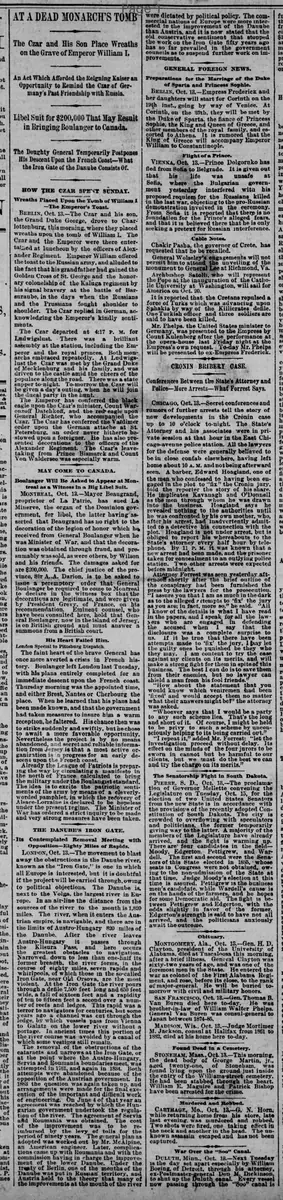
—Its Contemplated Removal Meeting with Opposition—Eighty Miles of Rapids.
LONDON, Oct. 13.—The movement to blast away the obstructions in the Danube river, known as the "Iron Gate," is one in which all Europe is interested, but it is doubtful if the project will be carried through, owing to political objections. The Danube is, next to the Volga, the largest river in Europe. In an air-line the distance from the sources of the river to the mouth is 1,820 miles. The river, when it enters the Austrian empire, is navigable, and there are in the limits of Austro-Hungary 820 miles of the Danube. After the river leaves Austro-Hungary it passes through the Klisura Pass, and here occurs the greatest obstacles to navigation. Narrowed down to less than one-half its former breadth, the river forms, in the course of eighty miles, seven rapids and whirlpools, of which those in the so-called Iron Gate, near old Orsova, are the most violent. At the Iron Gate the river pours through a defile 7,500 feet long and 650 feet wide, a fall of sixteen feet and a rapidity of ten to fifteen feet a second over a number of reefs and ledges. This rapid was a terror to navigators for centuries, but some years ago a channel was cut through the ledge, by which vessels pass from Vienna to Galatz on the lower river without a portage. In ancient times this portion of the river course was avoided by a canal of which some vestiges still remain. The removal of the obstructions of the cataracts and narrows at the Iron Gate, or at the point where the Austro-Hungary, Servia and Roumania boundaries meet, was attempted in 1781, and again in 1834. Both attempts were abandoned because of the opposition of the Austrian government. In 1883 the question was again taken up, and arrangements were made for the final execution of the important and difficult work of engineering. On June 4 of that year an agreement was reached by which the Hungarian government undertook the regulation of the river. The agreement of Servia and Roumania was obtained. The cost of the improvement was to be reimbursed by the levy of tolls for the period of ninety years. The general plan as adopted was worked out by Mr. McAlpine, an American engineer. Later, complications came up with Roumania and with the commission having in charge the improvement of the lower Danube. Under the treaty of Berlin, one of the mouths of the Danube was put in Russian territory, and Austria held to the theory that many of the improvements at the mouth of the river were dictated by political policy. The commercial nations of Europe were more interested in the improvement of the Danube than Austria, and it is now stated that the old conservative sentiment that stopped the work on the Iron Gate fifty years ago has so far prevailed in the government councils as to suspend further work on improvements.
What sub-type of article is it?
What keywords are associated?
What entities or persons were involved?
Where did it happen?
Foreign News Details
Primary Location
Iron Gate, Danube
Event Date
London, Oct. 13
Key Persons
Outcome
the project to remove obstructions at the iron gate has been suspended due to political opposition from austria, despite agreements with hungary, servia, and roumania in 1883.
Event Details
The movement to blast away obstructions in the Danube river at the Iron Gate faces opposition, potentially halting the project despite European interest. The Danube spans 1,820 miles, with 820 miles navigable in Austro-Hungary. The Iron Gate features violent rapids over 80 miles. Past attempts in 1781 and 1834 failed due to Austrian opposition. In 1883, agreements were made for improvements, planned by American engineer Mr. McAlpine, with costs recovered via tolls over 90 years, but complications with Roumania and the lower Danube commission, influenced by the Treaty of Berlin, have led to suspension.