Thank you for visiting SNEWPapers!
Sign up free
Seattle Daily Post Intelligencer
Seattle, King County, Washington
What is this article about?
In Pittsburg, Pennsylvania, on April 11, detectives expose a multi-year scheme by railroad employees stealing $300,000 in freight from Pan Handle trains, leading to mass arrests of 56 conductors and brakemen amid recovered goods and confessions.
Clipping
OCR Quality
Full Text
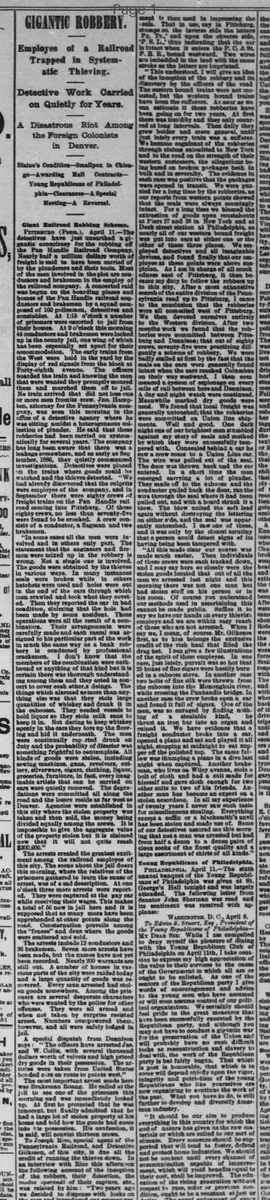
Employes of a Railroad Trapped in Systematic Thieving: Detective Work Carried on Quietly for Years.
A Disastrous Riot Among the Foreign Colonists in Denver.
Boin Condition-Smallpox b Gie s•-Awarltx Coataucta Ioan Repaliow K PaD-4sl Dhi--Cloerzmoos-ASpodi-l Kootlme-a Roouml.
Giant Railroad Robbing Scheme.
Pittsburg (Penn.), April 11.-The detectives have just unearthed a gigantic conspiracy for the robbing of the Pan Handle Railroad Company. Nearly half a million dollars worth of freight is said to have been carried off by the plunderers and their tools. Most of the men involved in the plot are conductors and brakemen in the employ of the railroad company. A concerted raid was begun on the boarding places and homes of the Pan Handle railroad conductors and brakemen by a squad composed of 100 policemen, detectives and constables. At 1:15 o'clock a number of prisoners were escorted to jail from their homes. At 9 o'clock this morning 44 conductors and brakemen were locked up in the county jail, one wing of which has been especially set apart for their accommodation. The early trains from the West were held in the yard by the display of red signals from the block at Forty-eighth avenue. The officers boarded the train and knowing the men that were wanted they promptly secured them and marched them off to jail. No train arrived that did not lose one or more men from its crew. Jno. Hampton, attorney for the Pennsylvania company, was seen this morning in the office of a detective agency where he was sitting amidst a heterogeneous collection of plunder. He said that these robberies had been carried on systematically for several years. The company has long been aware that there was a leakage somewhere, and as early as September, 1886, they quietly commenced investigations. Detectives were placed on the trains where goods could be watched and the thieves detected. We had already discovered that the culprits were employes of the company, and in September there were eighty crews of freight trains on the Pan Handle rail road coming into Pittsburg. Of these eighty crews, no less than seventy-five were found to be crooked. A crew consists of a conductor, a flagman and two brakemen. In some cases all the men were involved and in others only part. The statement that the engineers and firemen were mixed up in the robbery is wrong. Not a single one is involved. The goods were obtained by the thieves in various ways. In many instances seals were broken while in others hatchets were used and holes were cut in the end of the cars through which men crawled and took what they coveted. Then they reported the car in bad condition, claiming that the hole had been made by some accident. These operations were all the result of a combination. Their arrangements were carefully made and each rascal was assigned to his particular part of the work in much the same way as a bank robbery is conducted by professional cracksmen. I don't know that the members of the combination were oath bound or anything of that kind but it is certain there was thorough understanding among them and they acted in concert to cover each other's doings. The things which alarmed us more than anything else was that they stole large quantities of whiskey and drank it in the cabooses. They needed vessels to hold liquor so they stole milk cans to keep it in. Not daring to keep whiskey openly in the cars they tore up the flooring and hid it underneath. The men were continually reported drunk on duty and the probability of disaster was something frightful to contemplate. All kinds of goods were stolen, including sewing machines, guns, revolvers, cutlery, silverware, cigars, clothing, liquor, groceries, furniture, in fact, every imaginable article that can be carried on cars were quietly removed. The depredations were committed all along the road and the robbers reside as far west as Denver. Agencies were established in this city where the stolen property was taken and then sold, the money being divided equally among the crews. It is impossible to give the aggregate value of the property stolen but it is claimed now that it will not quite reach $300,000. The arrests created the greatest excitement among the railroad employes of this city. The scene about the jail doors this morning, where the relatives of the prisoners gathered to learn the cause of arrest, was of a sad description. At one o'clock three more arrests were reported. They were captured at the pay car while receiving their wages. This makes a total of 56 now in jail here and it is supposed that as many more have been apprehended at other points along the road. Consternation prevails among the fences and dens where the goods were scattered and sold. The arrests include 12 conductors and 36 brakemen. Seven more arrests have been made, but the names have not yet been recorded. Nearly 200 warrants are still out. A number of houses in various parts of the city were raided today and a large quantity of goods was recovered. Every man arrested had stolen goods somewhere. Among the prisoners are several desperate characters who were wanted by the police for other offenses. They were all armed and when not taken by surprise resisted arrest. Numbers overpowered them, however, and all were safely lodged in jail. A special dispatch from Dennison says: The officers have arrested Jas. and W. Collis, with several thousand dollars worth of velvets and high priced dry goods in their possession. The articles were taken from United States bonded cars en route to points west. The most important arrest made here was Brakeman Rouge. He called at the jail to see one of the prisoners this morning and was immediately locked up. At first he protested that he was innocent, but finally admitted that he had a large lot of stolen property at his home and told how the goods had come into his possession. His confession, it is said, will convict thirteen crews. To Joseph Rice, special agent of the Pennsylvania Railroad, and Detective Gilkeson, of this city, is due all the credit of running the thieves down. In an interview with Rice this afternoon the following account of the inception of the robbers, their detection, the modus operandi of their capture, etc., was related by him: Two years ago we decided to dispense with locks on the cars and introduced our present system of seals. The seal is of lead, is about the size of a five-cent piece, and is about one eighth of an inch in thickness. The wire used in connection with the seals is one sixteenth of an inch iron wire. There are barbs in it to prevent its being pulled through the lead seal. The method of using it is as follows: The wire is passed through the seal, then through the hasp of the car door, then back through the seal again, forming an unbroken circle. An instrument is then used in impressing the seals. That in use, say in Pittsburg, stamps on the inverse side the letters P. R. R. and upon the obverse side, P. S. L., thus indicating that the car is intact when it enters the P. C. & St. L. P. R. R. bound westward. Two wires are imbedded in the lead with the same stroke as the letters are imprinted. This understood, I will give an idea of the inception of the robbery and its discovery by the officers of the road The eastern bound trains were not molested, but the western bound trains have been the sufferers. As near as we can estimate it these robberies have been going on for two years. At first there was timidity and they only occurred at long intervals. Then daily they grew bolder and more general, until just lately every train was a sufferer. We became cognizant of the robberies through claims submitted to New York and to the road on the strength of their western customers, the allegations being based on broken packages both in bulk and in severalty. The evidence in each case was positive that the packages were opened in transit. We were puzzled for a long time by the robberies, as our reports from western points showed that the seals were always seemingly intact. For a long time we blamed the extraction of goods upon roustabouts at Piers 27 and 28 in New York and at Dock street station at Philadelphia, as nearly all of our western bound freight was put into cars at either one or the other of these three places. We employed detectives and all imaginable devices, and found finally that our employes at these points were above suspicion. As I am in charge of all crookedness east of Pittsburg, it then became my duty to follow the robbers up to this city. After a most exhaustive search of the entire division of the Pennsylvania road up to Pittsburg, I came to the conclusion that the robberies were all committed west of Pittsburg. We then devoted ourselves entirely to the Western division. After two months work we found that the robberies were committed between Pittsburg and Dennison; that out of eighty crews, seventy-five were practicing diligently a scheme of robbery. We were badly stalled at first by the fact that the seals on the cars were generally found intact when the cars reached Columbus on their way westward. I then commenced a system of espionage on every mile of rail between here and Dennison. A day and night watch were continued. Meanwhile marked dry goods were used. We found that local freight was generally untouched; that the robberies were committed on Union Line shipments. Well and good. One dark night one of our brightest men stumbled against my theory of seals and method by which they were successfully tampered with. Concealed behind a car he saw a crew come to a Union Line car. The wire was pulled out of the seal. The door was thrown back and the car entered. In a short time the men emerged carrying a lot of plunder. They made off to the caboose and the conductor pulled back the door, ran the wire through the seal where it had been pulled out, and with a board struck it a blow. The blow united the soft lead again without destroying the lettering on either side, and the seal was apparently untouched. I saw one of these, and it was only by the closest scrutiny that a person could detect signs of its having been tampered with. All this made clear our course was made much easier. Then individuals of these crews were each tracked down, and I may say here so closely were the stolen goods located that out of all the men we arrested last night and this morning there was not one man but had stolen stuff on his person or in his room. Of course you understand our methods used in ascertaining this cannot be made public. Suffice it to say we have our hands on every thievish employe and we are within easy reach of those who are not arrested. When I say we, I mean, of course, Mr. Gilkeson first, as to him belongs the exclusive credit of the rich haul that filled the drag net. I can give a few illustrations of the spirit of these employes. In one case, just lately, pursuit was so hot that 25 boxes of fine cigars were hastily burned in a caboose stove. In another case two bolts of fine silk were thrown from the caboose into the Monongahela river, while crossing the Panhandle bridge. In another case the crew broke open a car and found it full of cigars. One of the men, was so enraged by finding nothing of stealable kind, be thrust an iron bar into an organ and ruined it. We have evidence that a freight conductor broke into a car opened a piano and sat and played it all night, stopping at midnight to eat supper off the polished top. The same fellow was thumping a piano in a dive last night when captured. Another brakeman, who lives on Wiley avenue, stole a bolt of cloth and had a suit made for himself and gave cloth enough for two other suits to two of his friends. Another man has become an expert on a stolen accordion. In all my experience of twenty years I never saw such taste for miscellaneous stealing. Everything except a coffin or a blacksmith's anvil has been stolen and made use of. Some of our detectives assured me this morning that not a man was arrested but had from half a dozen to a dozen pairs of clean socks of the finest quality and a large assortment of shirts of all kinds.
What sub-type of article is it?
What themes does it cover?
What keywords are associated?
What entities or persons were involved?
Where did it happen?
Story Details
Key Persons
Location
Pittsburg, Penn.; Pan Handle Railroad; Denver
Event Date
April 11
Story Details
Detectives uncover a long-running conspiracy among Pan Handle Railroad conductors and brakemen stealing freight worth nearly $300,000. Systematic thefts involved breaking seals, hiding goods, and selling through agencies. Raids lead to 56 arrests in Pittsburg, with more expected; stolen items include whiskey, clothing, and machinery.