Thank you for visiting SNEWPapers!
Sign up free
Literary Cadet, And Saturday Evening Bulletin
Providence, Providence County, Rhode Island
What is this article about?
A Virginia man's letter recounts his childhood memories during the 1781 Siege of Yorktown, where his mother anxiously listened to cannon fire, prayed for his father's safety in the militia, and instilled patriotism in her children; the father died in battle, deepening the family's love for their country.
Clipping
OCR Quality
Full Text
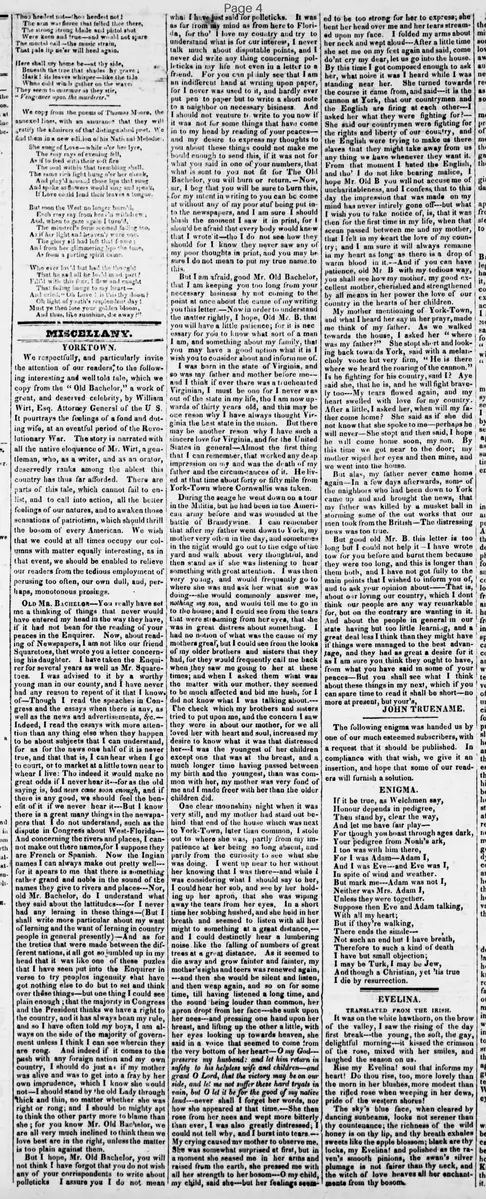
YORKTOWN.
We respectfully, and particularly invite the attention of our readers, to the following interesting and well told tale, which we copy from the "Old Bachelor," a work of great, and deserved celebrity, by William Wirt, Esq. Attorney General of the U S. It pourtrays the feelings of a fond and doting wife, at an eventful period of the Revolutionary War. The story is narrated with all the native eloquence of Mr. Wirt, a gentleman, who, as a writer, and as an orator, deservedly ranks among the ablest this country has thus far afforded. There are parts of this tale, which cannot fail to enlist, and to call into action, all the better feelings of our natures, and to awaken those sensations of patriotism, which should thrill the bosom of every American. We wish that we could at all times occupy our columns with matter equally interesting, as in that event, we should be enabled to relieve our readers from the tedious employment of perusing too often, our own dull, and, perhaps, monotonous prosings.
Old Mr. Bachelor-You really have set me a thinking of things that never would have entered my head in the way they have, if it had not been for the reading of your pieces in the Enquirer. Now, about reading of Newspapers, I am not like our friend Squaretoes, that wrote you a letter concerning his daughter. I have taken the Enquirer for several years as well as Mr. Squaretoes. I was advised to it by a worthy young man in our county, and I have never had any reason to repent of it that I know of-Though I read the speeches in Congress and the essays when there is any, as well as the news and advertisements, &c.-
Indeed, I read the essays with more attention than any thing else when they happen to be about subjects that I can understand, for as for the news one half of it is never true, and that that is, I can hear when I go to court, or to market at a little town near to where I live: Tho indeed it would make no great odds if I never hear it---for as the old saying is, bad news come soon enough, and if there is any good, we should feel the benefit of it if we never hear it---But I know there is a great many things in the newspapers that I do not understand, such as the dispute in Congress about West-Florida---And concerning the rivers and places, I cannot make out their names, for I suppose they are French or Spanish. Now the Indian names I can always make out pretty well--for it appears to me that there is something rather grand and noble in the sound of the names they give to rivers and places---Nor old Mr. Bachelor, do I understand what they said about the latitudes---for I never had any learning in these things-(But I shall write more particular about my want of learning and the want of learning in country people in general presently)-And as for the treaties that were made between the different nations, it all got so jumbled up in my head that it was like one of these puzzles that I have seen put into the Enquirer in verse to try peoples ingenuity that have got nothing else to do but to set and think over those things-but one thing I could see plain enough ; that the majority in Congress and the President thinks we have a right to the country, and it has always been my rule, and so I have often told my boys, I am always on the side of the majority of government unless I think I can see wherein they are wrong. And indeed if it comes to the push with any foreign nation and my own country, I should do just as if my mother was alive and was to get into a fray by her own imprudence, which I know she would not—I should stand by the old Lady through Thick and thin, no matter whether she was right or wrong; and I should be mighty apt to think the other party more to blame than she; for you know Mr. Old Bachelor, we are all very much inclined to think those we love best are in the right, unless the matter is too plain against them.
But I hope, Mr. Old Bachelor, you will not think I have forgot that you do not wish any of your correspondents to write about politicks I assure you I do not mean what I have just said for politicks. It was as far from my mind as from here to Florida, for tho' I love my country and try to understand what is for our interest, I never talk much about disputable points, and I never did write any thing concerning politicks in my life not even in a letter to a friend. For you can plainly see that I am an indifferent hand at writing upon paper, for I never was used to it, and hardly ever put pen to paper but to write a short note to a neighbor on necessary business. And I should not venture to write to you now if it was not for some things that have come in to my head by reading of your pieces- and my desire to express my thoughts to you about those things could not make me bold enough to send this, if it was not for what you said in one of your numbers, that what is sent to you not fit for The Old Bachelor, you will burn or return.-Now, sir, I beg that you will be sure to burn this, for my intent in writing to you can be come at without any of my poor stuff being put into the newspapers, and I am sure I should blush the moment I saw it in print, for I should be afraid that every body would know that I wrote it-tho I do not see how they should for I know they never saw any of my poor thoughts in print, and you may be sure I do not mean to put my true name to this.
But I am afraid, good Mr. Old Bachelor, that I am keeping you too long from your necessary business by not coming to the point at once about the cause of my writing you this letter.-Now in order to understand the matter rightly, I hope, Old Mr. B. that you will have a little patience; for it is necessary for you to know what sort of a man I am, and something about my family, that you may have a good notion what it is I wish you to consider about and inform me of.
I was born in the state of Virginia, and so was my father and mother before me-- and I think if ever there was a true hearted Virginian, I must be one for I never was out of the state in my life, tho I am now upwards of thirty years old, and this may be one reason why I have always thought Virginia the best state in the union. But there may be another reason why I have such a sincere love for Virginia, and for the United States in general-Almost the first thing that I can remember, that worked any deep impression on my mind was the death of my father and the circumstances of it. He lived at that time about forty or fifty miles from York-Town where Cornwallis was taken. During the siege he went down on a tour in the Militia, but he had been in the American army before and was wounded at the battle of Brandywine. I can remember that after my father went down to York, my mother very often in the day, and sometimes in the night would go out to the edge of the yard and walk about very thoughtful, and then stand as if she was listening to hear something with great attention. I was then very young, and would frequently go to where she was and ask her what she was doing---she would commonly answer me, nothing my son, and would tell me to go in to the house; and I could see from the tears that were streaming from her eyes, that she was in great distress about something. I had no notion of what was the cause of my mothers grief, but I could see from the looks of my older brothers and sisters that they had, for they would frequently call me back when they saw me going to her at these times; and when I asked them what was the matter with our mother, they seemed to be much affected and bid me hush, for I did not know what I was talking about.--- The check which my brothers and sisters tried to put upon me, and the concern I saw they were in about our mother, for we all loved her with heart and soul, increased my desire to know what it was that distressed her---I was the youngest of her children except one that was at the breast, and a much longer time having passed between my birth and the youngest, than was common with her, my mother was very fond of me and I made freer with her than the older children did.
One clear moonshiny night when it was very still, and my mother had staid out behind that end of the house which was next to York-Town, later than common, I stole out to where she was, partly from my impatience at her being so long absent, and partly from the curiosity to see what she was doing. I went up near to her without her knowing that I was there--and while I was considering what I should say to her. I could hear her sob, and see by her holding up her apron, that she was wiping away the tears from her eyes. In a short time her sobbing hushed, and she held in her breath and seemed to listen with all her might to something at a great distance,-- and I could distinctly hear a lumbering noise like the falling of numbers of great trees at a great distance. As it seemed to die away and grow fainter and fainter, my mothers sighs and tears was renewed again, ---and then she would be silent and listen, and then weep again, and so on for some time, till having listened a long time, and the sound being louder than common, her apron dropt from her face---she sunk upon her knees---and pressing one hand upon her breast, and lifting up the other a little, with her eyes looking up towards heaven, she said in a voice that seemed to come from the very bottom of her heart O my God--- preserve my husband: and let him return in safety to his helpless wife and children-and grant O Lord, that the victory may be on our side, and let me not suffer these hard tryals in vain, but O let it be for the good of my native land---never shall I forget her words, nor how she appeared at that time.---She then rose from her knees and wept more bitterly than ever, I was also greatly distressed; I could not tell why, and I burst into tears.- My crying caused my mother to observe me. She was somewhat surprised at first, but in a moment she seized me in her arms and raised from the earth, she pressed me with all her strength to her bosom---O my child, my child, said she---but her feelings seemed to be too strong for her to express; she bent her head over me and her tears streamed upon my face. I folded my arms about her neck and wept aloud---After a little time she set me on my feet again and said, come don't cry my dear, let us go into the house. By this time I got composed enough to ask her, what noise it was I heard while I was standing near her. She turned towards the course it came from, and said---it is the cannon at York, that our countrymen and the English are firing at each other---I asked her what they were fighting for?--. She said our countrymen were fighting for the rights and liberty of our country, and the English were trying to make us their slaves that they might take away from us any thing we have whenever they want it. From that moment I hated the English, and tho' I do not like bearing malice, I hope Mr. Old B you will not accuse me of uncharitableness, and I confess that to this day the impression that was made on my mind has never intirely gone off---but what I wish you to take notice of, is, that it was then for the first time in my life, when that scene passed between me and my mother, that I felt in my heart the love of my country; and I am sure it will always remain in my heart as long as there is a drop of warm blood in it.--And if you can have patience, old Mr B with my tedious way, you shall see how my mother, my good excellent mother, cherished and strengthened by all means in her power the love of our country in the hearts of her children.
My mother mentioning of York-Town, and what I heard her say in her prayr, made me think of my father. As we walked towards the house, I asked her "where was my father?" She stopt short and looking back towards York, said with a melancholy voice but very firm, "He is there where we heard the roaring of the cannon." Is he fighting for his country, said I? Aye said she, that he is, and he will fight bravely too---My tears flowed again, and my heart swelled with love for my country. After a little. I asked her, when will my father come home? She said as if she did not know that she spoke to me--perhaps he will never-She stopt and then said, I hope he will come home soon, my son. By this time we got near to the door; my mother wiped her eyes and then mine, and we went into the house.
But alas, my father never came home again--In a few days afterwards, some of the neighbors who had been down to York came up and brought the news, that my father was killed by a musket ball in storming some of the out works that our men took from the British-The distressing news was too true.
But good old Mr. B. this letter is too long but I could not help it-I have wrote two for you before and burnt them because they were too long, and this is longer than them both, and I have not got fully to the main points that I wished to inform you of, and to ask your opinion about---That is. about our loving our country, which I dont think our people are any way remarkable for, but on the contrary are wanting in it. And about the people in general in our state having but too little learning, and a great deal less I think than they might have if things were managed to the best advantage, and they had as great a desire for it as I am sure you think they ought to have, from what you have said in some of your pieces--But you shall see what I think about these things in my next, which if you can spare time to read it shall be short-no more at present, but your's,
JOHN TRUENAME.
What sub-type of article is it?
What themes does it cover?
What keywords are associated?
What entities or persons were involved?
Where did it happen?
Story Details
Key Persons
Location
Virginia, Near Yorktown
Event Date
During The Siege Of Yorktown
Story Details
A young boy observes his mother's anguish listening to distant cannon fire from the Siege of Yorktown, where his father fights in the militia; she prays for his safety and the American victory, instilling patriotism in her son; the father is later killed in battle.