Thank you for visiting SNEWPapers!
Sign up free
Literary
April 22, 1843
Richmond Palladium
Richmond, Wayne County, Indiana
What is this article about?
In Renaissance Florence, a mysterious stranger visits philosopher Cornelius Agrippa, seeking to view his deceased daughter Miriam through a magical mirror. Agrippa performs the ritual, revealing a 1200-year-old vision of her, but the stranger, revealed as the Wandering Jew, collapses in grief and flees.
Clipping
OCR Quality
95%
Excellent
Full Text
SELECT TALES
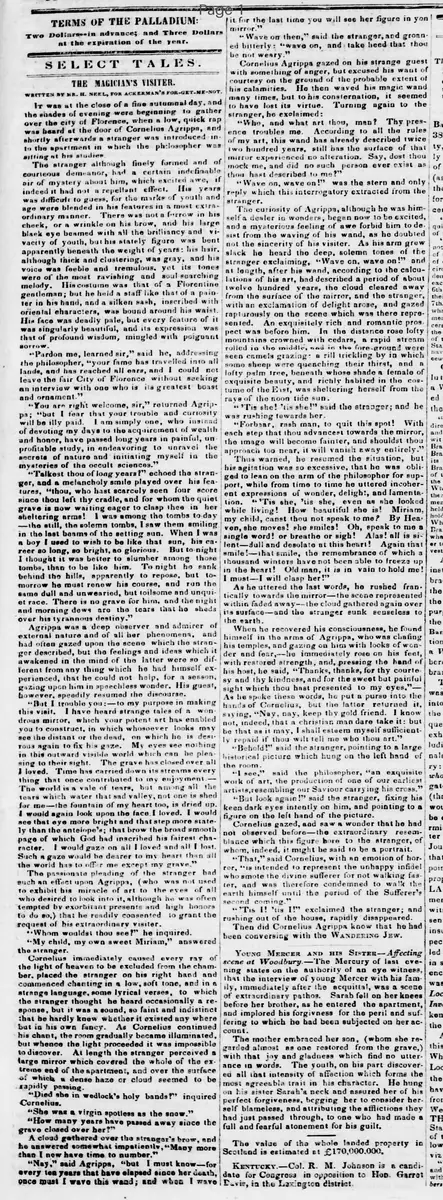
THE MAGICIAN'S VISITOR.
WRITTEN BY MR. H. NEEL, FOR ACKERMAN'S FORGET-ME-NOT,
It was at the close of a fine autumnal day, and the shades of evening were beginning to gather over the city of Florence, when a low, quick rap was heard at the door of Cornelius Agrippa, and shortly afterwards a stranger was introduced into the apartment in which the philosopher was sitting at his studies.
The stranger although finely formed and of courteous demeanor, had a certain indefinable air of mystery about him, which excited awe, if indeed it had not a repellant effect. His age was difficult to guess, for the marks of youth and age were blended in his features in a most extraordinary manner. There was not a furrow in his cheek, or a wrinkle on his brow, and his large black eye beamed with all the brilliancy and vivacity of youth, but his stately figure was bent apparently beneath the weight of years: his hair, although thick and clustering, was gray, and his voice was feeble and tremulous, yet its tones were of the most ravishing and soul searching melody. His costume was that of a Florentine gentleman; but he held a staff like that of a painter in his hand, and a silken sash, inscribed with oriental characters, was bound around his waist.
His face was deadly pale, but every feature of it was singularly beautiful, and its expression was that of profound wisdom, mingled with poignant sorrow.
"Pardon me, learned sir," said he, addressing the philosopher, "your fame has travelled into all lands, and has reached all ears, and I could not leave the fair City of Florence without seeking an interview with one who is its greatest boast and ornament."
"You are right welcome, sir," returned Agrippa; "but I fear that your trouble and curiosity will be ill paid. I am simply one, who instead of devoting my days to the acquirement of wealth and honor, have passed long years in painful, unprofitable study, in endeavoring to unravel the secrets of nature and initiating myself in the mysteries of the occult sciences."
"Talkest thou of long years?" echoed the stranger, and a melancholy smile played over his features, "thou, who hast scarcely seen four score since thou left thy cradle, and for whom the quiet grave is now waiting eager to clasp thee in her sheltering arms! I was among the tombs to-day—the still, the solemn tombs, I saw them smiling in the last beams of the setting sun. When I was a boy I used to wish to be like that sun, his career so long, so bright, so glorious. But to-night I thought it was better to slumber among those tombs, than to be like him. To night he sank behind the hills, apparently to repose, but to-morrow he must renew his course, and run the same dull and unwearied, but toilsome and inquiet race. There is no grave for him, and the night and morning dews are the tears that he sheds over his tyrannous destiny."
Agrippa was a deep observer and admirer of external nature and of all her phenomena, and had often gazed upon the scene which the stranger described, but the feelings and ideas which it awakened in the mind of the latter were so different from any thing which he had himself experienced, that he could not help, for a season, gazing upon him in speechless wonder. His guest, however, speedily resumed the discourse.
"But I trouble you: to my purpose in making this visit. I have heard strange tales of a wondrous mirror, which your potent art has enabled you to construct, in which whosoever looks may see the distant or the dead, on which he is desirous again to fix his gaze. My eyes see nothing in this outward visible world which can be pleasing to their sight. The grave has closed over all I loved. Time has carried down its streams every thing that once contributed to my enjoyment. The world is a vale of tears, but among all the tears which water that sad valley, not one is shed for me—the fountain of my heart too, is dried up.
I would again look upon the face I loved. I would see that eye more bright and that step more stately than the antelope's; that brow the broad smooth page of which God had inscribed his fairest character. I would gaze on all I loved and all I lost. Such a gaze would be dearer to my heart than all the world has to offer me except my grave."
The passionate pleading of the stranger had such an effect upon Agrippa, (who was not used to exhibit his miracle of art to the eyes of all who desired to look into it, although he was often tempted by exorbitant presents and high honors to do so,) that he readily consented to grant the request of his extraordinary visitor.
"Whom wouldst thou see?" he inquired.
"My child, my own sweet Miriam," answered the stranger.
Cornelius immediately caused every ray of the light of heaven to be excluded from the chamber, placed the stranger on his right hand and commenced chanting in a low, soft tone, and in a strange language, some lyrical verses, to which the stranger thought he heard occasionally a response, but it was a sound, so faint and indistinct that he hardly knew whether it existed any where but in his own fancy. As Cornelius continued his chant, the room gradually became illuminated, but whence the light proceeded it was impossible to discover. At length the stranger perceived a large mirror which covered the whole of the extreme end of the apartment, and over the surface of which a dense haze or cloud seemed to be rapidly passing.
"Died she in wedlock's holy bands?" inquired Cornelius.
"She was a virgin spotless as the snow."
"How many years have passed away since the grave closed over her?"
A cloud gathered over the stranger's brow, and he answered somewhat impatiently, "Many more than I now have time to number."
"Nay," said Agrippa, "but I must know—for every ten years that have elapsed since her death, once must I wave this wand; and when I wave
it or the last time you will see her figure in yon mirror."
"Wave or then," said the stranger, and groaned bitterly: "wave on, and take heed that thou be not weary."
Cornelius Agrippa gazed on his strange guest with something of anger, but excused his want of courtesy on the ground of the probable extent of his calamities. He then waved his magic wand many times, but to his consternation, it seemed to have lost its virtue. Turning again to the stranger, he exclaimed:
"Who, and what art thou, man? Thy presence troubles me. According to all the rules of my art, this wand has already described twice two hundred years, still has the surface of that mirror experienced no alteration. Say, dost thou mock me, and did no such person ever exist as thou hast described to me?"
"Wave on, wave on!" was the stern and only reply which this interrogatory extracted from the stranger.
The curiosity of Agrippa, although he was himself a dealer in wonders, began now to be excited, and a mysterious feeling of awe forbid him to desist from the waving of his wand, as he doubted not the sincerity of his visitor. As his arm grew slack he heard the deep, solemn tones of the stranger exclaiming, "Wave on, wave on!" and at length, after his wand, according to the calculations of his art, had described a period of about twelve hundred years, the cloud cleared away from the surface of the mirror, and the stranger, with an exclamation of delight arose, and gazed rapturously on the scene which was there represented. An exquisitely rich and romantic prospect was before him. In the distance rose lofty mountains crowned with cedars, a rapid stream rolled in the middle, and in the fore-ground were seen camels grazing: a rill trickling by in which some sheep were quenching their thirst, and a lofty palm tree, beneath whose shade a female of exquisite beauty, and richly habited in the costume of the East, was sheltering herself from the rays of the noon tide sun.
" 'Tis she! 'tis she!" said the stranger; and he was rushing forwards her.
"Forbear, rash man, to quit this spot! With each step that thou advancest towards the mirror, the image will become fainter, and shouldst thou approach too near, it will vanish away entirely."
Thus warned, he resumed the situation, but his agitation was so excessive, that he was obliged to lean on the arm of the philosopher for support, while from time to time he uttered incoherent expressions of wonder, delight, and lamentation. " 'Tis she, 'tis she, even as she looked while living! How beautiful she is! Miriam, my child, Canst thou not speak to me? By Heaven, she moves! she smiles! Oh, speak to me a single word! or breathe or sigh! Alas! all is silent—dull and desolate at this heart! Again that smile!—that smile, the remembrance of which a thousand winters have not been able to freeze up in the heart! Old man, it is in vain to hold me! I must—I will clasp her!"
As he uttered the last words, he rushed frantically towards the mirror—the scene represented within faded away—the cloud gathered again over its surface—and the stranger sunk senseless to the earth.
When he recovered his consciousness, he found himself in the arms of Agrippa, who was chafing his temples, and gazing on him with looks of wonder and fear,—he immediately rose on his feet, with restored strength, and, pressing the hand of his host, he said, "Thanks, thanks, for thy courtesy and thy kindness, and for the sweet but painful sight which thou hast presented to my eyes,"
As he spoke these words, he put a purse into the hands of Cornelius, but the latter returned it, saying, "Nay, nay, keep thy gold friend. I know not, indeed, that a christian man dare take it: but be that as it may, I shall esteem myself sufficiently repaid if thou wilt tell me who thou art."
"Behold!" said the stranger, pointing to a large historical picture which hung on the left hand of the room.
"I see," said the philosopher, "an exquisite work of art, the production of one of our earliest artists, resembling our Saviour carrying his cross."
"But look again!" said the stranger, fixing his keen dark eyes intently on him, and pointing to a figure on the left hand of the picture.
Cornelius gazed, and saw a wonder that he had not observed before—the extraordinary resemblance which this figure bore to the stranger, of whom, indeed, it might be said to be a portrait.
"That," said Cornelius, with an emotion of horror, "is intended to represent the unhappy infidel who smote the divine sufferer for not walking faster, and was therefore condemned to walk the earth himself until the period of the Sufferer's second coming."
" 'Tis I! 'tis I!" exclaimed the stranger: and rushing out of the house, rapidly disappeared.
Then did Cornelius Agrippa know that he had been conversing with the WANDERING JEW.
THE MAGICIAN'S VISITOR.
WRITTEN BY MR. H. NEEL, FOR ACKERMAN'S FORGET-ME-NOT,
It was at the close of a fine autumnal day, and the shades of evening were beginning to gather over the city of Florence, when a low, quick rap was heard at the door of Cornelius Agrippa, and shortly afterwards a stranger was introduced into the apartment in which the philosopher was sitting at his studies.
The stranger although finely formed and of courteous demeanor, had a certain indefinable air of mystery about him, which excited awe, if indeed it had not a repellant effect. His age was difficult to guess, for the marks of youth and age were blended in his features in a most extraordinary manner. There was not a furrow in his cheek, or a wrinkle on his brow, and his large black eye beamed with all the brilliancy and vivacity of youth, but his stately figure was bent apparently beneath the weight of years: his hair, although thick and clustering, was gray, and his voice was feeble and tremulous, yet its tones were of the most ravishing and soul searching melody. His costume was that of a Florentine gentleman; but he held a staff like that of a painter in his hand, and a silken sash, inscribed with oriental characters, was bound around his waist.
His face was deadly pale, but every feature of it was singularly beautiful, and its expression was that of profound wisdom, mingled with poignant sorrow.
"Pardon me, learned sir," said he, addressing the philosopher, "your fame has travelled into all lands, and has reached all ears, and I could not leave the fair City of Florence without seeking an interview with one who is its greatest boast and ornament."
"You are right welcome, sir," returned Agrippa; "but I fear that your trouble and curiosity will be ill paid. I am simply one, who instead of devoting my days to the acquirement of wealth and honor, have passed long years in painful, unprofitable study, in endeavoring to unravel the secrets of nature and initiating myself in the mysteries of the occult sciences."
"Talkest thou of long years?" echoed the stranger, and a melancholy smile played over his features, "thou, who hast scarcely seen four score since thou left thy cradle, and for whom the quiet grave is now waiting eager to clasp thee in her sheltering arms! I was among the tombs to-day—the still, the solemn tombs, I saw them smiling in the last beams of the setting sun. When I was a boy I used to wish to be like that sun, his career so long, so bright, so glorious. But to-night I thought it was better to slumber among those tombs, than to be like him. To night he sank behind the hills, apparently to repose, but to-morrow he must renew his course, and run the same dull and unwearied, but toilsome and inquiet race. There is no grave for him, and the night and morning dews are the tears that he sheds over his tyrannous destiny."
Agrippa was a deep observer and admirer of external nature and of all her phenomena, and had often gazed upon the scene which the stranger described, but the feelings and ideas which it awakened in the mind of the latter were so different from any thing which he had himself experienced, that he could not help, for a season, gazing upon him in speechless wonder. His guest, however, speedily resumed the discourse.
"But I trouble you: to my purpose in making this visit. I have heard strange tales of a wondrous mirror, which your potent art has enabled you to construct, in which whosoever looks may see the distant or the dead, on which he is desirous again to fix his gaze. My eyes see nothing in this outward visible world which can be pleasing to their sight. The grave has closed over all I loved. Time has carried down its streams every thing that once contributed to my enjoyment. The world is a vale of tears, but among all the tears which water that sad valley, not one is shed for me—the fountain of my heart too, is dried up.
I would again look upon the face I loved. I would see that eye more bright and that step more stately than the antelope's; that brow the broad smooth page of which God had inscribed his fairest character. I would gaze on all I loved and all I lost. Such a gaze would be dearer to my heart than all the world has to offer me except my grave."
The passionate pleading of the stranger had such an effect upon Agrippa, (who was not used to exhibit his miracle of art to the eyes of all who desired to look into it, although he was often tempted by exorbitant presents and high honors to do so,) that he readily consented to grant the request of his extraordinary visitor.
"Whom wouldst thou see?" he inquired.
"My child, my own sweet Miriam," answered the stranger.
Cornelius immediately caused every ray of the light of heaven to be excluded from the chamber, placed the stranger on his right hand and commenced chanting in a low, soft tone, and in a strange language, some lyrical verses, to which the stranger thought he heard occasionally a response, but it was a sound, so faint and indistinct that he hardly knew whether it existed any where but in his own fancy. As Cornelius continued his chant, the room gradually became illuminated, but whence the light proceeded it was impossible to discover. At length the stranger perceived a large mirror which covered the whole of the extreme end of the apartment, and over the surface of which a dense haze or cloud seemed to be rapidly passing.
"Died she in wedlock's holy bands?" inquired Cornelius.
"She was a virgin spotless as the snow."
"How many years have passed away since the grave closed over her?"
A cloud gathered over the stranger's brow, and he answered somewhat impatiently, "Many more than I now have time to number."
"Nay," said Agrippa, "but I must know—for every ten years that have elapsed since her death, once must I wave this wand; and when I wave
it or the last time you will see her figure in yon mirror."
"Wave or then," said the stranger, and groaned bitterly: "wave on, and take heed that thou be not weary."
Cornelius Agrippa gazed on his strange guest with something of anger, but excused his want of courtesy on the ground of the probable extent of his calamities. He then waved his magic wand many times, but to his consternation, it seemed to have lost its virtue. Turning again to the stranger, he exclaimed:
"Who, and what art thou, man? Thy presence troubles me. According to all the rules of my art, this wand has already described twice two hundred years, still has the surface of that mirror experienced no alteration. Say, dost thou mock me, and did no such person ever exist as thou hast described to me?"
"Wave on, wave on!" was the stern and only reply which this interrogatory extracted from the stranger.
The curiosity of Agrippa, although he was himself a dealer in wonders, began now to be excited, and a mysterious feeling of awe forbid him to desist from the waving of his wand, as he doubted not the sincerity of his visitor. As his arm grew slack he heard the deep, solemn tones of the stranger exclaiming, "Wave on, wave on!" and at length, after his wand, according to the calculations of his art, had described a period of about twelve hundred years, the cloud cleared away from the surface of the mirror, and the stranger, with an exclamation of delight arose, and gazed rapturously on the scene which was there represented. An exquisitely rich and romantic prospect was before him. In the distance rose lofty mountains crowned with cedars, a rapid stream rolled in the middle, and in the fore-ground were seen camels grazing: a rill trickling by in which some sheep were quenching their thirst, and a lofty palm tree, beneath whose shade a female of exquisite beauty, and richly habited in the costume of the East, was sheltering herself from the rays of the noon tide sun.
" 'Tis she! 'tis she!" said the stranger; and he was rushing forwards her.
"Forbear, rash man, to quit this spot! With each step that thou advancest towards the mirror, the image will become fainter, and shouldst thou approach too near, it will vanish away entirely."
Thus warned, he resumed the situation, but his agitation was so excessive, that he was obliged to lean on the arm of the philosopher for support, while from time to time he uttered incoherent expressions of wonder, delight, and lamentation. " 'Tis she, 'tis she, even as she looked while living! How beautiful she is! Miriam, my child, Canst thou not speak to me? By Heaven, she moves! she smiles! Oh, speak to me a single word! or breathe or sigh! Alas! all is silent—dull and desolate at this heart! Again that smile!—that smile, the remembrance of which a thousand winters have not been able to freeze up in the heart! Old man, it is in vain to hold me! I must—I will clasp her!"
As he uttered the last words, he rushed frantically towards the mirror—the scene represented within faded away—the cloud gathered again over its surface—and the stranger sunk senseless to the earth.
When he recovered his consciousness, he found himself in the arms of Agrippa, who was chafing his temples, and gazing on him with looks of wonder and fear,—he immediately rose on his feet, with restored strength, and, pressing the hand of his host, he said, "Thanks, thanks, for thy courtesy and thy kindness, and for the sweet but painful sight which thou hast presented to my eyes,"
As he spoke these words, he put a purse into the hands of Cornelius, but the latter returned it, saying, "Nay, nay, keep thy gold friend. I know not, indeed, that a christian man dare take it: but be that as it may, I shall esteem myself sufficiently repaid if thou wilt tell me who thou art."
"Behold!" said the stranger, pointing to a large historical picture which hung on the left hand of the room.
"I see," said the philosopher, "an exquisite work of art, the production of one of our earliest artists, resembling our Saviour carrying his cross."
"But look again!" said the stranger, fixing his keen dark eyes intently on him, and pointing to a figure on the left hand of the picture.
Cornelius gazed, and saw a wonder that he had not observed before—the extraordinary resemblance which this figure bore to the stranger, of whom, indeed, it might be said to be a portrait.
"That," said Cornelius, with an emotion of horror, "is intended to represent the unhappy infidel who smote the divine sufferer for not walking faster, and was therefore condemned to walk the earth himself until the period of the Sufferer's second coming."
" 'Tis I! 'tis I!" exclaimed the stranger: and rushing out of the house, rapidly disappeared.
Then did Cornelius Agrippa know that he had been conversing with the WANDERING JEW.
What sub-type of article is it?
Prose Fiction
What themes does it cover?
Death Mortality
Religious
What keywords are associated?
Wandering Jew
Cornelius Agrippa
Magic Mirror
Florence
Miriam
Immortality
Loss
What entities or persons were involved?
Written By Mr. H. Neel, For Ackerman's Forget Me Not,
Literary Details
Title
The Magician's Visitor.
Author
Written By Mr. H. Neel, For Ackerman's Forget Me Not,
Key Lines
" 'Tis She! 'Tis She!" Said The Stranger; And He Was Rushing Forwards Her.
" 'Tis I! 'Tis I!" Exclaimed The Stranger: And Rushing Out Of The House, Rapidly Disappeared.
Then Did Cornelius Agrippa Know That He Had Been Conversing With The Wandering Jew.