Thank you for visiting SNEWPapers!
Sign up free
American Watchman And Delaware Advertiser
Wilmington, New Castle County, Delaware
What is this article about?
Report on a congressional resolution granting the Committee of Manufactures power to summon witnesses and inspect papers, adopted 102-88. Originated by anti-tariff Mr. Martin (S.C.), supported by Southern and Jackson allies, opposed by pro-tariff figures like Mr. Mallary. Seen as hostile to manufacturing interests amid tariff debates.
Clipping
OCR Quality
Full Text
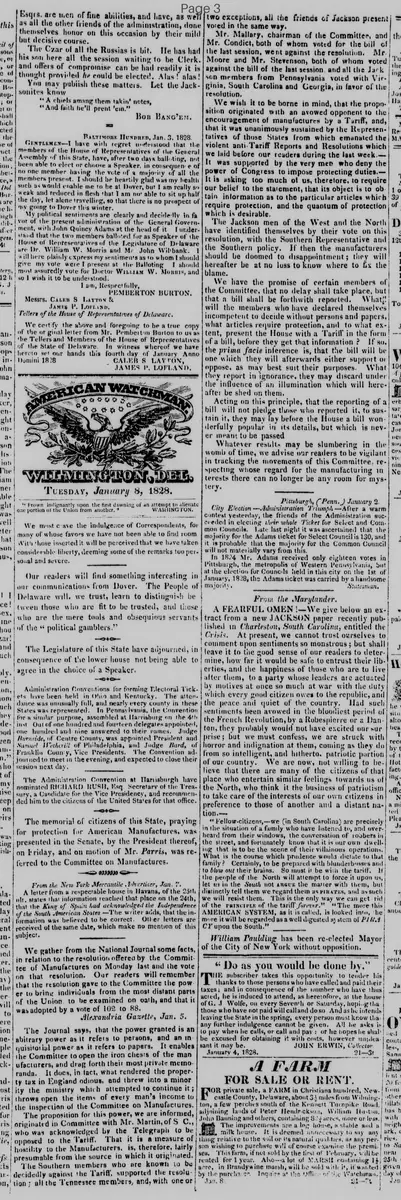
The Journal says, that the power granted is an arbitrary power as it refers to persons, and an inquisitorial power as it refers to papers. It enables the Committee to open the iron chests of the manufacturer, and drag forth their most private memoranda. It does, in fact, what rendered the property tax in England odious, and threw into a minority the ministry which attempted to continue it; throws open the items of every man's income to the inspection of the Committee on Manufactures.
The proposition for this power, we are informed, originated in Committee with Mr. Martin, of S.C., who was acknowledged by the Telegraph to be opposed to the Tariff. That it is a measure of hostility to the Manufacturers, is, therefore, fairly presumable from the source in which it originated.
The Southern members who are known to be decidedly against the Tariff, supported the resolution: all the Tennessee members, and, with one or two exceptions, all the friends of Jackson present voted in the same way. Mr. Mallary, chairman of the Committee, and Mr. Condict, both of whom voted for the bill of the last session, went against the resolution. Mr. Moore and Mr. Stevenson, both of whom voted against the bill of the last session, and all the Jackson members from Pennsylvania voted with Virginia, South Carolina and Georgia, in favor of the resolution.
We wish it to be borne in mind, that the proposition originated with an avowed opponent to the encouragement of manufactures by a Tariff, and, that it was unanimously sustained by the Representatives of those States from which emanated the violent anti-Tariff Reports and Resolutions which we laid before our readers during the last week.
It was supported by the very men who deny the power of Congress to impose protecting duties.
It is asking too much of us, therefore, to require our belief to the statement, that its object is to obtain information as to the particular articles which require protection, and the quantum of protection which is desirable.
The Jackson men of the West and the North have identified themselves by their vote on this resolution, with the Southern Representative and the Southern policy. If then the manufacturers should be doomed to disappointment; they will hereafter be at no loss to know where to fix the blame.
We have the promise of certain members of the Committee, that no delay shall take place, but that a bill shall be forthwith reported. What! will the members who have declared themselves incompetent to decide without persons and papers, what articles require protection, and to what extent, present the House with a Tariff in the form of a bill, before they get that information? If so, the prima facie inference is, that the bill will be one which they will afterwards either support or oppose, as may best suit their purposes. What they report in ignorance, they may discard under the influence of an illumination which will hereafter be shed on them.
Acting on this principle, that the reporting of a bill will not pledge those who reported it, to sustain it, they may lay before the House a bill wonderfully popular in its details, but which is never meant to be passed.
Whatever result may be slumbering in the womb of time, we advise our readers to be vigilant in tracking the movements of this Committee, respecting whose regard for the manufacturing interests there can no longer be any room for mystery.
What sub-type of article is it?
What keywords are associated?
What entities or persons were involved?
Domestic News Details
Event Date
Monday Last
Key Persons
Outcome
resolution adopted by a vote of 102 to 88, granting the committee of manufactures power to bring individuals from distant parts of the union for examination on oath and to inspect papers.
Event Details
The resolution offered by the Committee of Manufactures empowered the committee to summon individuals for oath examination and access private papers of manufacturers. It originated with Mr. Martin of S.C., an opponent of the tariff, and was supported by Southern members against the tariff, all Tennessee members, most Jackson friends present, Mr. Moore, Mr. Stevenson, and Jackson members from Pennsylvania, voting with Virginia, South Carolina, and Georgia. Opposed by Mr. Mallary and Mr. Condict, who supported the previous session's bill. The resolution is criticized as arbitrary and inquisitorial, potentially hostile to manufacturers.