Thank you for visiting SNEWPapers!
Sign up free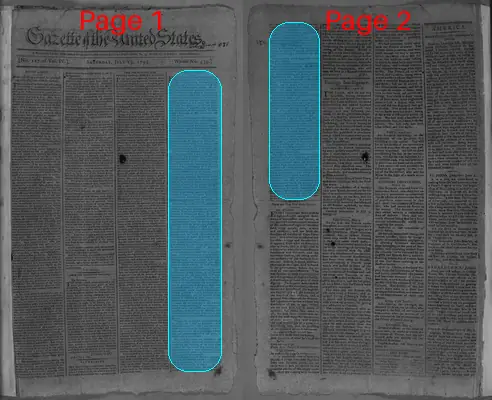
Gazette Of The United States
New York, New York County, New York
What is this article about?
This editorial examines France's motivations for aiding the American Revolution, attributing it to rivalry with Britain rather than sympathy for liberty. It argues against excessive gratitude to France or its people, emphasizing instead esteem for honorable conduct and specific acknowledgment of Louis XVI's role over the nation.
Merged-components note: This is a continuation of the editorial piece across pages 1 and 2, as the text cuts off mid-sentence on page 1 and resumes directly on page 2.
Clippings

1 of 2
OCR Quality
Full Text
FRANCE, the rival time immemorial of Great-Britain, had in the course of the war, which ended in 1763, suffered from the successful arms of the latter the severest losses and the most mortifying defeats. Britain from that moment had acquired an ascendancy over France in the affairs of Europe, and in the commerce of the world, too decided to be endured without impatience, or without an eager desire of finding a favorable opportunity to destroy it, and repair the breach which had been made in the national glory.
The animosity of wounded pride conspired with calculations of the interest of the State to give a keen edge to that impatience and to that desire.
The American Revolution -offered the occasion. It attracted early the notice of France, though with extreme circumspection. As far as countenance and aid may be presumed to have been given prior to the epoch of the acknowledgment of our independence, it will be no unkind derogation to assert, that they were marked neither with liberality, nor with vigour: that they wore the appearance rather of a desire to keep alive disturbances, which would embarrass a rival power, than of a serious design to assist a revolution, or a serious expectation that it would be effected.
The victories of Saratoga, the capture of an army, which went a great way towards deciding the issue of the contest, decided also the hesitations of France. They established in the government of that country a confidence in our ability to accomplish our purpose; and as a consequence of it produced the treaties of alliance and commerce.
It is impossible to see in all this any thing more than the conduct of a rival nation, embracing a most promising opportunity to repress the pride and diminish the dangerous power of its rival; by seconding a successful resistance to its authority, and by lopping off a valuable portion of its dominions. The dismemberment of this country from Great-Britain was an obvious and a very important interest of France. It cannot be doubted. that it was the determining motive. and an adequate compensation for the assistance afforded us.
Men of sense, in this country, deduced an encouragement to the part which their zeal for liberty prompted them to take in our revolution, from the probability of the co-operation of France and Spain. It will be remembered, that this argument was used in the publications of the day; but upon what was it bottomed? Upon the known competition between those powers and Great-Britain, upon their evident interest to reduce her power and circumscribe her empire; not upon motives of regard to our interest, or of attachment to our cause, Whoever should have alleged the latter, as grounds of the expectation held out, would have been then justly considered as a visionary, or a deceiver.
And whoever shall now ascribe the aid we received to such motives would not deserve to be viewed in a better light.
The inference from these facts is not obscure. Aid and co-operation founded upon a great interest, pursued and obtained by the party affording them, is not a proper stock upon which to engraft that enthusiastic gratitude, which is claimed from us, by those who love France more than the United States.
This view of the subject, extorted by the extravagancy of such a claim, is not meant to disparage the just pretensions of France upon our good will. Though neither in the motives to the succours which she furnished us, nor in their extent (considering how powerfully the point of honor in such a war reinforced the considerations of interest when she was once engaged) can be found a sufficient basis for that gratitude which is the theme of so much declamation : Yet we shall find in the manner of affording us those succours just cause for our esteem and friendship.
France did not attempt, in the first instance, to take advantage of our situation to extort from us any humiliating or injurious concessions, as the price of her assistance ; nor afterwards in the progress of the war, to impose hard terms as the condition of particular aids.
Though this course was certainly dictated by policy: yet it was an honorable and a magnanimous policy; such a one as always constitutes a title to the approbation and esteem of mankind; and a claim to the friendship and acknowledgment of the party, in whose favor it is practiced.
But these sentiments are satisfied on the part of a nation; when they produce sincere wishes for the happiness of the party from whom it has experienced such conduct, and a cordial disposition to render all good and friendly offices which can be rendered without prejudice to its own solid and permanent interests.
To ask of a nation so situated, to make a sacrifice of substantial interest; to expose itself to the jealousy, illwill, or resentment of the rest of the world; to hazard in an eminent degree its own safety. for the benefit of the party, who may have observed towards it
The conduct which has been described would be to ask more than the nature of the case demands, more than the fundamental maxims of society authorize, more than the dictates of sound reason justify.
A question has arisen, with regard to the proper object of that gratitude, which is so magnificently upon; whether the unfortunate Prince by whom the assistance received was given; or the nation of whom he was the Chief or the organ. It interests the national justice to form right conceptions on this point.
The arguments which support the latter idea are as follow:
"Louis the XVI was but the constitutional agent of the French nation. He acted for and on behalf of the nation: 'twas with their money and their blood he supported our cause. 'Tis to them therefore, not to him, that our obligations are due. Louis the XVI. in taking our part was no doubt actuated by State-policy. An absolute Prince could not love liberty. But the people of France patronized our cause with zeal, from sympathy in its object. The people therefore, not its monarch are entitled to our sympathy."
This reasoning may be ingenious, but it is not founded in nature or fact.
Louis the XVI, though no more than the constitutional agent of the nation, had at the time the sole power of managing its affairs, the legal right of directing its will and its forces. It belonged to him to aid us, or not, without consulting the nation; and he did aid us without such consultation. His will alone was active; that of the nation passive.
If there was any kindness in the decision, demanding a return of kindness from us, it was the kindness of Louis the XVI; his heart was the depository of the sentiment. Let the genuine voice of nature then, unperverted by political subtleties, pronounce whether the acknowledgment, which may be due for that kindness, can be equitably transferred from him to others, who had no share in the decision. Whether the principle of gratitude ought to determine us to behold with indifference his misfortunes, and with satisfaction the triumphs of his enemies.
The doctrine that the Prince is only the organ of his nation is conclusive to enforce the obligations of good faith between nation and nation; in other words, the observance of duties stipulated in treaties for national purposes—and it will even suffice to continue to a nation a claim to the friendship and good will of another resulting from friendly offices done by its Prince; but it would be to carry it too far and to render it too artificial to attribute to it the effect of transferring that claim from the Prince to the nation, by way of opposition and contrast. Friendship, good will, gratitude for favors received have so inseparable a reference to the motives with which and to the persons by whom they were rendered, as to be incapable of being transferred to another at his expense.
What sub-type of article is it?
What keywords are associated?
What entities or persons were involved?
Editorial Details
Primary Topic
France's Motives In The American Revolution And The Object Of American Gratitude
Stance / Tone
Critical Of Excessive Pro French Sentiment; Advocates Measured Gratitude And Recognition Of Louis Xvi
Key Figures
Key Arguments