Thank you for visiting SNEWPapers!
Sign up free
Norfolk Gazette And Publick Ledger
Norfolk, Virginia
What is this article about?
Committee report on Baltimore riots: Attack on Federal Republican editors' fortified house on July 26-27, 1812, led to gunfire and surrender; subsequent jail assault on July 27-28 killed Gen. Lingan and injured prisoners amid political tensions.
Clipping
OCR Quality
Full Text
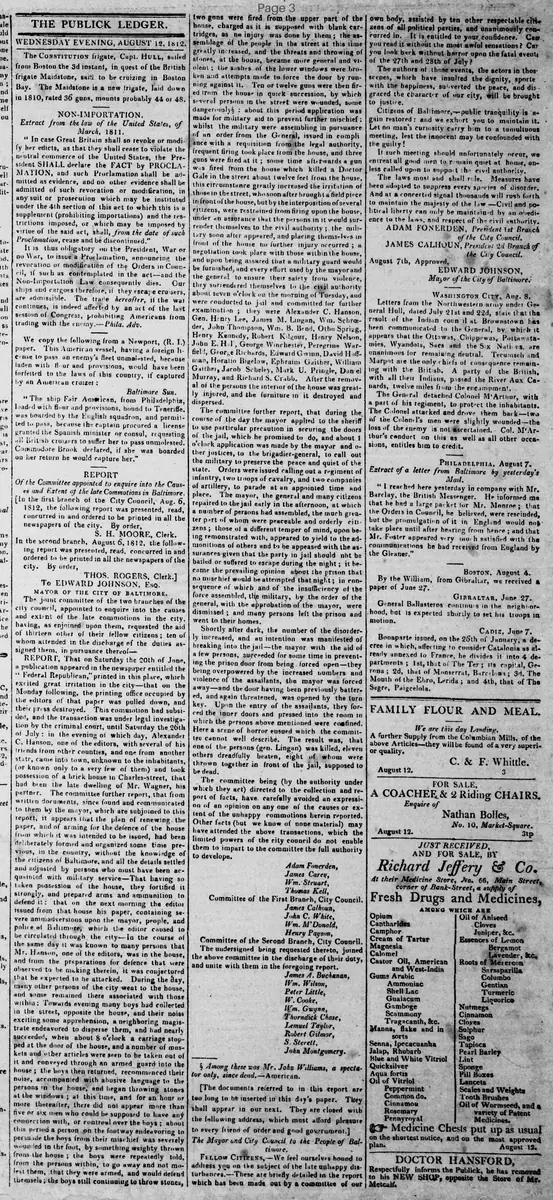
Of the Committee appointed to enquire into the Causes and Extent of the late Commotions in Baltimore.
[In the first branch of the City Council, Aug. 6, 1812, the following report was presented, read, concurred in and ordered to be printed in all the newspapers of the city. By order,
S. H. MOORE, Clerk.
In the second branch, August 6, 1812, the following report was presented, read, concurred in and ordered to be printed in all the newspapers of the city. By order,
THOS. ROGERS, Clerk.]
To EDWARD JOHNSON, Esq.
MAYOR OF THE CITY OF BALTIMORE.
The joint committee of the two branches of the city council, appointed to enquire into the causes and extent of the late commotions in the city, having, as enjoined upon them, requested the aid of thirteen other of their fellow citizens; ten of whom attended in the discharge of the duties assigned them, in pursuance thereof—
REPORT, That on Saturday the 20th of June, a publication appeared in the newspaper entitled the "Federal Republican," printed in this place, which excited great irritation in the city—that on the Monday following, the printing office occupied by the editors of that paper was pulled down, and their press destroyed. This commotion had subsided, and the transaction was under legal investigation by the criminal court, until Saturday the 26th of July: in the evening of which day, Alexander C. Hanson, one of the editors, with several of his friends from other counties, and one from another state, came into town, unknown to the inhabitants, (or known only to a very few of them) and took possession of a brick house in Charles-street, that had been the late dwelling of Mr. Wagner, his partner. The committee further report, that from written documents, since found and communicated to them by the mayor, which are subjoined to this report, it appears that the plan of renewing the paper, and of arming for the defence of the house from which it was intended to be issued, had been deliberately formed and organized some time previous, in the country, without the knowledge of the citizens of Baltimore, and all the details settled and adjusted by persons who must have been acquainted with military service—That having so taken possession of the house, they fortified it strongly, and prepared arms and ammunition to defend it: that on the next morning the editor issued from that house his paper, containing severe animadversions upon the mayor, people, and police of Baltimore, which the editor caused to be circulated through the city. In the course of the same day it was known to many persons that Mr. Hanson, one of the editors, was in the house, and from the preparations for defence that were observed to be making therein, it was conjectured that he expected to be attacked. During the day, many other persons of the city went to the house, and some remained there associated with those within: Towards evening many boys had collected in the street, opposite the house, and their noise exciting some apprehension, a neighboring magistrate endeavored to disperse them, and had nearly succeeded, when about 8 o'clock a carriage stopped at the door of the house, and a number of muskets and other articles were seen to be taken out of it and conveyed through an armed guard into the house; the boys then returned, recommenced their noise, accompanied with abusive language to the persons in the house, and began throwing stones at the windows; at this time, and for an hour or more thereafter, there did not appear more than five or six men who could be supposed to have any connection with, or controul over the boys; about this period a person on the footway endeavoring to persuade the boys from their mischief was severely wounded in the foot, by something weighty thrown from the house; the boys were repeatedly told, from the persons within, to go away and not molest them, that they were armed, and would defend themselves; the boys still continuing to throw stones, two guns were fired from the upper part of the house, charged as it is supposed with blank cartridges, as no injury was done by them; the assemblage of the people in the street at this time greatly increased, and the threats and throwing of stones, at the house, became more general and violent; the sashes of the lower windows were broken and attempts made to force the door by running against it. Ten or twelve guns were then fired from the house in quick succession, by which several persons in the street were wounded, some dangerously: about this period application was made for military aid to prevent further mischief: whilst the military were assembling in pursuance of an order from the General, issued in compliance with a requisition from the legal authority, frequent firing took place from the house, and three guns were fired at it; some time afterwards a gun was fired from the house which killed a Doctor Gale in the street about twelve feet from the house, this circumstance greatly increased the irritation of those in the street, who soon after brought a field piece in front of the house, but by the interposition of several citizens, were restrained from firing upon the house, under an assurance that the persons in it would surrender themselves to the civil authority; the military soon after appeared, and placing themselves in front of the house no further injury occurred; a negotiation took place with those within the house, and upon being assured that a military guard would be furnished, and every effort used by the mayor and the general to ensure their safety from violence, they surrendered themselves to the civil authority about seven o'clock on the morning of Tuesday, and were conducted to jail and committed for further examination; they were Alexander C. Hanson, Gen. Henry Lee, James M. Lingan, Wm. Schroeder, John Thompson, Wm. B. Bond, Otho Sprigg, Henry Kennedy, Robert Kilgour, Henry Nelson, John E. Hall, George Winchester, Peregrine Warfield, George Richards, Edward Gwinn, David Hoffman, Horatio Bigelow, Ephraim Gaither, William Gaither, Jacob Scheley, Mark U. Pringle, Daniel Murray, and Richard S. Crabb. After the removal of the persons the interior of the house was greatly injured, and the furniture in it destroyed and dispersed.
The committee further report, that during the course of the day the mayor applied to the sheriff to use particular precaution in securing the doors of the jail, which he promised to do, and about 1 o'clock application was made by the mayor and other justices, to the brigadier-general, to call out the military to preserve the peace and quiet of the state. Orders were issued calling out a regiment of infantry, two troops of cavalry, and two companies of artillery, to parade at an appointed time and place. The mayor, the general and many citizens repaired to the jail early in the afternoon, at which a number of persons had assembled, the much greater part of whom were peaceable and orderly citizens; those of a different temper of mind, upon being remonstrated with, appeared to yield to the admonitions of others and to be appeased with the assurances given that the party in jail should not be bailed or suffered to escape during the night; it became the prevailing opinion about the prison that no mischief would be attempted that night; in consequence of which and of the insufficiency of the force assembled, the military, by the order of the general, with the approbation of the mayor, were dismissed; and many persons left the prison and went to their homes.
Shortly after dark, the number of the disorderly increased, and an intention was manifested of breaking into the jail—the mayor with the aid of a few persons, succeeded for some time in preventing the prison door from being forced open—they being overpowered by the increased numbers and violence of the assailants, the mayor was forced away—and the door having been previously battered, and again threatened, was opened by the turnkey. Upon the entry of the assailants, they forced the inner doors and pressed into the room in which the persons above mentioned were confined. Here a scene of horror ensued which the committee cannot well describe. The result was, that one of the persons (gen. Lingan) was killed, eleven others dreadfully beaten, eight of whom were thrown together in front of the jail, supposed to be dead.
The committee being (by the authority under which they act) directed to the collection and report of facts, have carefully avoided an expression of an opinion on any one of the causes or extent of the unhappy commotions herein reported. Other facts (but we know of none material) may have attended the above transactions, which the limited powers of the city council do not enable them to impart to the committee the full authority to develope.
Adam Fonerden,
James Carey,
Wm. Steuart,
Thomas Kell,
Committee of the First Branch, City Council.
James Calhoun,
John C. White,
Wm. M'Donald,
Henry Payson,
Committee of the Second Branch, City Council.
The undersigned being requested thereto, joined the above committee in the discharge of their duty, and unite with them in the foregoing report.
James A. Buchanan,
Wm. Wilson,
Peter Little,
W. Cooke,
Wm. Gwynn,
Thorndike Chase,
Lemuel Taylor,
Robert Gilmor,
S. Sterett,
John Montgomery.
§ Among these was Mr. John Williams, a spectator only, since dead.—American.
The documents referred to in this report are too long to be inserted in this day's paper. They shall appear in our next. They are closed with the following address, which must afford pleasure to every friend of order and good government.]
The Mayor and City Council to the People of Baltimore.
Fellow Citizens,—We feel ourselves bound to address you on the subject of the late unhappy disturbances.—These are briefly detailed in the report which has been made out by a committee of our own body, assisted by ten other respectable citizens of all political parties, and unanimously concurred in. It is entitled to your confidence. Can you read it without the most awful sensations? Can you look back without horror upon the fatal event of the 27th and 28th of July?
The authors of those events, the actors in those scenes, which have insulted the dignity, sported with the happiness, subverted the peace, and disgraced the character of our city, will be brought to justice.
Citizens of Baltimore,—public tranquility is again restored: and we exhort you to maintain it. Let no man's curiosity carry him to a tumultuous meeting, lest the innocent may be confounded with the guilty!
If such meeting should unfortunately occur, we entreat all good men to remain quiet at home, unless called upon to support the civil authority.
The laws must and shall rule. Measures have been adopted to suppress every species of disorder. And at a concerted signal thousands will rush forth to maintain the majesty of the law—Civil and political liberty can only be maintained by an obedience to the laws, and respect of the civil authority.
ADAM FONERDEN, President 1st Branch of the City Council.
JAMES CALHOUN, President 2d Branch of the City Council.
August 7th, Approved,
EDWARD JOHNSON.
Mayor of the City of Baltimore.
What sub-type of article is it?
What keywords are associated?
What entities or persons were involved?
Where did it happen?
Domestic News Details
Primary Location
Baltimore
Event Date
June 20, 1812; July 26 28, 1812
Key Persons
Outcome
gen. james m. lingan killed; eleven others dreadfully beaten, eight thrown out supposed dead; several wounded by gunfire; house damaged and furniture destroyed.
Event Details
A publication in the Federal Republican on June 20, 1812, irritated the city. On July 26, Hanson and armed friends fortified a house and issued a critical paper. Boys threw stones; defenders fired guns, wounding several. Military intervened; occupants surrendered and were jailed. On July 27-28, mob attacked the jail, killing Lingan and beating prisoners.