Thank you for visiting SNEWPapers!
Sign up free
The National Intelligencer And Washington Advertiser
Washington, District Of Columbia
What is this article about?
Detailed account of the 21st anniversary dinner for Charles James Fox's election as Westminster MP, featuring toasts and speeches celebrating the recent preliminaries of peace with France, criticizing the war, and praising Fox's anti-war stance. Attendees included Lord Besborough, Mr. Erskine, and others; hymns and songs were performed.
Merged-components note: Direct textual continuation of the report on Mr. Fox's election and speech across pages 1 and 2.
Clippings
1 of 2
OCR Quality
Full Text
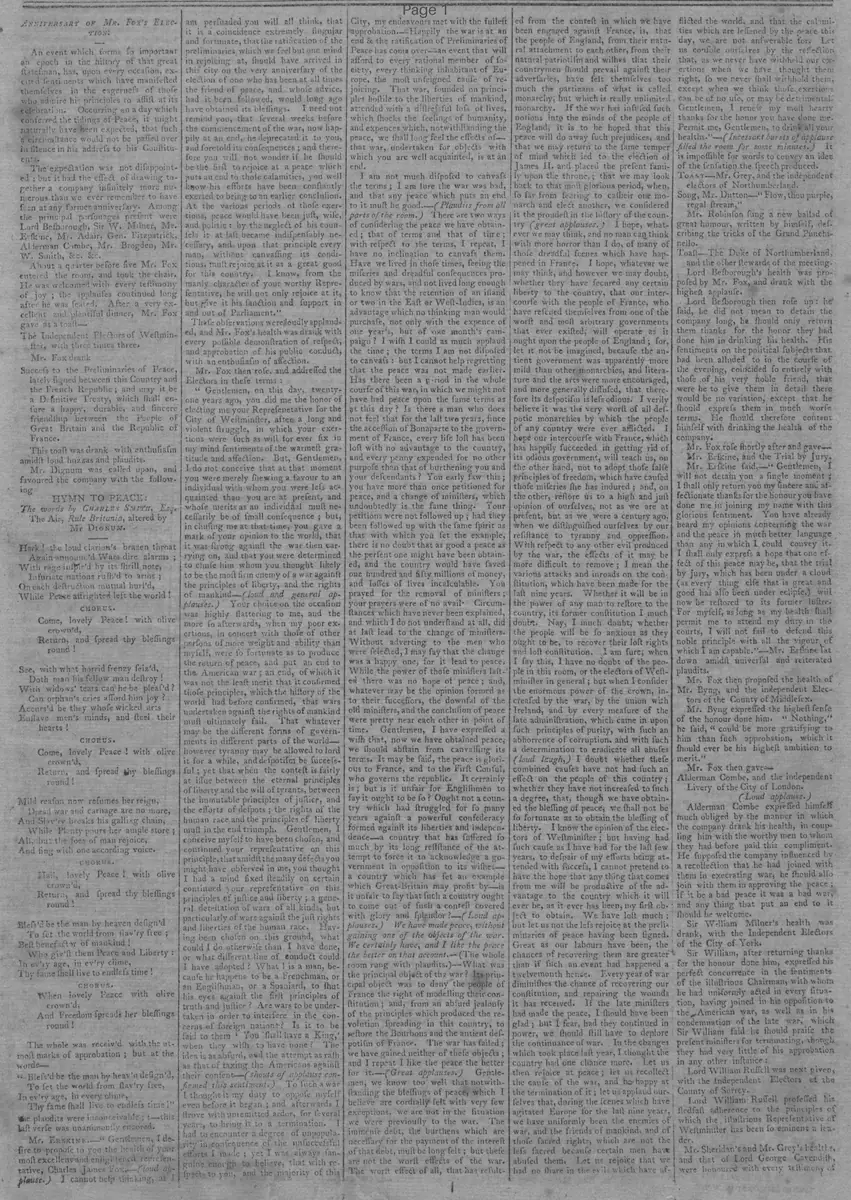
An event which forms an important epoch in the history of that great nation, has, upon every occasion, excited sentiments which have manifested themselves in the eagerness of those who admire his principles to assist at its celebration. Occurring on a day which conferred the tidings of Peace, it might naturally have been expected, that such a circumstance would not be passed over in silence in his address to his Constituents.
The expectation was not disappointed: but it had the effect of drawing together a company infinitely more numerous than we ever remember to have seen at any former anniversary. Among the principal personages present were Lord Besborough, Sir W. Milner, Mr. Erskine, Mr. Adair, Gen. Fitzpatrick, Alderman Combe, Mr. Brogden, Mr. W. Smith, &c. &c.
About a quarter before five Mr. Fox entered the room, and took the chair. He was welcomed with every testimony of joy; the applauses continued long after he was seated. After a very excellent and plentiful dinner, Mr. Fox gave as a toast
The Independent Electors of Westminster, with three times three.
Mr. Fox drank Success to the Preliminaries of Peace, lately signed between this Country and the French Republic; and may it be a Definitive Treaty, which shall ensure a happy, durable, and sincere friendship between the People of Great Britain and the Republic of France.
This toast was drank with enthusiasm amidst loud huzzas and plaudits.
Mr. Dignum was called upon, and favoured the company with the following
HYMN TO PEACE:
The words by CHARLES SWAIN, Esq.
The Air, Rule Britannia, altered by Mr. DIGNUM.
Hark! the loud clarion's brazen throat
Again announc'd War's dire alarms;
With rage inspir'd by its shrill note,
Infuriate nations rush'd to arms;
On each destruction mutual hurl'd,
While Peace affrighted left the world
CHORUS.
Come, lovely Peace! with olive crown'd,
Return, and spread thy blessings round!
See, with what horrid frenzy seiz'd,
Doth man his fellow man destroy!
With widows' tears can he be pleas'd?
Can orphan's cries afford him joy?
Accurs'd be they whose wicked arts
Enslave men's minds, and steel their hearts!
CHORUS.
Come, lovely Peace! with olive crown'd,
Return, and spread thy blessings round!
Mild reason now resumes her reign,
Dread war and carnage are no more,
And Slavery breaks his galling chain,
While Plenty pours her ample store;
All, but the foes of man rejoice,
And sing with one according voice.
CHORUS.
Hail, lovely Peace! with olive crown'd,
Return, and spread thy blessings round!
Blest be the man by heaven deign'd
To set the world from slavery free;
Best benefactor of mankind!
Who giv'st them Peace and Liberty:
In ev'ry age, in ev'ry clime,
Thy fame shall live to endless time!
CHORUS.
When lovely Peace with olive crown'd,
And Freedom spreads her blessings round!
The whole was receiv'd with the utmost marks of approbation; but at the words
Blest be the man by heav'n deign'd,
To set the world from slavery free,
In ev'ry age, in every clime,
Thy fame shall live to endless time!"
the plaudits were inconceivable; this last verse was unanimously encored.
Mr. ERSKINE. "Gentlemen, I desire to propose to you the health of your most excellent and enlightened representative, Charles James Fox,"—(loud applause.) "I cannot help thinking, as I am persuaded you will all think, that it is a coincidence extremely singular and fortunate, that the ratification of the preliminaries which we feel but one mind in rejoicing at, should have arrived in this city on the very anniversary of the election of one who has been at all times the friend of peace, and whose advice, had it been followed, would long ago have obtained its blessings. I need not remind you, that several weeks before the commencement of the war, now happily at an end, he deprecated it to you, and foretold its consequences; and therefore you will not wonder if he should be the first to rejoice at a peace which puts an end to those calamities, you well know his efforts have been constantly exerted to bring to an earlier conclusion. At the various periods of those exertions, peace would have been just, wise, and politic: by the neglect of his counsel it at last became indispensably necessary, and, upon that principle every man, without canvassing its conditions, must rejoice at it as a great good for this country. I know, from the manly character of your worthy Representative, he will not only rejoice at it, but give it his sanction and support in and out of Parliament."
These observations were loudly applauded, and Mr. Fox's health was drank with every possible demonstration of respect, and approbation of his public conduct, with an enthusiasm of affection.
Mr. Fox then rose, and addressed the Electors in these terms:
"Gentlemen, on this day, twenty-one years ago, you did me the honor of electing me your Representative for the City of Westminster, after a long and violent struggle, in which your exertions were such as will for ever fix in my mind sentiments of the warmest gratitude and affection. But, Gentlemen, I do not conceive that at that moment you were merely shewing a favour to an individual with whom you were less acquainted than you are at present, and whose merits as an individual must necessarily be of small consequence; but, in chusing me at that time, you gave a mark of your opinion to the world, that it was strong against the war then carrying on, and that you were determined to chuse him whom you thought likely to be the most firm enemy of a war against the principles of liberty, and the rights of mankind—(loud and general applauses.) Your choice on the occasion was highly flattering to me, and the more so afterwards, when my poor exertions, in concert with those of other persons of more weight and ability than myself, were so fortunate as to produce the return of peace, and put an end to the American war; an end, of which it was not the least merit that it confirmed those principles, which the history of the world had before confirmed, that wars undertaken against the rights of mankind must ultimately fail. That whatever may be the different forms of governments in different parts of the world, however tyranny may be allowed to lord it for a while, and despotism be successful; yet that when the contest is fairly at issue between the eternal principles of liberty and the will of tyrants, between the immutable principles of justice, and the efforts of despots; the rights of the human race and the principles of liberty must in the end triumph. Gentlemen, I conceive myself to have been chosen, and continued your representative on this principle, that amidst the many defects you might have observed in me, you thought I had a mind fixed steadily on certain principles of justice and liberty; a general detestation of wars of all kinds, but particularly of wars against the just rights and liberties of the human race. Having been chosen on this ground, what could I do otherwise than I have done, or what different line of conduct could I have adopted? What! is a man, because he happens to be a Frenchman, or an Englishman, or a Spaniard, to shut his eyes against the first principles of truth and justice? Are wars to be undertaken in order to interfere in the concerns of foreign nations? Is it to be said to them 'You shall have a King,' when they wish to have none? The idea is as absurd, and the attempt as rash as that of taxing the Americans against their consent—(shouts of applause confirmed this sentiment.) To such a war I thought it my duty to oppose myself even before it began; and afterwards I strove with unremitted ardor, for several years, to bring it to a termination. I had to encounter a degree of unpopularity in consequence of the unsuccessful efforts I made; yet I was always sanguine enough to believe, that with respect to you, and the minority of this City, my endeavours met with the fullest approbation. Happily the war is at an end & the ratification of Preliminaries of Peace has come over an event that will afford to every rational member of society, every thinking inhabitant of Europe, the most unfeigned cause of rejoicing. That war, founded on principles hostile to the liberties of mankind, attended with a distressful loss of lives, which shocks the feelings of humanity, and expences which, notwithstanding the peace, we shall long feel the effects of that war, undertaken for objects with which you are well acquainted, is at an end.
I am not much disposed to canvass the terms: I am sure the war was bad, and that any peace which puts an end to it must be good.—(Pl audits from all parts of the room.) There are two ways of considering the peace we have obtained; that of terms and that of time; with respect to the terms, I repeat, I have no inclination to canvass them. Have we lived in those times, seeing the miseries and dreadful consequences produced by wars, and not lived long enough to know that the retention of an island or two in the East or West-Indies, is an advantage which no thinking man would purchase, not only with the expence of one year's, but of one month's campaign? I wish I could as much applaud the time; the terms I am not disposed to canvass: but I cannot help regretting that the peace was not made earlier. Has there been a period in the whole course of this war, in which we might not have had peace upon the same terms as at this day? Is there a man who does not feel that for the last two years, since the accession of Bonaparte to the government of France, every life lost has been lost with no advantage to the country, and every penny expended for no other purpose than that of burthening you and your descendants? You early saw this; you have more than once petitioned for peace, and a change of ministers, which undoubtedly is the same thing. Your petitions were not followed up; had they been followed up with the same spirit as that with which you set the example, there is no doubt that as good a peace as the present one might have been obtained, and the country would have saved one hundred and fifty millions of money, and loss of lives incalculable. You prayed for the removal of ministers; your prayers were of no avail. Circumstances which have never been explained, and which I do not understand at all, did at last lead to the change of ministers. Without adverting to the men who were elected, I may say that the change was a happy one, for it lead to peace. While the power of those ministers lasted there was no hope of peace; and, whatever may be the opinion formed as to their successors, the downfall of the old ministers, and the conclusion of peace were pretty near each other in point of time. Gentlemen, I have expressed a wish that, now we have obtained peace; we should abstain from canvassing its terms. It may be said, the peace is glorious to France, and to the First Consul, who governs the republic. It certainly is; but is it unfair for Englishmen to say it ought to be so? Ought not a country which had struggled for so many years against a powerful confederacy formed against its liberties and independence—a country that has suffered so much by its long resistance of the attempt to force it to acknowledge a government in opposition to its wishes—a country which has set an example which Great-Britain may profit by—is it unfair to say that such a country ought to come out of such a contest covered with glory and splendor?—(Loud applauses.) We have made peace, without gaining one of the objects of the war. We certainly have, and I like the peace the better on that account.—(The whole room rung with plaudits.)—What was the principal object of that war? Its principal object was to deny the people of France the right of modelling their constitution; and, from an absurd jealousy of the principles which produced the revolution spreading in this country, to restore the Bourbons and the ancient despotism of France. The war has failed; we have gained neither of these objects; and I repeat I like the peace the better for it.—(Great applauses.) Gentlemen, we know too well that notwithstanding the blessings of peace, which I believe are cordially felt with very few exceptions, we are not in the situation we were previously to the war. The immense debt, the burthens which are necessary for the payment of the interest of that debt, must be long felt; but these are not the worst effects of the war. The worst effect of all, that has resulted from the contest in which we have been engaged against France, is, that the people of England, from their natural attachment to each other, from their natural patriotism and wishes that their countrymen should prevail against their adversaries, have felt themselves too much the partizans of what is called monarchy, but which is really unlimited monarchy. If the war has infused such notions into the minds of the people of England, it is to be hoped that this peace will do away such prejudices, and that we may return to the same temper of mind which led to the election of James II. and placed the present family upon the throne; that we may look back to that most glorious period, when, so far from fearing to cashier one monarch and elect another, we considered it the proudest in the history of the country (great applauses.) I hope, whatever we may think, and no man can think with more horror than I do, of many of those dreadful scenes which have happened in France. I hope, whatever we may think, and however we may doubt, whether they have secured any certain liberty to the country, that our intercourse with the people of France, who have rescued themselves from one of the worst and most arbitrary governments that ever existed; will operate as it ought upon the people of England; for, let it not be imagined, because the ancient government was apparently more mild than other monarchies, and literature and the arts were more encouraged, and more generally diffused, that therefore its despotism is less odious. I verily believe it was the very worst of all despotic monarchies by which the people of any country were ever afflicted. I hope our intercourse with France, which has happily succeeded in getting rid of its odious government, will teach us, on the other hand, not to adopt those false principles of freedom, which have caused those miseries she has endured; and, on the other, restore us to a high and just opinion of ourselves, not as we are at present, but as we were a century ago, when we distinguished ourselves by our resistance to tyranny and oppression. With respect to any other evil produced by the war, the effects of it may be more difficult to remove; I mean the various attacks and inroads on the constitution, which have been made for the last nine years. Whether it will be in the power of any man to restore to the country, its former constitution I much doubt. Nay, I much doubt, whether the people will be so anxious as they ought to be, to recover their lost rights and lost constitution. I am sure, when I say this, I have no doubt of the people in this room, or the electors of Westminster in general; but when I consider the enormous power of the crown, increased by the war, by the union with Ireland, and by every measure of the late administration, which came in upon such principles of purity, with such an abhorrence of corruption, and with such a determination to eradicate all abuses (loud laugh,) I doubt whether these combined causes have not had such an effect on the people of this country; whether they have not increased to such a degree, that, though we have obtained the blessing of peace; we shall not be so fortunate as to obtain the blessing of liberty. I know the opinion of the electors of Westminster; but having had such cause as I have had for the last few years, to despair of my efforts being attended with success, I cannot pretend to have the hope that any thing that comes from me will be productive of the advantage to the country which, it will ever be, as it ever has been, my first object to obtain. We have lost much: but let us not the less rejoice at the preliminaries of peace having been signed. Great as our labours have been, the chances of recovering them are greater than if such an event had happened a twelvemonth hence. Every year of war diminishes the chance of recovering our constitution, and repairing the wounds it has received. If the late ministers had made the peace, I should have been glad; but I fear, had they continued in power, we should still have to deplore the continuance of war. In the changes which took place last year, I thought the country had one chance more. Let us then rejoice at peace; let us recollect the cause of the war, and be happy at the termination of it; let us applaud ourselves that, during the scenes which have agitated Europe for the last nine years, we have uniformly been the enemies of war, and the friends of mankind, and of those sacred rights, which are not the less sacred because certain men have abused them. Let us rejoice that we had no share in the evils which have afflicted the world, and that the calamities which are lessened by the peace this day, we are not answerable for. Let us console ourselves by the reflection that, as we never have withheld our exertions when we have thought them right, so we never shall withhold them, except when we think those exertions can be of no use, or may be detrimental. Gentlemen, I renew my most hearty thanks for the honor you have done me. Permit me, Gentlemen, to drink all your healths."—(Incessant bursts of applause filled the room for some minutes.) It is impossible for words to convey an idea of the sensation the speech produced.
TOAST—Mr. Grey, and the independent electors of Northumberland.
Song, Mr. Dutton—"Flow, thou purple, regal stream,"
Mr. Robinson sung a new ballad of great humour, written by himself, describing the tricks of the Grand Punchinello.
Toast—The Duke of Northumberland, and the other stewards of the meeting—
Lord Besborough's health was proposed by Mr. Fox, and drank with the highest applause.
Lord Besborough then rose up: he said, he did not mean to detain the company long, he should only return them thanks for the honor they had done him in drinking his health. His sentiments on the political subjects that had been alluded to in the course of the evening, coincided so entirely with those of his very noble friend, that were he to give them in detail there would be no variation, except that he should express them in much worse terms. He should therefore content himself with drinking the health of the company.
Mr. Fox rose shortly after and gave—
Mr. Erskine, and the Trial by Jury.
Mr. Erskine said,—"Gentlemen, I will not detain you a single moment; I shall only return you my sincere and affectionate thanks for the honour you have done me in joining my name with this glorious sentiment. You have already heard my opinions concerning the war and the peace in much better language than any in which I could convey it. I shall only express a hope that one effect of this peace may be, that the trial by jury, which has been under a cloud (as every thing else that is great and good has also been under eclipse,) will now be restored to its former lustre. For myself, as long as my health shall permit me to attend my duty in the courts, I will not fail to defend this noble principle with all the vigour of which I am capable." Mr. Erskine sat down amidst universal and reiterated plaudits.
Mr. Fox then proposed the health of
Mr. Byng, and the independent Electors of the County of Middlesex.
Mr. Byng expressed the highest sense of the honour done him. "Nothing," he said, "could be more gratifying to him than such approbation, which it should ever be his highest ambition to merit."
Mr. Fox then gave
Alderman Combe, and the independent Livery of the City of London.
(Loud applause.)
Alderman Combe expressed himself much obliged by the manner in which the company drank his health, in coupling him with the worthy men to whom they had before paid this compliment. He supposed the company influenced by a recollection that he had joined with them in execrating war, he should also join with them in approving the peace; if it be a bad peace it was a bad war, and any thing that put an end to it should be welcome.
Sir William Milner's health was drank, with the Independent Electors of the City of York
Sir William, after returning thanks for the honour done him, expressed his perfect concurrence in the sentiments of the illustrious Chairman, with whom he had uniformly acted in every situation, having joined in his opposition to the American war, as well as in his condemnation of the late war, which Sir William said he should praise the present ministers for terminating, though they had very little of his approbation in any other instance:
Lord William Russell was next given,
with the Independent Electors of the County of Surrey.
Lord William Russell professed his steadfast adherence to the principles of which the illustrious Representative of Westminster has been so eminent a leader.
Mr. Sheridan's and Mr. Grey's Healths, and that of Lord George Cavendish, were honoured with every testimony of
approbation, though neither of them was vicious.
About half past eight, previous to his retiring, Mr. Fox gave the usual toast—
The cause of Liberty all over the Globe; which was hailed with the loudest and most universal applause, and shortly after its ablest advocate left the room amidst the warmest proofs of the most affectionate approbation.
What sub-type of article is it?
What keywords are associated?
What entities or persons were involved?
Where did it happen?
Foreign News Details
Primary Location
France
Event Date
Ratification Of The Preliminaries Of Peace Lately Signed Between This Country And The French Republic, Arrived On The Anniversary Of Mr. Fox's Election Twenty One Years Ago
Key Persons
Outcome
the war is at an end; peace obtained without gaining objects of the war such as denying france the right to model its constitution or restoring the bourbons; immense debt and burthens to be long felt; ratification arrived, celebrated with enthusiasm
Event Details
At the anniversary dinner of Charles James Fox's election as Representative for Westminster, attended by numerous principal personages, toasts were given to the Independent Electors and Success to the Preliminaries of Peace with the French Republic. A Hymn to Peace was sung. Mr. Erskine proposed Fox's health, praising his friendship to peace. Fox addressed the electors, expressing gratitude, criticizing the war against French liberties, regretting its delay, and rejoicing at the peace despite its terms, noting it ends a war hostile to mankind's liberties. Further toasts and speeches followed, supporting peace and anti-war principles.