Thank you for visiting SNEWPapers!
Sign up free
Summit County Labor News
Akron, Summit County, Ohio
What is this article about?
The U.S. Bureau of Labor Statistics reported on Nov. 29 that the cost of living index reached a record high of 174.8 on Oct. 15, up from September, triggering wage increases of 2-3 cents per hour for 900,000 workers, mainly in the auto industry. Wholesale food prices also rose, and a rent correction will push the index higher to 176.1. Walter Reuther criticized inflation amid Korean War costs.
Merged-components note: Merged story from page 1 and continuation from page 4 on cost of living index reaching record high; relabeled to domestic_news as it is a non-narrative economic report.
Clippings
1 of 2
OCR Quality
Full Text
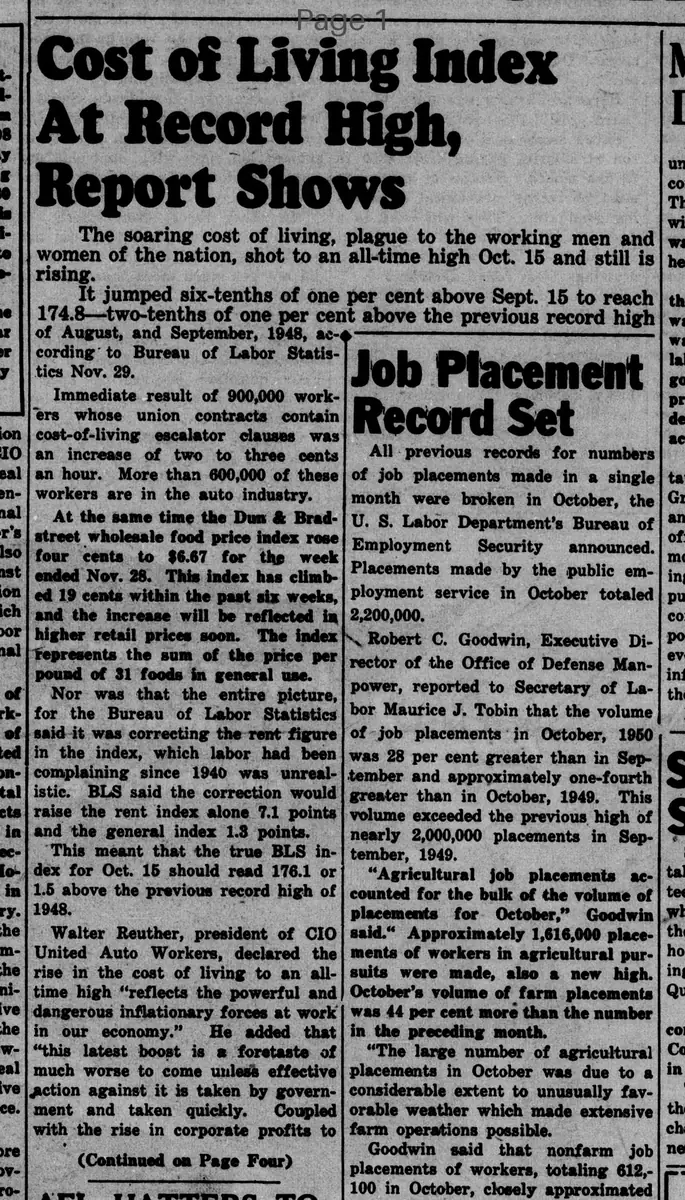
The soaring cost of living, plague to the working men and women of the nation, shot to an all-time high Oct. 15 and still is rising.
It jumped six-tenths of one per cent above Sept. 15 to reach 174.8—two-tenths of one per cent above the previous record high of August, and September, 1948, according to Bureau of Labor Statistics Nov. 29.
Immediate result of 900,000 workers whose union contracts contain cost-of-living escalator clauses was an increase of two to three cents an hour. More than 600,000 of these workers are in the auto industry.
At the same time the Dun & Bradstreet wholesale food price index rose four cents to $6.67 for the week ended Nov. 28. This index has climbed 19 cents within the past six weeks, and the increase will be reflected in higher retail prices soon. The index represents the sum of the price per pound of 31 foods in general use.
Nor was that the entire picture, for the Bureau of Labor Statistics said it was correcting the rent figure in the index, which labor had been complaining since 1940 was unrealistic. BLS said the correction would raise the rent index alone 7.1 points and the general index 1.3 points.
This meant that the true BLS index for Oct. 15 should read 176.1 or 1.5 above the previous record high of 1948.
Walter Reuther, president of CIO United Auto Workers, declared the rise in the cost of living to an all-time high "reflects the powerful and dangerous inflationary forces at work in our economy." He added that "this latest boost is a foretaste of much worse to come unless effective action against it is taken by government and taken quickly. Coupled with the rise in corporate profits to
PAGE FOUR
Cost of Living Index At Record High, Report Shows
(Continued from Page One)
new all-time levels, the increase in living costs testifies to the success of Big Business in shifting to the shoulders of those least able to bear it-the cost of the Korean War and the defense program.
"Inflationary price-profiteering is undermining the living standards of all low-income families whose bread-winners are not protected by cost-of-living escalator contracts. Fantastic auto industry profits answer in advance any claim that the coming three cents an hour wage increase requires an increase in the industry's prices. We sincerely hope the auto industry will furnish a salutary example to industry generally by holding the line on its prices."
The increase in the index meant raises for workers at General Motors, Ford, Kaiser-Frazer, Packard, Studebaker, Bendix and North American Aviation. Chrysler does not have an escalator clause.
The escalator clause calls for an increase of one cent for every 1.14 fluctuation in the index, with a limit on cuts if the index drops. However, the contracts with GM, Ford and other firms added 1.3 to the index as a rent allowance, bringing the raise to three cents. Wage adjustments are made quarterly.
Estimated cost to the auto industry for the December-January-February period is $720,000 a week or $9 million for the entire period.
Salaried employees also benefitted, with 80,000 at GM and 25,000 at Ford getting $15 and $15.75, respectively for the quarter.
Ford has 120,000 non-salaried workers and GM has 357,000 covered by union contracts.
International Harvester announced that 85,000 employees will get increases of three cents totaling $5 million, including members of the UAW-CIO and the Farm Equipment Workers.
The BLS consumers' price index measures the cost of an average family's goods and services. The BLS reported all principal commodities cost more in October. House furnishings were up 2.3 per cent, apparel up 1.5 per cent. Food prices were up two-tenths of one per cent to 209 of the 1935-39 average and only a seasonal drop in meat prices kept it from going higher. Fuel, electricity and refrigeration rose fractionally, as did rents and miscellaneous goods and services.
Egg prices went up 7.4 per cent between September and October; dairy products, 2.9; fruits and vegetables, 1.3; coffee, 2.1; fish prices, 5.6.
Meat prices fell 3.3, led by a 12 per cent drop for pork chops. But the food index, at 209, was still 3.6 per cent under the July, 1948, record-high of 216.8.
What sub-type of article is it?
What keywords are associated?
What entities or persons were involved?
Domestic News Details
Event Date
Oct. 15
Key Persons
Outcome
wage increases of 2-3 cents per hour for 900,000 workers, mainly in auto industry; estimated $9 million cost to auto industry for quarter; $5 million for international harvester employees; higher retail food prices expected; corrected index to 176.1.
Event Details
Bureau of Labor Statistics reported cost of living index reached 174.8 on Oct. 15, up 0.6% from Sept. 15, surpassing 1948 record; rent correction to raise it to 176.1; Dun & Bradstreet wholesale food index rose to $6.67; escalator clauses triggered wage hikes in unions; Reuther blamed inflation on Big Business and Korean War costs.