Thank you for visiting SNEWPapers!
Sign up free
Richmond Enquirer
Richmond, Richmond County, Virginia
What is this article about?
The Northwestern Virginia Rail-Road Convention assembled in Clarksburg on May 20, with delegates from multiple counties, electing officers and adopting a preamble and resolutions urging the legislature to grant rights for a railroad from the Potomac to the Ohio River above the Little Kanawha, protesting prior denial and threatening to withhold support for other state improvements.
Clipping
OCR Quality
Full Text
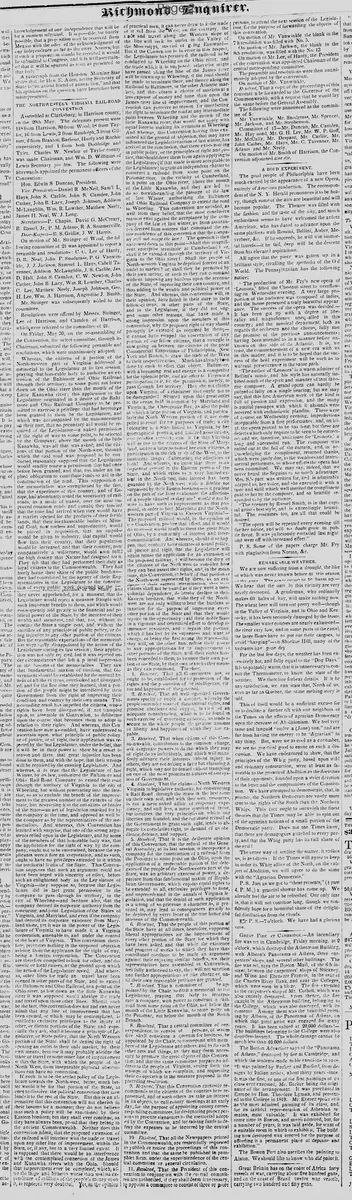
Assembled at Clarksburg, in Harrison county, on the 20th May. The delegates present were 115 from Harrison, 80 from Wood, 18 from Taylor, 16 from Lewis, 3 from Randolph, 3 from Gilmer, 2 from Braxton, Barbour, Hardy and Ritchie respectively, and 1 from both Doddridge and Tyler. Charles W. Newlon of Taylor county was made Chairman, and Wm. D. Williams of Lewis Secretary pro tem. The following were afterwards appointed the permanent officers of the Convention:
Hon. Edwin S. Duncan, President.
Vice Presidents—Daniel R. McNeil, Sam'l L. Hays, John S. Carlile, John S. Camden, John Cather, John B. Lacy, Joseph Johnson, Addison McLaughlin, Wm. R. Lowther, Matthew Neely, James H. Neal, W. J. Long.
Secretaries—P. Chapin, David G. McCreary, B. Bassel, Jr., P. M. Adams, R. A. Sommerville.
Door-Keepers—B. S. Griffin, J. W. Harris.
On motion of Mr. Stringer of Wood, the following committee of 21 was appointed to report a preamble and resolutions: C. C. Lee of Hardy, D. R. Neal, John F. Snodgrass, P. G. Vanwinkle, J. J. Jackson, Samuel L. Hays, Cabell Tavener, Addison McLaughlin, J. S. Carlile, Jas. D. Hall, John S. Camden, C. W. Newlon, John C. Lee, Matthew Neely, Joseph Johnson, Geo. Cather, John B. Lacy, Wm. R. Lowther, Charles H. Lee, Wm. A. Harrison, Augustine J. Smith.
Mr. Stringer was subsequently added to the committee.
Resolutions were offered by Messrs. Stringer, Lee of Harrison, and Camden of Harrison, which were referred to the committee of 21.
On Friday, May 30, on the re-assembling of the Convention, the select committee, through its Chairman, submitted the following preamble and resolutions, which were unanimously adopted:
Whereas, the citizens of a portion of the North-western part of Virginia addressed a memorial to the Legislature at its last session, praying that honorable body to authorise an extension of the Baltimore and Ohio Railroad through their territory, to some point not lower down on the Ohio river than the mouth of the Little Kanawha river; this application to the Legislature originated in a desire of the Baltimore and Ohio Railroad Company to be permitted to exercise a privilege that had heretofore been granted to them by the Legislature, and which was accompanied by the announcement on their part, that no pecuniary aid would be required of the Legislature—a naked permission of the right of way to some point, to be selected by the Company, above the mouth of the Little Kanawha, was all that was asked; and the citizens of that portion of the North-west, through which the said road was proposed to be conducted, reasonably supposed that the Legislature would readily renew a permission that had once before been granted, and that, too, under an implied obligation to contribute funds to aid in the construction of the road. This supposition of the memorialists was strengthened by the fact, that the experience of this country, and of Europe, had abundantly tested the superiority of rail-roads, as a mode of transit, over the most improved common roads and canals; they fancied that the time had arrived when they would have a market opened for the products of their fertile lands, that their inexhaustible bodies of Mineral Coal, now useless and unproductive, would be placed in requisition, that an impulse would be given to industry, that capital would flow into their country, that their population would be increased, and that their country, now comparatively a wilderness, would soon fulfill the high destiny that Nature had designed for it. They felt that they had performed their duty as loyal citizens to the Commonwealth. They had freely borne their share of the public burdens—they had contributed by the agency of their Representatives in the Legislature to the construction of every road and canal in the State—they never apprehended, for a moment, that the Legislature would reject a measure fraught with such important benefits to them, and which would consequently add greatly to the financial and political power of the State, by the increase of their wealth and numbers, and that, too, without its costing the State a single cent, and without the sacrifice of any principle of public policy, or doing injustice to any other portion of the citizens. But the reasonable expectations of the memorialists were sadly disappointed by the action of the Legislature during its last session; their application was not only rejected, but it was rejected under circumstances that left a painful impression in the bosoms of the memorialists. They saw that fundamental maxim of freedom, that Government should be established for the mutual benefit of all the citizens, overlooked and disregarded, and for the first time they learned, that a portion of the people might be interdicted by their Government from the right of improving their condition and country by their own means. This astounding result has impelled the citizens, whose rights have been disregarded, if not trampled upon, to assemble in Convention, to deliberate upon the course that becomes them to adopt in relation to their rights. And whereas, this Convention here now assembled, have endeavored to ascertain upon what principle of public policy or of justice, or of right, their application was rejected by the last Legislature, under the belief, that it will be in their power to show by a resort to reason and facts, that great injustice has been done to them, and with the hope, that their wrong will be repaired by the ensuing Legislature. And whereas, it is true that the Legislature of last Winter, by its law, authorized the Baltimore and Ohio Rail Road Company to extend their road through the territory of Virginia to the city of Wheeling, but without penetrating into the interior, so as to exclude the benefit of the improvement to the greatest number of the citizens of the State, but restricting it to the out-skirts or border of the State—an act of legislation unasked for by the company at the time, and opposed as well by the company as by the representatives of the memorialists. And whereas, this Convention has learned with surprise, that one of the strong arguments relied upon in the Legislature, and by some of the members of that honorable body was, that the application for the right of way by the company, ought not to be entertained, because the applicants were a foreign corporation, and as such, ought to have no privileges extended to it within the territorial limits of the State. This Convention supposes that such an argument could not have been urged with sincerity or effect, before such an enlightened body as the Legislature of Virginia—they suppose so, because that Legislature did in fact grant permission to the company to pass through its territory, to the city of Wheeling—and because also, that the company derived its corporate authority from the concurring, and joint Legislation of the States of Virginia, and Maryland, and even if the company had derived its corporate existence from Maryland alone, yet it was in the power of the Legislature of Virginia to have made it a Virginia corporation, amenable to, and under the control of the laws of Virginia. This convention therefore, perceives nothing in the supposed objection arising from the applicants for the right of way, being a foreign corporation. The Convention are therefore compelled to look for other, and domestic or local causes, as the ground upon which the action of the Legislature rested. And whereas, other lines for trade and travel have been opened in other parts of the State, and to extend the Baltimore and Ohio Railroad, to a point on the Ohio river, as low down as the little Kanawha river it was supposed would abridge the trade and travel upon those other lines. Should such be the fact, this convention does not and can never admit that any line of improvement that has been opened, or which may be contemplated, is entitled to exclusive privileges to the injury of other, or distant portions of the State: and especially they ask, shall it become a principle of Legislative, or State policy, that the North Western portion of the State shall be denied the right of opening an outlet to their only market, by their own means, because it may probably abridge the trade or travel or some other line of improvement within the State, with which the people of the North West, from inseparable physical obstructions can have no connection. If such is to be the settled policy of the Legislature towards the North-west, better, much better would it be for that portion of the State, at once to dissolve the political connection that now binds it to the rest of the State. But this is an alternative that this convention will not cherish in their bosoms for a moment; they do not believe that such a policy will be sanctioned by their Eastern brethren; but they shall ever continue, as they have always been, proud that they belong to the ancient Commonwealth. Neither does this convention admit, that the proposed extension of the railroad will interfere with the trade or travel upon any other line of improvement, within the State, or, if any, but to a very limited extent. It is supposed that there would be an interference with the contemplated connection of the James and Kanawha rivers with the Ohio. Should that improvement ever be completed, which, after the large and hitherto worse than useless expenditure of millions of the people's money upon it, is rendered very doubtful, yet, in the opinion of practical men, it can never draw to it the trade or travel from the West; on the contrary, the trade and travel along the Western slope of the line will seek its outlet in the Valley of the Mississippi, instead of going Eastward—But if the Convention is inferior in this respect, the Legislature has permitted the railroad to be conducted to Wheeling on the Ohio river, and the trade which it is supposed, otherwise might have passed along the line of the James river will be drawn up to Wheeling, if the road should be made to terminate there, and thence along the Railroad to Baltimore, or the other Atlantic markets, and thus obtain a choice of markets at a less expense of money and time than upon the James river line of improvement; and the Convention can perceive no reason for interdicting the right to terminate the road at any intermediate point between Wheeling and the mouth of the little Kanawha river, that would not apply with equal force to making its terminus at Wheeling: And whereas, this Convention having thus examined all the ground of objection, that may have influenced the Legislative action of last winter, has arrived at the conclusion, that there exists nothing in public policy, or the principles of right and justice, that should deter them from again applying to the Legislature (if that mode is more acceptable to the Legislature) to grant an independent charter to construct a railroad from some point on the Potomac river, in the vicinity of Cumberland, to a point on the Ohio river, above the mouth of the Little Kanawha, and they are led to do so notwithstanding the passage of the law of last Winter, authorizing the Baltimore and Ohio Railroad Company to extend the road to Wheeling. This convention are satisfied, as well from their belief, that the most conclusive reasons exist against the acceptance by the company of the law of last winter, as from assurances derived from sources that command the entire confidence of this convention that the company will not accept the law! The question is then narrowed down to this point—Shall this magnificent enterprise terminate at Cumberland? or, shall it be extended through the territory of Virginia to the Ohio river? Shall the people of North-western Virginia be deprived forever of an outlet to market? or, shall they be permitted by their own means, or such as they can command without imposing any burdens upon the revenue of the State, of improving their own country, and thus adding to the wealth and political power of the State. "And whereas, this convention will, in their opinion, have failed in their duty to their fellow-citizens, in other parts of the State, and to the Legislature, if they did not suggest some other reasons, that have made a strong impression upon the members of this convention, why the proposed right of way should promptly be extended as required by them;—it cannot have escaped the observation of any portion of our fellow citizens, that a struggle is now going on between the citizens of the great Commercial Emporiums of Philadelphia, New York and Boston, to draw the trade of the West to their respective cities. Much has already been done by each to effect that object. Baltimore, with a becoming zeal and energy is a competitor for the splendid prize, and she offers to Virginia a participation in it, for the permission, merely, to pass through her territory. Has she not claims upon Virginia, of a character that ought not to be disregarded? Situated upon that great outlet to the ocean, held in common by Maryland and Virginia, the Chesapeake Bay, as also the point at which a large portion of Virginia, and particularly the North Western portion of it, are compelled to resort for the purposes of trade; a city belonging to a State linked to Virginia, by her geographical position, and kindred associations, on common interests; can it be that Virginia will refuse to the citizens of the State of Maryland, and to a large portion of her own citizens, a participation in the rich trade of the West, to the imminent danger of alienating the affections of both? And whereas, we know that there is an important interest in the Eastern portion of the State, and which exists to a very limited extent in the North west; that interest has been guarded by the North west with a fidelity not surpassed by their Eastern brethren—is it prudent on the part of the latter to alienate the affections of a people situated as they are? would it not be wise to have such an improvement as that proposed, in order to bind Maryland and the North western part of Virginia to Eastern Virginia?—The proposed railroad would, in the opinion of the Convention, produce that effect, and it would do more—it would attach to them the great State of Ohio, by a community of interest and intercourse. And whereas, should it so happen, that, contrary to the dictates of sound policy, of justice and right, that the Legislature will again refuse the application for an extension of the proposed railway, it will become the duty of the citizens of the North west to consider how they can best assert their rights, and, in the mean time, this Convention, on behalf of that portion of the North-west represented by them, as an evidence of their earnest determination, that their claims shall not be treated as if they were a mere colonial dependency, do hereby declare to their Eastern brethren, that whilst they of the North west are not only willing to bear the burdens of taxation for the purpose of improving every other portion of the State and that they would rejoice in the opportunity to aid their noble State in a vigorous and determined effort to develop its immense resources, and to regain the position which it has lost by its supineness and want of energy, of being the first among the States—they will, on the other hand, refuse their assent to any appropriations for the improvement of other portions of the State, until their rights have been conceded to them, to improve their own portion of the State, by their own or such other means as they can command. Therefore,
1. Resolved, That all Governments are, or ought to be, established for the protection of the rights and the promotion of the intelligence, virtue and happiness of the governed.
Resolved, That all well organized Governments specify or imply a compact, whereby the people surrender some of their natural rights, and promise obedience and support, in view of an adequate consideration, which is to be found in such exercise of governing authority, as tends to secure to the whole people the greatest amount of liberty and happiness of which they are capable.
3. Resolved, That when citizens of this Commonwealth, contributors to the common charge ask corporate powers to do that which they may of right do as individuals, and which will manifestly advance their interests without injury to others, they are not asking a favor but claiming a right, which may not be denied without trampling on one of the most prominent features of our system of Government.
Resolved, That the claims of North-Western Virginia to legislative authority, for constructing a Rail Road through the State on the best route on their own soil, and with their own resources, is not a mere naked affair of temporary expediency, and still less, a mere question of favor, but involves the very principles on which our liberties are founded, and the continued refusal of the Government to grant such right, tends to abrogate its correlative right, to demand of us obedience, defense, and support.
5. Resolved, That it is the deliberate opinion of this Convention, that the refusal of the General Assembly, at its last session, to incorporate a company for the construction of a railroad from the Potomac to some point on the Ohio, upon the application of a respectable portion of the delegates of the people of the Northwestern part of the State, was an arbitrary exercise of power, a departure from that fundamental maxim of Republican Government, which enjoins equal rights to be extended to all, exclusive privileges to none, and unprecedented in the annals of Virginia legislation, and that the denial of such application is a wrong of so grievous a character as, if persisted in, may lead to consequences greatly to be deplored by every lover of the true honor and interests of the Commonwealth.
6. Resolved, That the people of this portion of the State have at all times, heretofore, supported liberal appropriations for the improvement of every other portion of the State for which they have been asked, and that while the existence and progress of works to which they have thus contributed continue to be made an argument against their enjoying similar benefits, we, their representatives here assembled in Convention, feel fully authorised to say, they will not sanction any further appropriations of like character, until their own reasonable petitions are granted.
7. Resolved, That a committee of be appointed by the Chair to draft a memorial to the Legislature, praying that body to incorporate a company, with power to construct a railroad from some point on the Ohio, not below the mouth of the Little Kanawha, to some point on the Potomac, not below the mouth of the South Branch.
8. Resolved, That a central committee of correspondence, to consist of persons, of whom five shall constitute a quorum for business, be appointed by the Chair, to correspond with members of the Legislature and others, and to do such other acts and things, as they may deem necessary to promote the great objects of this Convention; and that the same committee prepare an address to the people of Virginia, setting forth the wrongs of which we complain, and requesting their co-operation in the measure proposed in the preceding resolution.
9. Resolved, That this Convention earnestly recommends to the citizens of the counties here represented, and of such others as take an interest in its objects, to call county meetings at an early day, for the purpose of appointing county corresponding committees, for designating proper persons to procure signatures to the memorial adopted by the Convention, and for raising funds to defray the expenses to be incurred by the central committee.
10. Resolved, That all the Newspapers printed in the Commonwealth, are respectfully requested to publish or notice the proceedings of this convention and that the same be published in pamphlet form, under the superintendence of the central committee for general circulation.
11. Resolved, That the President of this convention in conjunction with the central committee are authorized, if they shall deem it necessary, in appoint a committee to consist of three or more persons, to attend the next session of the Legislature, for the purpose of forwarding the objects of this convention.
The 7th resolution was filled with No. 5.
On motion of Mr. Vanwinkle the blank in the 8th resolution, was filled with the No. 13.
On motion of Mr. Jackson, the blank in the 9th was filled with No. 5.
On motion of Mr. Lee, of Hardy, the President of the convention was appointed Chairman of the central corresponding committee.
The preamble and resolutions were then unanimously adopted by the convention.
On motion of Mr. Vanwinkle, Resolved, That a copy of the proceedings of this convention be forwarded to the Governor of the Commonwealth, with a request that he would lay the same before the General Assembly.
The following were announced as the committee of 5:
Mr. Vanwinkle, Mr. Snodgrass, Mr. Spencer, Mr. Jackson, and Mr. Stephenson.
Committee of 13—Mr. Duncan, Mr. Camden, John Cather, Mr. Hays, Mr. C. Tavener, Mr. McCally, Mr. Despard, Mr. Carlile, Mr. Adams and Mr. Neely. Mr. Haywood, Mr. G. H. Lee, Mr. W. P. Goff.
On motion of Mr. Smith of Harrison, the Convention adjourned sine die.
What sub-type of article is it?
What keywords are associated?
What entities or persons were involved?
Where did it happen?
Domestic News Details
Primary Location
Clarksburg, Harrison County, Virginia
Event Date
20th May To 30th May
Key Persons
Outcome
preamble and resolutions unanimously adopted; committees appointed to draft memorial, prepare address, and promote the cause; convention adjourned sine die.
Event Details
Delegates from northwestern Virginia counties assembled in convention to protest the legislature's refusal to allow extension of the Baltimore and Ohio Railroad through their territory to the Ohio River above the Little Kanawha. They elected officers, formed committees, and adopted a detailed preamble criticizing the decision and resolutions demanding legislative action for an independent railroad charter, threatening to withhold support for other state improvements if denied.