Thank you for visiting SNEWPapers!
Sign up free
National Gazette
Philadelphia, Philadelphia County, Pennsylvania
What is this article about?
In a congressional committee debate on the New Representation Bill, Mr. Giles advocates for a 1:30,000 representation ratio to maximize representatives as per the Constitution, arguing it promotes republicanism, counters monied interests, and ensures sympathy with the people's landed interests against growing inequalities and executive overreach.
Clipping
OCR Quality
Full Text
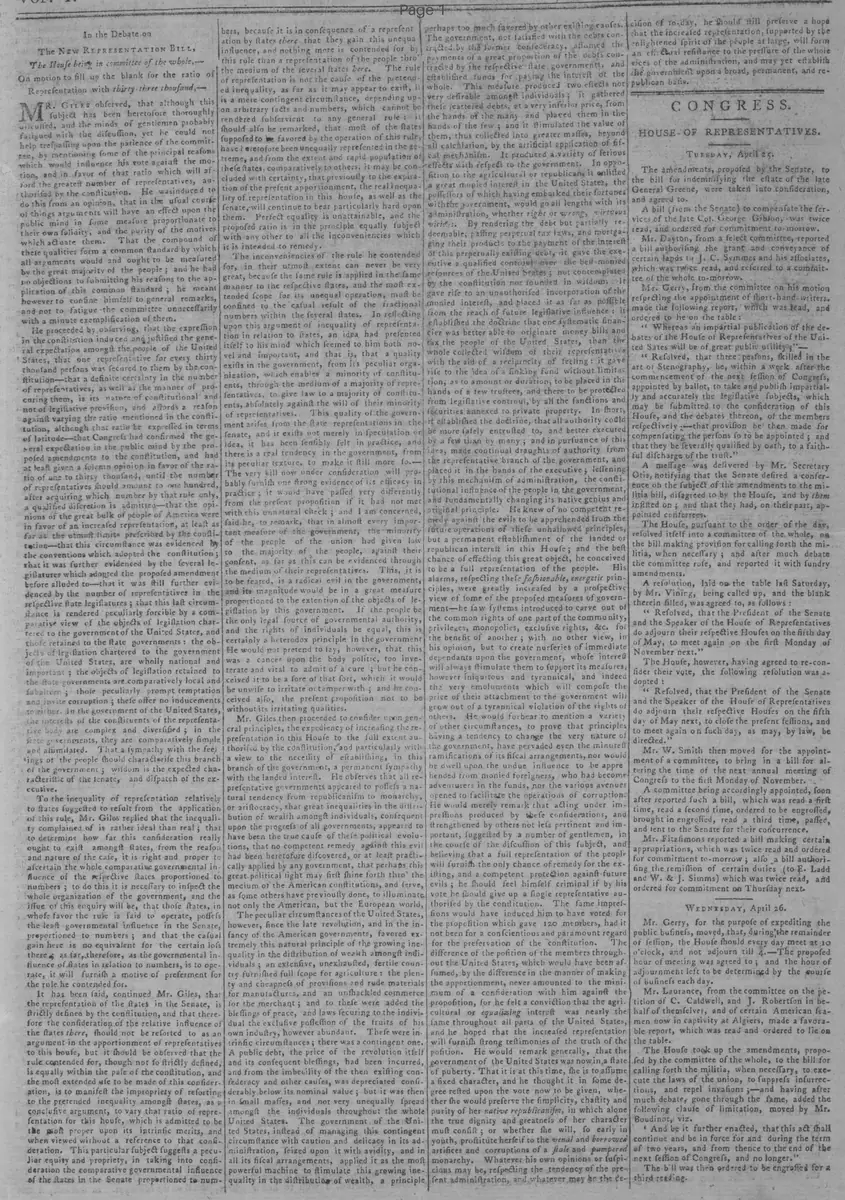
The one being in committee of the whole,-
On motion to fill up the blank for the ratio of Representation with thirty three thousand,-
Mr. Giles observed, that although this subject has been heretofore thoroughly discussed, and the minds of gentlemen probably fatigued with the discussion, yet he could not help trespassing upon the patience of the committee, by mentioning some of the principal reasons which would influence his vote against the motion, and in favor of that ratio which will afford the greatest number of representatives, authorized by the constitution. He was induced to do this from an opinion, that in the usual course of things arguments will have an effect upon the public mind in some measure proportionate to their own solidity, and the purity of the motives which actuate them. That the compound of these qualities form a common standard by which all arguments would and ought to be measured by the great majority of the people; and he had no objections to submitting his reasons to the application of this common standard; he meant however to confine himself to general remarks, and not to fatigue the committee unnecessarily with a minute exemplification of them.
He proceeded by observing, that the expression in the constitution induces and justified the general expectation amongst the people of the United States, that one representative for every thirty thousand persons was secured to them by the constitution-that a definite certainty in the number of representatives, as well as the manner of procuring them, is its nature of constitutional and not of legislative provision, and affords a reason against varying that ratio mentioned in the constitution, although that ratio be expressed in terms of latitude--that Congress had confirmed the general expectation in the public mind by the proposed amendments to the constitution, and had at least given a solemn opinion in favor of the ratio of one to thirty thousand, until the number of representatives should amount to one hundred, after acquiring which number by that rule only, a qualified discretion is admitted-that the opinions of the great bulk of people of America were in favor of an increased representation, at least as far as the utmost limits prescribed by the constitution-that this circumstance was evidenced by the conventions which adopted the constitution; that it was further evidenced by the several legislatures which adopted the proposed amendment before alluded to-that it was still further evidenced by the number of representatives in the respective state legislatures; that this last circumstance is rendered peculiarly forcible by a comparative view of the objects of legislation chartered to the government of the United States, and those retained to the state governments: the objects of legislation chartered to the government of the United States, are wholly national and important; the objects of legislation retained to the state governments are comparatively local and subaltern; those peculiarly prompt temptation and invite corruption; these offer no inducements to either. In the government of the United States, the interests of the constituents of the representative body, are complex and diversified; in the state governments, they are comparatively simple and assimilated. That a sympathy with the feelings of the people should characterize this branch of the government; wisdom is the expected characteristic of the senate, and dispatch of the executive.
To the inequality of representation relatively to states suggested to result from the application of this rule, Mr. Giles replied that the inequality complained of is rather ideal than real; that to determine how far this consideration really ought to exist amongst states, from the reason and nature of the case, it is right and proper to ascertain the whole comparative governmental influence of the respective states proportioned to numbers; to do this it is necessary to inspect the whole organization of the government, and the issue of this enquiry will be, that those states, in whose favor the rule is said to operate, possess the least governmental influence in the Senate, proportioned to numbers; and that the casual gain here is no equivalent for the certain loss there. As far, therefore, as the governmental influence of states in relation to numbers, is to operate, it will furnish a motive of preference for the rule he contended for.
It has been said, continued Mr. Giles, that the representation of the states in the Senate, is strictly defined by the constitution, and that therefore the consideration of the relative influence of the states there, should not be resorted to as an argument in the apportionment of representatives to this house, but it should be observed that the rule contended for, though not so strictly defined, is equally within the pale of the constitution, and the most extended use to be made of this consideration, is to manifest the impropriety of resorting to the pretended inequality amongst states, as a conclusive argument, to vary that ratio of representation for this house, which is admitted to be the most proper upon its intrinsic merits, and when viewed without a reference to that consideration. This particular subject suggests a peculiar equity and propriety, in taking into consideration the comparative governmental influence of the states in the Senate proportioned to numbers, because it is in consequence of a representation by states there that they gain this unequal influence, and nothing more is contended for by this rule than a representation of the people thro' the medium of the several states here. The rule of representation is not the cause of the pretended inequality, as far as it may appear to exist, it is a mere contingent circumstance, depending upon arbitrary facts and numbers, which cannot be rendered subservient to any general rule: it should also be remarked, that most of the states supposed to be favored by the operation of this rule, have heretofore been unequally represented in the extreme, and from the extent and rapid population of these states, comparatively to others, it may be concluded with certainty, that previously to the expiration of the present apportionment, the real inequality of representation in this house, as well as the senate, will continue to bear particularly hard upon them. Perfect equality is unattainable, and the proposed ratio is in the principle equally subject with any other to all the inconveniences which it is intended to remedy.
The inconveniences of the rule he contended for, in their utmost extent can never be very great, because the same rule is applied in the same manner to the respective states, and the most extended scope for its unequal operation, must be confined to the casual result of the fractional numbers within the several states. In reflecting upon this argument of inequality of representation in relation to states, an idea had presented itself to his mind which seemed to him both novel and important, and that is, that a quality exists in the government, from its peculiar organization, which enables a minority of constituents, through the medium of a majority of representatives, to give law to a majority of constituents, absolutely against the will of their minority of representatives. This quality of the government arises from the state representations in the senate, and it exists not merely in speculation or idea, it has been sensibly felt in practice, and there is a real tendency in the government, from its peculiar texture, to make it still more so. The very bill now under consideration will probably furnish one strong evidence of its efficacy in practice; it would have passed very differently from the present proposition if it had not met with this unnatural check; and I am concerned, said he, to remark, that in almost every important measure of the government, the minority of the people of the union had given law to the majority of the people, against their consent, as far as this can be evidenced through the medium of their representatives. This, it is to be feared, is a radical evil in the government, and its magnitude would be in a great measure proportioned to the extension of the objects of legislation by this government. If the people be the only legal source of governmental authority, and the rights of individuals be equal, this is certainly a heterodox principle in the government. He would not pretend to say, however, that this was a cancer upon the body politic, too inveterate and vital to admit of a cure; but he conceived it to be a sore of that sort, which it would be unwise to irritate or tamper with; and he conceived also, the present proposition not to be without its irritating qualities.
Mr. Giles then proceeded to consider upon general principles, the expediency of increasing the representation in this House to the full extent authorized by the constitution, and particularly with a view to the necessity of establishing, in this branch of the government, a permanent sympathy with the landed interest. He observed that all representative governments appeared to possess a natural tendency from republicanism to monarchy, or aristocracy, that great inequalities in the distribution of wealth amongst individuals, consequent upon the progress of all governments, appeared to have been the true cause of these political evolutions, that no competent remedy against this evil had been heretofore discovered, or at least practically applied by any government, that perhaps this great political light may first shine forth thro' the medium of the American constitutions, and serve, as some others have previously done, to illuminate not only the American, but the European world.
The peculiar circumstances of the United States, however, since the late revolution, and in the infancy of the American governments, favored extremely this natural principle of the growing inequality in the distribution of wealth amongst individuals; an extensive, unexhausted, fertile country furnished full scope for agriculture: the plenty and cheapness of provisions and rude materials for manufactures, and an unshackled commerce for the merchant; and to these were added the blessings of peace, and laws securing to the individual the exclusive possession of the fruits of his own industry, however abundant. These were intrinsic circumstances; there was a contingent one. A public debt, the price of the revolution itself and its consequent blessings, had been incurred, and from the imbecility of the then existing confederacy and other causes, was depreciated considerably below its nominal value; but it was then in small masses, and not very unequally spread amongst the individuals throughout the whole United States. The government of the United States, instead of managing this contingent circumstance with caution and delicacy in its administration, seized upon it with avidity, and in all its fiscal arrangements, applied it as the most powerful machine to stimulate this growing inequality in the distribution of wealth, a principle perhaps too much favored by other existing causes.
The government, not satisfied with the debts contracted by the former confederacy, assumed the payments of a great proportion of the debt contracted by the respective state governments, and established funds for paying the interest of the whole. This measure produced two effects not very desirable amongst individuals; it gathered these scattered debts, at a very inferior price, from the hands of the many and placed them in the hands of the few; and it stimulated the value of them, thus collected into greater masses, beyond all calculation, by the artificial application of fiscal mechanism. It produced a variety of serious effects with respect to the government. In opposition to the agricultural or republican, it enlisted a great monied interest in the United States, the possessors of which having embarked their fortunes with the government, would go all lengths with its administration, whether right or wrong, virtuous or vicious. By rendering the debt but partially redeemable, passing perpetual tax laws, and mortgaging their products to the payment of the interest of this perpetually existing debt, it gave the executive a qualified control over the best-monied resources of the United States; not contemplated by the constitution nor founded in wisdom. It gave rise to an unauthorized incorporation of the monied interest, and placed it as far as possible from the reach of future legislative influence: it established the doctrine that one systematic financier was better able to originate money bills and tax the people of the United States, than the whole collected wisdom of their representatives with the aid of a reciprocity of feeling: it gave rise to the idea of a sinking fund without limitation, as to amount or duration, to be placed in the hands of a few trustees, and there to be protected from legislative control, by all the sanctions and securities annexed to private property. In short, it established the doctrine, that all authority could be more safely entrusted to, and better executed by a few than by many; and in pursuance of this idea, made continual draughts of authority from the representative branch of the government, and placed it in the hands of the executive; lessening by this mechanism of administration, the constitutional influence of the people in the government, and fundamentally changing its native genius and original principle. He knew of no competent remedy against the evils to be apprehended from the subtle operations of these unhallowed principles, but a permanent establishment of the landed or republican interest in this House; and the best chance of effecting this great object, he conceived to be a full representation of the people. His alarms, respecting these fashionable, energetic principles, were greatly increased by a prospective view of some of the proposed measures of government-he saw systems introduced to carve out of the common rights of one part of the community, privileges, monopolies, exclusive rights, &c. for the benefit of another; with no other view, in his opinion, but to create nurseries of immediate dependants upon the government, whose interest will always stimulate them to support its measures, however iniquitous and tyrannical, and indeed the very emoluments which will compose the price of their attachment to the government will grow out of a tyrannical violation of the rights of others. He would forbear to mention a variety of other circumstances, to prove that principles having a tendency to change the very nature of the government, have pervaded even the minutest ramifications of its fiscal arrangements, nor would he dwell upon the undue influence to be apprehended from monied foreigners, who had become adventurers in the funds, nor the various avenues opened to facilitate the operations of corruption. He would merely remark that acting under impressions produced by these considerations, and strengthened by others not less pertinent and important, suggested by a number of gentlemen, in the course of the discussion of this subject, and believing that a full representation of the people will furnish the only chance of remedy for the existing, and a competent protection against future evils; he should feel himself criminal if by his vote he should give up a single representative authorized by the constitution. The same impressions would have induced him to have voted for the proposition which gave 120 members, had it not been for a conscientious and paramount regard for the preservation of the constitution. The difference of the position of the members throughout the United States, which would have been assumed, by the difference in the manner of making the apportionment, never amounted to the minimum of a consideration with him against the proposition, for he felt a conviction that the agricultural or equalizing interest was nearly the same throughout all parts of the United States, and he hoped that the increased representation will furnish strong testimonies of the truth of the position. He would remark generally, that the government of the United States was now in a state of puberty. That it is at this time, she is to assume a fixed character, and he thought it in some degree rested upon the vote now to be given, whether she would preserve the simplicity, chastity and purity of her native republicanism, in which alone the true dignity and greatness of her character must consist; or whether she will, so early in youth, prostitute herself to the venal and borrowed artifices and corruptions of a sale and pampered monarchy. Whatever his own opinions or suspicions may be, respecting the tendency of the present administration, and whatever may be the decision of to-day, he should still preserve a hope that the increased representation, supported by the enlightened spirit of the people at large, will form an effectual resistance to the pressure of the whole vices of the administration, and may yet establish the government upon a broad, permanent, and republican basis.
What sub-type of article is it?
What keywords are associated?
What entities or persons were involved?
Domestic News Details
Key Persons
Event Details
Mr. Giles delivers a speech in committee of the whole on the New Representation Bill, opposing a 1:33,000 ratio and advocating for 1:30,000 to maximize constitutional representation, arguing it ensures public sympathy, counters state inequalities via Senate balance, addresses minority rule via Senate, and protects republicanism against monied interests, public debt policies, and executive overreach.