Thank you for visiting SNEWPapers!
Sign up free
The Kentucky Gazette
Lexington, Fayette County, Kentucky
What is this article about?
A treaty of peace, commerce, fishery, and navigation concluded between Spain and the Emperor of Morocco at Mequinez, promoting friendship with Christian powers, steps toward abolishing slavery and privateering, and regulating trade duties.
Clipping
OCR Quality
Full Text
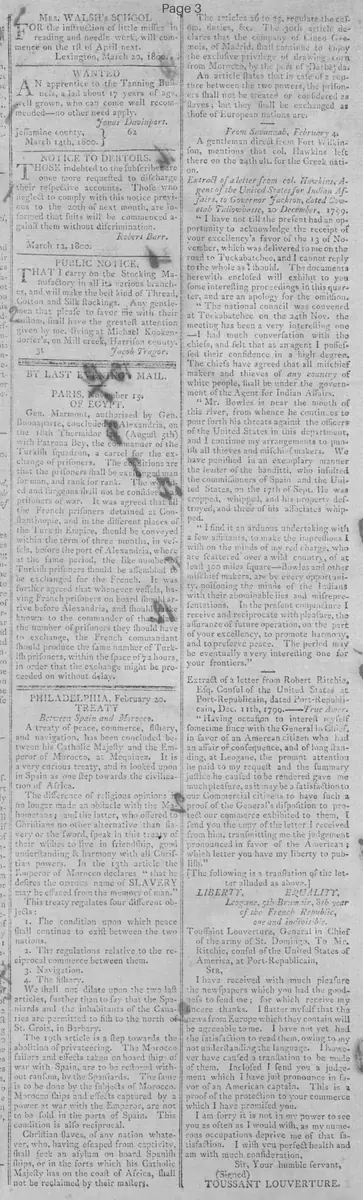
TREATY
Between Spain and Morocco.
A treaty of peace, commerce, fishery, and navigation, has been concluded between his Catholic Majesty and the Emperor of Morocco, at Mequinez. It is a very curious treaty, and is looked upon in Spain as one step towards the civilization of Africa.
The difference of religious opinions is no longer made an obstacle with the Mahometans; and the latter, who offered to Christians no other alternative than slavery or the sword, speak in this treaty of their wishes to live in friendship, good understanding & harmony with all Christian powers. In the 13th article the Emperor of Morocco declares "that he desires the opprobious name of SLAVERY may be effaced from the memory of man."
This treaty regulates four different objects:
1. The condition upon which peace shall continue to exist between the two nations.
2. The regulations relative to the reciprocal commerce between them.
3. Navigation.
4. The fishery
We shall not dilate upon the two last articles, further than to say that the Spaniards and the inhabitants of the Canaries are permitted to fish to the north of St. Croix, in Barbary.
The 10th article is a step towards the abolition of privateering. The Morocco sailors and effects taken on board ships of war with Spain, are to be restored without ransom, by the Spaniards. The same is to be done by the subjects of Morocco. Morocco ships and effects captured by a power at war with the Emperor, are not to be sold in the ports of Spain. This condition is also reciprocal.
Christian slaves, of any nation whatever, who, having escaped from captivity, shall seek an asylum on board Spanish ships, or in the forts which his Catholic Majesty has on the coast of Africa, shall not be reclaimed by their masters.
The articles 26 to 35, regulate the custom, duties, &c. The 20th article declares that the company of Cinco Gremios, of Madrid, shall continue to enjoy the exclusive privilege of drawing corn from Morocco, by the port of--Dahbetda.
An article states that in case of a rupture between the two powers, the prisoners shall not be treated or considered as slaves; but they shall be exchanged as those of European nations are.
What sub-type of article is it?
What keywords are associated?
What entities or persons were involved?
Where did it happen?
Foreign News Details
Primary Location
Mequinez
Key Persons
Outcome
treaty promotes peace, commerce, navigation, and fishery; steps toward abolishing slavery and privateering; regulates duties and prisoner exchanges without enslavement.
Event Details
Treaty concluded at Mequinez between Spain and Morocco, viewed in Spain as advancing African civilization. Addresses religious differences, expresses desire for harmony with Christian powers, and aims to erase slavery. Covers peace conditions, reciprocal commerce, navigation, and fishery permissions north of St. Croix. 10th article restores captured sailors and effects without ransom, prohibits selling enemy ships in ports. Escaped Christian slaves not reclaimed. Articles 26-35 on customs; 20th grants exclusive corn import privilege to Cinco Gremios via Dahbetda. Prisoners in rupture exchanged as in Europe, not enslaved.