Thank you for visiting SNEWPapers!
Sign up free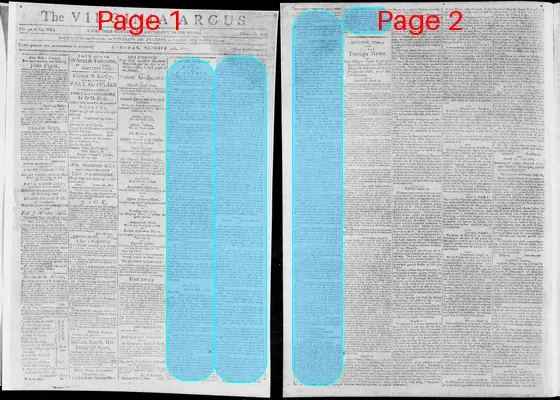
Virginia Argus
Richmond, Virginia
What is this article about?
Editorial from the Aurora defends publishing John Adams' 1792 letter alleging British influence in Thomas Pinckney's appointment as ambassador, criticizes Pinckney's response as electioneering trick amid 1800 election, and highlights duplicity in Adams and Pinckneys while referencing Sedition Law prosecution.
Merged-components note: Continuation of the political editorial from the Aurora about Adams and Pinckney across pages 1 and 2.
Clippings
1 of 2
OCR Quality
Full Text
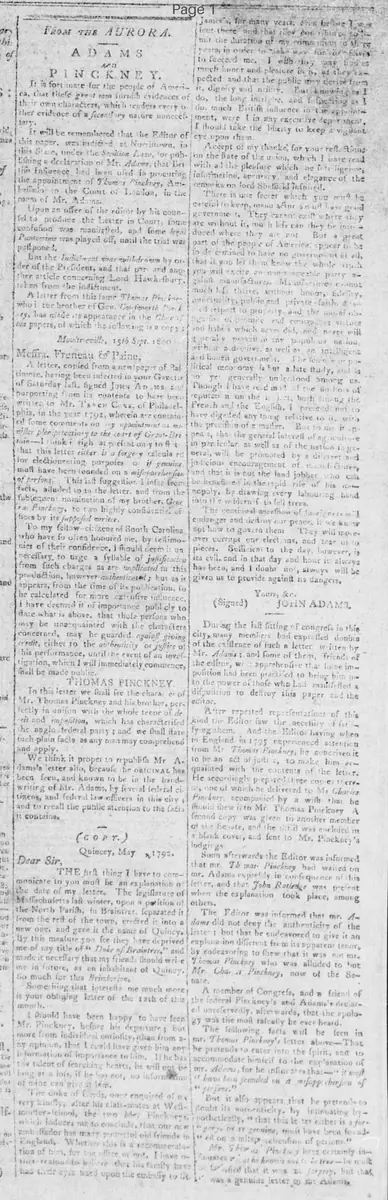
A D A M S
PINCKNEY.
It is fortunate for the people of America, that these great men furnish evidences of their own characters, which renders every other evidence of a secondary nature unnecessary.
It will be remembered that the Editor of this paper, when indicted at Norristown, in this State, under the Sedition Law, for publishing a declaration of Mr. Adams, that British Influence had been used in procuring the appointment of Thomas Pinckney, ambassador to the Court of London, in the room of Mr. Adams.
Upon an offer of the editor by his counsel to produce the Letter in Court, some confusion was manifested, and some legal Punch-and-Judy was played off, until the trial was postponed.
But the Indictment was withdrawn by order of the President, and that part and any other article concerning Lord Hawkesbury, taken from the indictment.
A letter from this same Thomas Pinckney, who is the brother of Geo. Charles Pinckney, has made its appearance in the Christian papers, of which the following is a copy;
Moultrieville, 15th Sept. 1800
Messrs. Freneau & Paine,
A letter, copied from a news paper of Baltimore, having been inserted in your Gazette of Saturday last, signed John Adams and purporting from its contents to have been written to Mr. Tench Coxe, of Philadelphia, in the year 1792, wherein are contained some comments on my appointment as minister plenipotentiary to the court of Great-Britain- I think it right at present to state that this letter either is a forgery calculated for electioneering purposes or if genuine must have been founded on a misapprehension of persons. This last suggestion I infer from facts, alluded to in the letter, and from the subsequent nomination of my brother, Charles Pinckney, to two highly confidential offices by the supposed writer.
To my fellow-citizens of South Carolina, who have so often honored me, by testimonies of their confidence, I should deem it unnecessary to urge a syllable of justification from such charges as are implicated in this production, however authenticated; but as it appears, from the time of its publication, to be calculated for more extensive influence, I have deemed it of importance publicly to state what is above, that those persons who may be unacquainted with the characters concerned, may be guarded against giving credit, either to the authenticity or justice of his performance, until the event of an investigation, which I will immediately commence, shall be made public.
THOMAS PINCKNEY
In this letter we shall see the character of Mr. Thomas Pinckney and his brother, perfectly in unison with the whole tenor of the reign and administration, which has characterized the anglo federal party: and we shall state such plain facts as any man may comprehend and apply.
We think it proper to republish Mr. Adams's letter also, because it originally has been seen, and known to be in the handwriting of Mr. Adams, by several federal citizens, and federal law officers in this city; and to recall the public attention to the facts it contains.
(coy.)
Quincy, May 21 1792.
Dear Sir,
THE first thing I have to communicate to you must be an explanation of the date of my letter. The legislature of Massachusetts last winter, upon a petition of the North Parish, in Braintree, separated it from the rest of the town, erected it into a new one, and gave it the name of Quincy. By this measure you see they have deprived me of my title of "Duke of Braintree," and made it necessary that my friends should write me in future, as an inhabitant of Quincy.
So much for this whim-wham.
Something that interests me much more is your obliging letter of the 11th of this month.
I should have been happy to have seen Mr. Pinckney, before his departure; but more from individual curiosity, than from any opinion, that I could have given him any information of importance to him. If he has the talent of searching hearts, he will not be long at a loss, if he has not, no information of mine can give it him.
The Duke of Leeds once enquired of me very kindly, after his class-mates at college, Harcourt, the two Fitzherberts which induced me to conclude, that our ambassador has many young old friends in England. Whether there is a recommendation of him, for the office by me, I have other reason to believe than his family have had their eyes fixed upon the embassy to France, James's, or than we have done here together and has since done horse to limit the duration of my commission as Minister at London, in order to make way for somebody to succeed me. I wish him as much honor and pleasure in it, as they expected and that the public may derive from it dignity and utility. But knowing me as I do, the long sighing and peaching as this, much British influence in the appointment, were I in any executive department, I should take the liberty to keep a vigilant eye upon them.
Accept of my thanks, for your remarks on the state of the union, which I have read with all the pleasure which the diligence, information, accuracy, and elegance of the remarks on lord Sheffield informed.
There is one secret which you and I must carefully keep, manufactures and a good government. They cannot exist where they are not about it, much less can they be introduced where they are not. But a great part of the people of America appear to be too determined to have no government at all, that if you let them know the whole truth you will excite an do agreeable party a mind manufacturer. Manufacturers cannot much less thrive, without honor, fidelity, honesty, public and private faith depended to property, and the usual observances to peace and comfort virtue and habits which never did, nor never will gain at any prevail in any population without a decent as well as an intelligent and honest government. The lore of political economy is but a late study, and is not yet generally understood among us.
Though I have read much after an loss of reputation on the ill it both during the French and the English. I pretend not to have digested any thing relative to it with the precision of the matter. But to me it appears, that the general interest of agriculture in particular as well as of the nation in general, will be promoted by a direct and judicious encouragement of manufacture and that it is not the land jobber who can be benefited in the rapid rise of his monopoly, by drawing every laboring hand into the woods to fell trees.
The continual accession of foreigners will endanger and destroy our peace, if we know not how to govern them. They will moreover corrupt our elections, and tear us to pieces. Sufficient to the day, however, is its evil, and in that day and hour it always has been, and I doubt not, always will be given us to provide against its dangers.
Yours, &c.
(Signed)
JOHN ADAMS,
During the last sitting of congress in this city, many members had expressed doubts of the existence of such a letter written by Mr. Adams; and some of them, friends of the editor, were apprehensive that some imposition had been practiced to bring him into the power of those who had manifested a disposition to destroy this paper and the editor.
After repeated representations of this kind the Editor saw the necessity of satisfying them. And the Editor having when in England in 1795 experienced attention from Mr. Thomas Pinckney, he conceived it to be an act of justice, to make him acquainted with the contents of the letter. He accordingly prepared three copies, one of which he delivered to Mr. Charles Pinckney; accompanied by a wish that he should show it to Mr. Thomas Pinckney. A second copy was given to another member of the Senate, and the third was enclosed in a blank cover, and sent to Mr. Pinckney's lodgings.
Soon afterwards the Editor was informed that Mr. Thomas Pinckney had waited on Mr. Adams expressly in consequence of his letter, and that John Rutledge was present when the explanation took place, among others.
The Editor was informed that Mr. Adams did not deny the authenticity of the letter; but that he endeavored to give it an explanation different from its apparent tenor, by endeavoring to show that it was not Mr. Thomas Pinckney who was alluded to but Mr. Charles Pinckney, now of the Senate.
A member of Congress, and a friend of the federal Pinckneys and Adams' declared unreservedly, afterwards, that the apology was the most farcical he ever heard.
The following facts will be seen in Mr. Thomas Pinckney's letter above- That he pretends to enter into the spirit, and to accommodate himself to be explanation of Mr. Adams, for he allows at least that- "if not I have been sounded on a misapprehension of "persons."
But it also appears that he pretends to doubt its authenticity, by insinuating by- "noteiently," that this letter either is a for- "gery, or if genuine, must have been foun- "ed on a misapprehension of persons."
Mr. Thomas Pinckney certainly insinuates what he knows is not true - he knew that it was not a forgery, but that it was a genuine letter of Adams.
The letter of Thomas Pinckney, however, in immediate paper I can be confident in too oft.
As to the egregious trick of Mr. Pinckney for his brother,
A more artful production couched so artfully as to make a pretence of exonerating the Pinckneys and Mr. Adams, while it really conveys the most disgraceful colouring upon the latter.
L. A. AN ELECTION TRICK
The adroit scheme on in South Carolina, it is believed, the last Monday in October, Mr. Pinckney knew very well that he seen the 10th September and that period, his letter could not reach this city in time to render any level authentication of Mr. Adams's letter applicable and transferable in time. His call upon the people, therefore to guard against giving credit to the authenticity of the letter, is in our eyes as worthy an act in Mr. Pinckney as the forgery of such a letter could be, because he knew it was authentic: and because had he any doubt of its authenticity he would not have waited to "commence an investigation." to this period, and at his present distance, which he might have done, when he was on the spot where the letter is, and was well acquainted with Mr. Gore, to whom it was written.
A CENSURE ON MR. ADAMS.
While he affects to suspend his opinion on the genuineness of the letter, and the misapprehensions of people; Mr. Thomas Pinckney takes a becoming care to guard his reputation and integrity, and to show by implication that if it was genuine, Mr. Adams was guilty of insincerity and worse.
He says that he infers from the charges of British intrigue in Mr. Adams's letter, being employed to obtain his appointment as Ambassador to the Court of Great Britain, that Mr. Adams could not in strict consistency with his sentiments therein contained, have appointed Gen. Pinckney twice Ambassador to France.
To the inconsistency of Mr. Adams in this case, every honest man will subscribe. If Mr. Adams believed what he wrote, Gen. Pinckney was certainly the last man that ought to have been sent to France. His conduct in France unhappily proved it.
Adams's mistake in sending him.
Mr. Thomas Pinckney further says, that he would "deem it unnecessary to urge a refutation of justice for the charges implicated in the production between our there reached." Here then Mr. Pinckney stands upon different ground, and the true ground he ought to have stood upon.
He stands upon his reputation to him from foreign contamination, and although Mr. Adams is the author of the implication, he stands conscious that his reputation is superior to the suspicion.
This is the true exposition of the two letters, and it is incumbent on the American people, whom these important documents may reach, to bestow on them a serious consideration.
For it is evident from both the letters that there is duplicity and cunning, there is a temper of deceit which renders those who are capable of it, unworthy the confidence of the country. To place confidence in such men, would be to justify any deception which they might practice hereafter, if entrusted with power.
In this place, and at this time, it will be proper to state to the public, how the letter of Mr. Adams came to the knowledge of the Editor; as it will show the fallacy of Mr. Thomas Pinckney's assumption that it was calculated for electioneering purposes.
It is well known that there could be no design to undermine against the Pinckneys two years ago. It is nearly eighteen months since the present prosecution was commenced against the Editor, for publishing Mr. Adams's letter, which came to the Editor's knowledge this way.
In a conversation with a grandson of Dr. Franklin now in Virginia, on the corrupt practices of Great Britain, and among other things, some attempts of the British government to suppress the publication of Dr. Franklin's life and private papers in London, he mentioned his having heard that Mr. Jay, had charged the British with not only acting corruptly but indirectly upon one government under the administration of General Washington.
The editor expressed a wish that he would make such inquiries as to assure himself that such a declaration had been made. He did so on receiving self, and the sentence, as nearly as could be recalled from a cursory knowledge, was immediately justified, and confirmed to be repeatedly published by the Aurora. The letter was entire and faithful, that the original was in Mr. Gore's hand and he determined that the people should not be denied the knowledge of a truth which was the duty of Mr. Adams to have proclaimed to his country publicly or officially. Mr. Gore was informed at the publication, and forewarned that there were some inaccuracies in the phraseology of the sentence, the sense was the same.
Upon the seizure of Callender's Letters upon Sweden, the Editor culled up a variety of facts relating to one great point namely, to prove that British interference had been practiced in the United States.
These items were--
1. Adams's Declaration
2. Lord Hawkesbury's Declaration.
3. Jay's Declaration.
4. A Declaration of Lord Clare in the Irish House of Lords
5. A Declaration of Mr. Pickering.
This angliest on Declaration in the Aurora of the 20th January last and upon its publication a prosecution was commenced. The Editor had now a fortunate opportunity to bring forth this letter by legal means. Mr. Cooper could not deny it and he was let the copy of forwarding the one ground.
These documents into the hands of the Counsel by proved by the Editor. It was that the letter came through. H. W. in he published will now be explained. When the federal courts at Richmond determine a trial the court contrary to right and to truth enjoined the what? nn to publish en against the Judge Perry he the terms the publish in he Court h ob ge1 to atlee of teedtr ejot bu fnl mp--sdur hn: inawlog the oneground pran thith h- Aimt Saei-i sh:y mir'st torn meer Ihs ind. cats were misdrawn. Copies f
What sub-type of article is it?
What keywords are associated?
What entities or persons were involved?
Editorial Details
Primary Topic
British Influence In Thomas Pinckney's Appointment And Defense Of Publishing Adams' Letter
Stance / Tone
Critical Of Adams And Pinckneys For Duplicity And Electioneering
Key Figures
Key Arguments