Thank you for visiting SNEWPapers!
Sign up free
Literary
March 4, 1868
Gold Hill Daily News
Gold Hill, Storey County, Nevada
What is this article about?
This essay portrays snowflakes as microscopic flowers and bouquets, revealing their beauty, ozone composition, and winter benefits through poetic and scientific observation, urging appreciation of nature's wonders amid everyday snowstorms.
Clipping
OCR Quality
95%
Excellent
Full Text
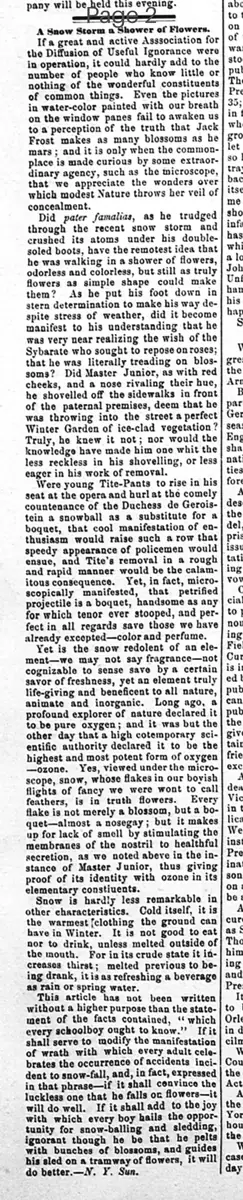
A SNOW STORM A SHOWER OF FLOWERS.
If a great and active Association for the Diffusion of Useful Ignorance were in operation, it could hardly add to the number of people who know little or nothing of the wonderful constituents of common things. Even the pictures in water-color painted with our breath on the window panes fail to awaken us to a perception of the truth that Jack Frost makes as many blossoms as he mars: and it is only when the commonplace is made curious by some extraordinary agency, such as the microscope, that we appreciate the wonders over which modest Nature throws her veil of concealment.
Did pater familias, as he trudged through the recent snow storm and crushed its atoms under his double-soled boots, have the remotest idea that he was walking in a shower of flowers, odorless and colorless, but still as truly flowers as simple shape could make them? As he put his foot down in stern determination to make his way despite stress of weather, did it become manifest to his understanding that he was very near realizing the wish of the Sybarite who sought to repose on roses; that he was literally treading on blossoms? Did Master Junior, as with red cheeks, and a nose rivaling their hue, he shovelled off the sidewalks in front of the paternal premises, deem that he was throwing into the street a perfect Winter Garden of ice-clad vegetation?
Truly, he knew it not: nor would the knowledge have made him one whit the less reckless in his shovelling, or less eager in his work of removal.
Were young Tite-Pants to rise in his seat at the opera and hurl at the comely countenance of the Duchess de Gerostein a snowball as a substitute for a bouquet, that cool manifestation of enthusiasm would raise such a row that speedy appearance of policemen would ensue, and Tite's removal in a rough and rapid manner would be the calamitous consequence. Yet, in fact, microscopically manifested, that petrified projectile is a bouquet, handsome as any for which tenor ever stooped, and perfect in all regards save those we have already excepted—color and perfume.
Yet is this snow redolent of an element—we may not say fragrance—not cognizable to sense save by a certain savor of freshness, yet an element truly life-giving and beneficent to all nature, animate and inorganic. Long ago, profound explorer of nature declared it to be pure oxygen; and it was but the other day that a high contemporary scientific authority declared it to be the highest and most potent form of oxygen—ozone. Yes, viewed under the microscope, snow, whose flakes in our boyish flights of fancy we were wont to call feathers, is in truth flowers. Every flake is not merely a blossom, but a bouquet—almost a nosegay: but it makes up for lack of smell by stimulating the membranes of the nostril to healthful secretion, as we noted above in the instance of Master Junior, thus giving proof of its identity with ozone in its elementary constituents.
Snow is hardly less remarkable in other characteristics. Cold itself, it is the warmest clothing the ground can have in Winter.
It is not good to eat nor to drink, unless melted outside of the mouth. For in its crude state it increases thirst; melted previous to being drank, it is as refreshing a beverage as rain or spring water.
This article has not been written without a higher purpose than the statement of the facts contained, "which every schoolboy ought to know." If it shall serve to modify the manifestation of wrath with which every adult celebrates the occurrence of accidents incident to snow-fall, and, in fact, expressed in that phrase—if it shall convince the luckless one that he falls on flowers—it will do well. If it shall add to the joy with which every boy hails the opportunity for snow-balling and sledding, ignorant though he be that he pelts with bunches of blossoms, and guides his sled on a tramway of flowers, it will do better.—N. Y. Sun.
If a great and active Association for the Diffusion of Useful Ignorance were in operation, it could hardly add to the number of people who know little or nothing of the wonderful constituents of common things. Even the pictures in water-color painted with our breath on the window panes fail to awaken us to a perception of the truth that Jack Frost makes as many blossoms as he mars: and it is only when the commonplace is made curious by some extraordinary agency, such as the microscope, that we appreciate the wonders over which modest Nature throws her veil of concealment.
Did pater familias, as he trudged through the recent snow storm and crushed its atoms under his double-soled boots, have the remotest idea that he was walking in a shower of flowers, odorless and colorless, but still as truly flowers as simple shape could make them? As he put his foot down in stern determination to make his way despite stress of weather, did it become manifest to his understanding that he was very near realizing the wish of the Sybarite who sought to repose on roses; that he was literally treading on blossoms? Did Master Junior, as with red cheeks, and a nose rivaling their hue, he shovelled off the sidewalks in front of the paternal premises, deem that he was throwing into the street a perfect Winter Garden of ice-clad vegetation?
Truly, he knew it not: nor would the knowledge have made him one whit the less reckless in his shovelling, or less eager in his work of removal.
Were young Tite-Pants to rise in his seat at the opera and hurl at the comely countenance of the Duchess de Gerostein a snowball as a substitute for a bouquet, that cool manifestation of enthusiasm would raise such a row that speedy appearance of policemen would ensue, and Tite's removal in a rough and rapid manner would be the calamitous consequence. Yet, in fact, microscopically manifested, that petrified projectile is a bouquet, handsome as any for which tenor ever stooped, and perfect in all regards save those we have already excepted—color and perfume.
Yet is this snow redolent of an element—we may not say fragrance—not cognizable to sense save by a certain savor of freshness, yet an element truly life-giving and beneficent to all nature, animate and inorganic. Long ago, profound explorer of nature declared it to be pure oxygen; and it was but the other day that a high contemporary scientific authority declared it to be the highest and most potent form of oxygen—ozone. Yes, viewed under the microscope, snow, whose flakes in our boyish flights of fancy we were wont to call feathers, is in truth flowers. Every flake is not merely a blossom, but a bouquet—almost a nosegay: but it makes up for lack of smell by stimulating the membranes of the nostril to healthful secretion, as we noted above in the instance of Master Junior, thus giving proof of its identity with ozone in its elementary constituents.
Snow is hardly less remarkable in other characteristics. Cold itself, it is the warmest clothing the ground can have in Winter.
It is not good to eat nor to drink, unless melted outside of the mouth. For in its crude state it increases thirst; melted previous to being drank, it is as refreshing a beverage as rain or spring water.
This article has not been written without a higher purpose than the statement of the facts contained, "which every schoolboy ought to know." If it shall serve to modify the manifestation of wrath with which every adult celebrates the occurrence of accidents incident to snow-fall, and, in fact, expressed in that phrase—if it shall convince the luckless one that he falls on flowers—it will do well. If it shall add to the joy with which every boy hails the opportunity for snow-balling and sledding, ignorant though he be that he pelts with bunches of blossoms, and guides his sled on a tramway of flowers, it will do better.—N. Y. Sun.
What sub-type of article is it?
Essay
What themes does it cover?
Nature
Seasonal Cycle
What keywords are associated?
Snow Storm
Microscope
Snowflakes
Ozone
Winter Garden
Nature Wonders
Seasonal Beauty
What entities or persons were involved?
N. Y. Sun
Literary Details
Title
A Snow Storm A Shower Of Flowers.
Author
N. Y. Sun
Subject
On Snow As Microscopic Flowers And Ozone
Key Lines
Did Pater Familias, As He Trudged Through The Recent Snow Storm And Crushed Its Atoms Under His Double Soled Boots, Have The Remotest Idea That He Was Walking In A Shower Of Flowers, Odorless And Colorless, But Still As Truly Flowers As Simple Shape Could Make Them?
Yes, Viewed Under The Microscope, Snow, Whose Flakes In Our Boyish Flights Of Fancy We Were Wont To Call Feathers, Is In Truth Flowers.
Every Flake Is Not Merely A Blossom, But A Bouquet—Almost A Nosegay:
Cold Itself, It Is The Warmest Clothing The Ground Can Have In Winter.
If It Shall Convince The Luckless One That He Falls On Flowers—It Will Do Well.