Thank you for visiting SNEWPapers!
Sign up free
Literary
December 5, 1845
Burlington Free Press
Burlington, Chittenden County, Vermont
What is this article about?
In this moral tale, Mr. Norton avoids marriage fearing extravagant wives, inspired by Miss La Mode's costly cloak. He admires Emily Harwood's old cloak, worn to fund her cousin's education. They fall in love and engage. Mrs. Hinton returns her new mantle, embracing economy amid her husband's financial woes.
Clipping
OCR Quality
95%
Excellent
Full Text
From the Columbian Magazine.
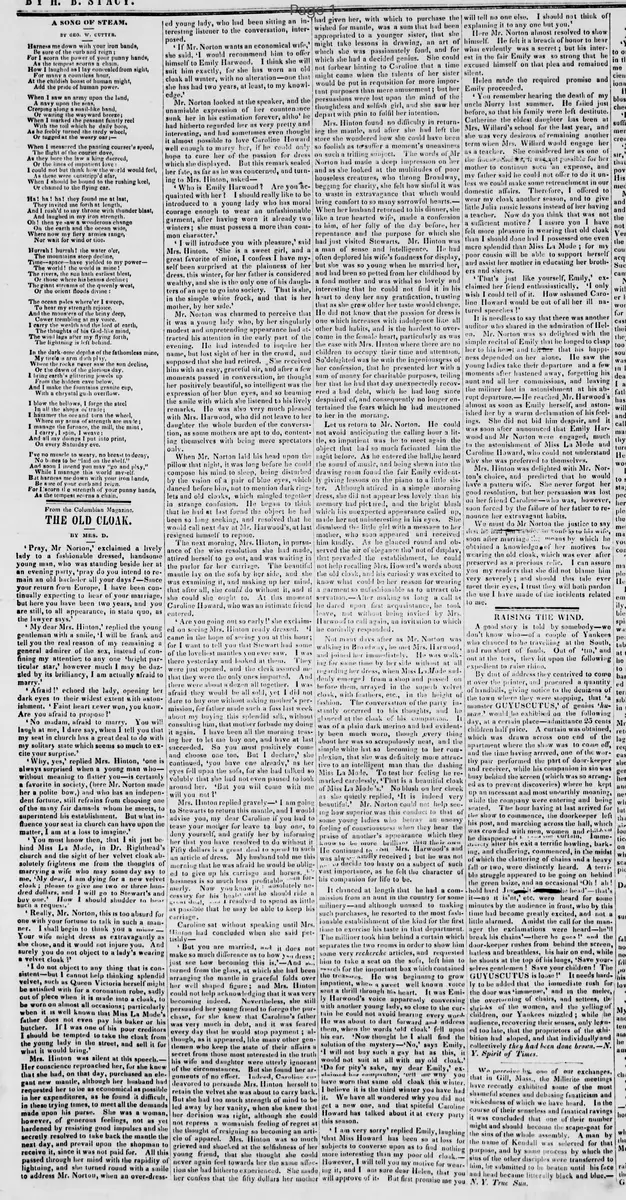
THE OLD CLOAK.
BY MRS. D.
"Pray, Mr. Norton," exclaimed a lively lady to a fashionably dressed, handsome young man, who was standing beside her at an evening party, "pray do you intend to remain an old bachelor all your days?--Since your return from Europe, I have been continually expecting to hear of your marriage, but here you have been two years, and you are still, to all appearance, in statu quo, as the lawyer says."
"My dear Mrs. Hinton," replied the young gentleman with a smile, "I will be frank and tell you the real reason of my remaining a general admirer of the sex, instead of confining my attention to any one 'bright particular star,' however much I may be dazzled by its brilliancy, I am actually afraid to marry."
"Afraid!" echoed the lady, opening her dark eyes to their widest extent with astonishment. "Faint heart ne'er won, you know. Are you afraid to propose?"
"No madam, afraid to marry. You will laugh at me, I dare say, when I tell you that my seat in church has a great deal to do with my solitary state which seems so much to excite your surprise."
"Why, yes," replied Mrs. Hinton, "one is always surprised when a young man who--without meaning to flatter you--is certainly a favorite in society, (here Mr. Norton made her a polite bow,) and who has an independent fortune, still refrains from choosing one of the many fair damsels whom he meets, to superintend his establishment. But what influence your seat in church can have upon the matter, I am at a loss to imagine."
"You must know then, that I sit just behind Miss La Mode, in Dr. Righthead's church and the sight of her velvet cloak absolutely frightens me from the thoughts of marrying a wife who may some day say to me, 'My dear, I am dying for a new velvet cloak; please to give me two or three hundred dollars, and I will go to Stewart's and buy one.' How I should shudder to hear such a request."
"Really, Mr. Norton, this is too absurd for one with your fortune to talk in such a manner. I shall begin to think you a miser--Your wife might dress as extravagantly as she chose, and it would not injure you. And surely you do not object to a lady's wearing a velvet cloak?"
"I do not object to any thing that is consistent--but I cannot help thinking splendid velvet, such as Queen Victoria herself might be satisfied with for a coronation robe, sadly out of place when it is made into a cloak, to be worn on almost all occasions; particularly when it is well known that Miss La Mode's father does not even pay his baker or his butcher. If I was one of his poor creditors I should be tempted to take the cloak from the young lady in the street, and sell it for what it would bring."
Mrs. Hinton was silent at this speech.--Her conscience reproached her, for she knew that she had, on that day, purchased an elegant new mantle, although her husband had requested her to be as economical as possible in her expenditures, as he found it difficult, in these trying times, to meet all the demands made upon his purse.
She was a woman, however, of generous feelings, not as yet hardened by resisting good impulses and she secretly resolved to take back the mantle the next day, and prevail upon the shopman to receive it, since it was not paid for. All this passed through her mind with the rapidity of lightning, and she turned round with a smile to address Mr. Norton, when an over-dressed young lady, who had been sitting an interesting listener to the conversation, interposed.
"If Mr. Norton wants an economical wife," she said, "I would recommend him to offer himself to Emily Harwood, I think she will suit him exactly, for she has worn an old cloak all winter, with no alteration--one that she has had two years, at least, to my knowledge."
Mr. Norton looked at the speaker, and the unamiable expression of her countenance sunk her in his estimation forever, altho' he had hitherto regarded her as very pretty and interesting, and had sometimes even thought it almost possible to love Caroline Howard well enough to marry her, if he could only hope to cure her of the passion for dress which she displayed. But this remark sealed her fate, as far as he was concerned, and turning to Mrs. Hinton, asked--
"Who is Emily Harwood? Are you acquainted with her? I should really like to be introduced to a young lady who has moral courage enough to wear an unfashionable garment, after having worn it already two winters; she must possess a more than common character."
"I will introduce you with pleasure," said Mrs. Hinton. "She is a sweet girl, and a great favorite of mine, I confess I have myself been surprised at the plainness of her dress, this winter, for her father is considered wealthy, and she is the only one of his daughters of an age to go into society. That is she, in the simple white frock, and that is her mother, by her side."
Mr. Norton was charmed to perceive that it was a young lady who, by her singularly modest and unpretending appearance had attracted his attention in the early part of the evening. He had intended to inquire her name, but lost sight of her in the crowd, and supposed that she had retired. She received him with an easy, graceful air, and after a few moments passed in conversation, he thought her positively beautiful, so intelligent was the expression of her blue eyes, and so beaming the smile with which she listened to his lively remarks. He was also very much pleased with Mrs. Harwood, who did not leave to her daughter the whole burden of the conversation, as some mothers are apt to do, contenting themselves with being mere spectators only.
When Mr. Norton laid his head upon the pillow that night, it was long before he could compose his mind to sleep, being disturbed by the vision of a pair of blue eyes, which danced before him, not to mention dark ringlets and old cloaks, which mingled together in strange confusion. He began to think that he had at last found the object he had been so long seeking, and resolved that he would call next day at Mr. Harwood's, at last resigned himself to repose.
The next morning, Mrs. Hinton, in pursuance of the wise resolution she had made, attired herself to go out, and was waiting in the parlor for her carriage. The beautiful mantle lay on the sofa by her side, and she was examining it, and making up her mind that after all, she could do without it, and if she could she ought to. At this moment Caroline Howard, who was an intimate friend entered.
"Are you going out so early!" she exclaimed on seeing Mrs. Hinton ready dressed. "I came in the hope of seeing you at this hour; for I want to tell you that Stewart had some of the loveliest mantles you ever saw. I was there yesterday and looked at them. They were just opened, and the clerk assured me that they were the only ones imported. And there were about a dozen all together. I was afraid they would be all sold, yet I did not dare to buy one without asking mother's permission, for father made such a fuss last week about my buying this splendid silk, without consulting him, that mother forbade my doing it again. I have been all the morning teasing her to let me buy one, and have at last succeeded. So you must positively come and choose one too. But I declare," she continued, "you have one already," as her eyes fell upon the sofa, for she had talked so volubly that she had not even paused to look around her. "But you will come with me will you not?"
Mrs. Hinton replied gravely--" I am going to Stewart's to return this mantle, and I would advise you, my dear Caroline if you had to tease your mother for leave to buy one, to deny yourself, and gratify her by informing her that you have resolved to do without it. Fifty dollars is a great deal to spend on such an article of dress. My husband told me this morning that he was afraid he would be obliged to give up his carriage and horses--business is so much less profitable than formerly. Now you know it is absolutely necessary for his health that he should ride a horse, and I resolved to spend as little as possible that he may be able to keep his carriage."
Caroline sat without speaking until Mrs. Hinton had concluded when she said pettishly--
"But you are married, and it does not make so much difference as to how you dress; just see how becoming this is."--And she turned from the glass, at which she had been arranging the mantle in graceful folds over her well shaped figure; and Mrs. Hinton could not help acknowledging that it was very becoming indeed. Nevertheless, she still persuaded her young friend to forego the purchase, for she knew that Caroline's father was very much in debt, and it was feared every day that he would stop payment; although, as it appeared, like many other gentlemen who keep the state of their affairs a secret from those most interested in the truth his wife and daughter were utterly ignorant of the circumstances. But she found her arguments of no effect. Indeed, Caroline endeavored to persuade Mrs. Hinton herself to retain the velvet she was about to carry back. But she had too much strength of mind to be led away by her vanity, when she knew that her decision was right, although she could not repress a womanish feeling of regret at the thought of resigning so becoming an article of apparel. Mrs. Hinton was so much grieved and shocked at the selfishness of her young friend, that she thought she could never again feel towards her the same affection she had hitherto experienced. She made her confess that the fifty dollars her mother had given her, with which to purchase the wished for mantle, was a sum that had been appropriated to a younger sister, that she might take lessons in drawing, an art of which she was passionately fond, and for which she had a decided genius. She could not forbear hinting to Caroline that a time might come when the talents of her sister would be put in requisition for more important purposes than mere amusement; but her persuasions were lost upon the mind of the thoughtless and selfish girl, and she saw her depart with pain to fulfil her intention.
Mrs. Hinton found no difficulty in returning the mantle, and after she had left the store she wondered how she could have been so foolish as to suffer a moment's uneasiness on such a trifling subject. The words of Mr. Norton had made a deep impression on her and as she looked at the multitudes of poor houseless creatures, who throng Broadway, begging for charity, she felt how sinful it was to waste in extravagance that which would bring comfort to so many sorrowful hearts.--
When her husband returned to his dinner, she like a true hearted wife, made a confession to him, of her folly of the day before. her repentance and the purpose for which she had just visited Stewart's. Mr. Hinton was a man of sense and intelligence. He had often deplored his wife's fondness for display, but she was so young when he married her. and had been so petted from her childhood by a fond mother and was withal so lovely and interesting that he could not find it in his heart to deny her any gratification, trusting that as she grew older her taste would change He did not know that the passion for dress is one which increases with indulgence like all other bad habits, and is the hardest to overcome in the female heart, particularly as was the case with Mrs. Hinton where there are no children to occupy their time and attention. So delighted was he with the ingenuousness of her confession. that he presented her with a sum of money for charitable purposes, telling her that he had that day unexpectedly recovered a bad debt, which he had long since despaired of, and consequently no longer entertained the fears which he had mentioned to her in the morning.
Let us return to Mr. Norton. He could not avoid anticipating the calling hour a little, so impatient was he to meet again the object that had so much fascinated him the night before. As he entered the hall, he heard the sound of music, and being shewn into the drawing room found the fair Emily evidently giving lessons on the piano to a little sister. Although attired in a simple morning dress, she did not appear less lovely than his memory had pictured, and the bright blush which his unexpected appearance called up, made her not uninteresting in his eyes. She dismissed the little girl with a message to her mother, who soon appeared and received him kindly. As he glanced round and observed the air of elegance tho' not of display. that pervaded the establishment, he could not help recalling Mrs. Harwood's words about the old cloak, and his curiosity was excited to know what could be her reason for wearing a garment so unfashionable as to attract observation,--After making as long a call as he dared upon first acquaintance, he took leave, not without being invited by Mrs. Harwood to call again, an invitation to which he cordially responded.
Not many days after as Mr. Norton was walking in Broadway, he met Mrs. Harwood. and joined her immediately. He was walking for some time by her side without at all regarding her dress, when Miss La Mode suddenly emerged from a shop and passed on before them, arrayed in the superb velvet cloak, with feathers, etc., in the height of fashion. The conversation of the party instantly occurred to his thoughts, and he glanced at the cloak of his companion. It was of a plain dark merino and had evidently been much worn, though every thing about her was so scrupulously neat, and the simple white hat so becoming to her complexion, that she was decidedly more attractive to an intelligent man than the dashing Miss La Mode. To test her feeling he remarked carelessly, "That is a beautiful cloak of Miss La Mode's." No blush on her cheek as she quietly replied, "It is indeed very beautiful." Mr. Norton could not help seeing how superior was this conduct to that of some young ladies who betray an uneasy feeling of consciousness when they hear the praise of another's appearance which they know to be more brilliant than their own
He continued to visit Mrs. Harwood's and on to decide too hasty on a subject of such vast importance, as he felt the character of his companion for life to be.
It chanced at length that he had a commission from an aunt in the country for some millinery--and although unused to making such purchases, he resorted to the most fashionable establishment of the kind for the first time to exercise his taste in that department. The milliner took him behind a curtain which separates the two rooms in order to show him some very recherche articles, and requested him to take a seat on the sofa, left him to search for the important box which contained the treasures. He was beginning to grow impatient, when a sweet well known voice sent a thrill through his heart. It was Emily Harwood's voice apparently conversing with another young lady, so close to the curtain he could not avoid hearing every word. He was about to dart forward and address them, when the words 'old cloak' fell upon his ear. Now thought he I shall find the solution of the mystery--"No," says Emily, "I will not buy such a gay hat as this, it would not suit at all with my old cloak."
"Do for pity's sake, my dear Emily," exclaimed her companion, "tell me why you have worn that same old cloak this winter. I believe it is the third winter you have had it. We have all wondered why you did not get a new one, and that spiteful Caroline Howard has talked about it at every party this season."
"I am very sorry" replied Emily, laughing "that Miss Howard has been so at loss for subjects to converse upon as to find nothing more interesting than my poor old cloak.--However, I will tell you my motive for wearing it, and I am sure dear Helen, that you will approve of it. But first promise me you will not tell of it."
Here Mr. Norton almost resolved to show himself. He felt it a breach of honor to hear what evidently was a secret; but his interest in the fair Emily was so strong that he excused himself on that plea and remained silent.
Helen made the required promise and Emily proceeded.
"You remember hearing the death of my uncle Murry last summer. He failed just before, so that his family were left destitute. Catherine the eldest daughter has been at Mrs. Willard's school for the last year, and she was very desirous of remaining another term when Mrs. Willard would engage her as a teacher. She considered her as one of the finest scholars, it was not possible for her mother to continue such an expense, and my father said he could not offer to do it unless we could make some retrenchment in our domestic affairs, Therefore, I offered to wear my cloak another season, and to give little Julia music lessons instead of her having a teacher. Now do you think that was not a sufficient motive? I assure you I have felt more pleasure in wearing that old cloak than I should done had I possessed one even more splendid than Miss La Mode; for my poor cousin will be able to support herself and assist her mother in educating her brothers and sisters."
"That's just like yourself, Emily," exclaimed her friend enthusiastically. "I only wish I could tell of it. How ashamed Caroline Howard would be out of all her ill natured speeches!"
It is needless to say that there was another auditor who shared in the admiration of Helen. Mr. Norton was so delighted with the simple recital of Emily that he longed to clasp her to his heart and swear that his happiness depended on her alone. He saw the young ladies take their departure and a few moments after hastened away, forgetting his aunt and all her commissions, and leaving the milliner lost in astonishment at his abrupt departure.--He reached Mr. Harwood's almost as soon as Emily herself, and astonished her by a warm declaration of his feelings. She did not bid him despair, and it was soon after announced that Emily Harwood and Mr Norton were engaged, much to the astonishment of Miss La Mode and Caroline Howard, who could not understand why she was preferred to themselves.
Mrs. Hinton was delighted with Mr. Norton's choice, and predicted that he would have a pattern wife. She never forgot her good resolution, but her persuasion was lost on her friend Caroline--who was, however, soon forced by the failure of her father to renounce her extravagant habits.
We must do Mr Norton the justice to say that he had not intended to tell as to his wife, soon after marriage he means by which he obtained a knowledge of her motives to wearing the old cloak, which was ever after preserved as a precious relic. I can assure you my readers that she did not blame him very severely; and should this tale ever meet their eyes, I trust they will both pardon the use I have made of the incidents related to me.
THE OLD CLOAK.
BY MRS. D.
"Pray, Mr. Norton," exclaimed a lively lady to a fashionably dressed, handsome young man, who was standing beside her at an evening party, "pray do you intend to remain an old bachelor all your days?--Since your return from Europe, I have been continually expecting to hear of your marriage, but here you have been two years, and you are still, to all appearance, in statu quo, as the lawyer says."
"My dear Mrs. Hinton," replied the young gentleman with a smile, "I will be frank and tell you the real reason of my remaining a general admirer of the sex, instead of confining my attention to any one 'bright particular star,' however much I may be dazzled by its brilliancy, I am actually afraid to marry."
"Afraid!" echoed the lady, opening her dark eyes to their widest extent with astonishment. "Faint heart ne'er won, you know. Are you afraid to propose?"
"No madam, afraid to marry. You will laugh at me, I dare say, when I tell you that my seat in church has a great deal to do with my solitary state which seems so much to excite your surprise."
"Why, yes," replied Mrs. Hinton, "one is always surprised when a young man who--without meaning to flatter you--is certainly a favorite in society, (here Mr. Norton made her a polite bow,) and who has an independent fortune, still refrains from choosing one of the many fair damsels whom he meets, to superintend his establishment. But what influence your seat in church can have upon the matter, I am at a loss to imagine."
"You must know then, that I sit just behind Miss La Mode, in Dr. Righthead's church and the sight of her velvet cloak absolutely frightens me from the thoughts of marrying a wife who may some day say to me, 'My dear, I am dying for a new velvet cloak; please to give me two or three hundred dollars, and I will go to Stewart's and buy one.' How I should shudder to hear such a request."
"Really, Mr. Norton, this is too absurd for one with your fortune to talk in such a manner. I shall begin to think you a miser--Your wife might dress as extravagantly as she chose, and it would not injure you. And surely you do not object to a lady's wearing a velvet cloak?"
"I do not object to any thing that is consistent--but I cannot help thinking splendid velvet, such as Queen Victoria herself might be satisfied with for a coronation robe, sadly out of place when it is made into a cloak, to be worn on almost all occasions; particularly when it is well known that Miss La Mode's father does not even pay his baker or his butcher. If I was one of his poor creditors I should be tempted to take the cloak from the young lady in the street, and sell it for what it would bring."
Mrs. Hinton was silent at this speech.--Her conscience reproached her, for she knew that she had, on that day, purchased an elegant new mantle, although her husband had requested her to be as economical as possible in her expenditures, as he found it difficult, in these trying times, to meet all the demands made upon his purse.
She was a woman, however, of generous feelings, not as yet hardened by resisting good impulses and she secretly resolved to take back the mantle the next day, and prevail upon the shopman to receive it, since it was not paid for. All this passed through her mind with the rapidity of lightning, and she turned round with a smile to address Mr. Norton, when an over-dressed young lady, who had been sitting an interesting listener to the conversation, interposed.
"If Mr. Norton wants an economical wife," she said, "I would recommend him to offer himself to Emily Harwood, I think she will suit him exactly, for she has worn an old cloak all winter, with no alteration--one that she has had two years, at least, to my knowledge."
Mr. Norton looked at the speaker, and the unamiable expression of her countenance sunk her in his estimation forever, altho' he had hitherto regarded her as very pretty and interesting, and had sometimes even thought it almost possible to love Caroline Howard well enough to marry her, if he could only hope to cure her of the passion for dress which she displayed. But this remark sealed her fate, as far as he was concerned, and turning to Mrs. Hinton, asked--
"Who is Emily Harwood? Are you acquainted with her? I should really like to be introduced to a young lady who has moral courage enough to wear an unfashionable garment, after having worn it already two winters; she must possess a more than common character."
"I will introduce you with pleasure," said Mrs. Hinton. "She is a sweet girl, and a great favorite of mine, I confess I have myself been surprised at the plainness of her dress, this winter, for her father is considered wealthy, and she is the only one of his daughters of an age to go into society. That is she, in the simple white frock, and that is her mother, by her side."
Mr. Norton was charmed to perceive that it was a young lady who, by her singularly modest and unpretending appearance had attracted his attention in the early part of the evening. He had intended to inquire her name, but lost sight of her in the crowd, and supposed that she had retired. She received him with an easy, graceful air, and after a few moments passed in conversation, he thought her positively beautiful, so intelligent was the expression of her blue eyes, and so beaming the smile with which she listened to his lively remarks. He was also very much pleased with Mrs. Harwood, who did not leave to her daughter the whole burden of the conversation, as some mothers are apt to do, contenting themselves with being mere spectators only.
When Mr. Norton laid his head upon the pillow that night, it was long before he could compose his mind to sleep, being disturbed by the vision of a pair of blue eyes, which danced before him, not to mention dark ringlets and old cloaks, which mingled together in strange confusion. He began to think that he had at last found the object he had been so long seeking, and resolved that he would call next day at Mr. Harwood's, at last resigned himself to repose.
The next morning, Mrs. Hinton, in pursuance of the wise resolution she had made, attired herself to go out, and was waiting in the parlor for her carriage. The beautiful mantle lay on the sofa by her side, and she was examining it, and making up her mind that after all, she could do without it, and if she could she ought to. At this moment Caroline Howard, who was an intimate friend entered.
"Are you going out so early!" she exclaimed on seeing Mrs. Hinton ready dressed. "I came in the hope of seeing you at this hour; for I want to tell you that Stewart had some of the loveliest mantles you ever saw. I was there yesterday and looked at them. They were just opened, and the clerk assured me that they were the only ones imported. And there were about a dozen all together. I was afraid they would be all sold, yet I did not dare to buy one without asking mother's permission, for father made such a fuss last week about my buying this splendid silk, without consulting him, that mother forbade my doing it again. I have been all the morning teasing her to let me buy one, and have at last succeeded. So you must positively come and choose one too. But I declare," she continued, "you have one already," as her eyes fell upon the sofa, for she had talked so volubly that she had not even paused to look around her. "But you will come with me will you not?"
Mrs. Hinton replied gravely--" I am going to Stewart's to return this mantle, and I would advise you, my dear Caroline if you had to tease your mother for leave to buy one, to deny yourself, and gratify her by informing her that you have resolved to do without it. Fifty dollars is a great deal to spend on such an article of dress. My husband told me this morning that he was afraid he would be obliged to give up his carriage and horses--business is so much less profitable than formerly. Now you know it is absolutely necessary for his health that he should ride a horse, and I resolved to spend as little as possible that he may be able to keep his carriage."
Caroline sat without speaking until Mrs. Hinton had concluded when she said pettishly--
"But you are married, and it does not make so much difference as to how you dress; just see how becoming this is."--And she turned from the glass, at which she had been arranging the mantle in graceful folds over her well shaped figure; and Mrs. Hinton could not help acknowledging that it was very becoming indeed. Nevertheless, she still persuaded her young friend to forego the purchase, for she knew that Caroline's father was very much in debt, and it was feared every day that he would stop payment; although, as it appeared, like many other gentlemen who keep the state of their affairs a secret from those most interested in the truth his wife and daughter were utterly ignorant of the circumstances. But she found her arguments of no effect. Indeed, Caroline endeavored to persuade Mrs. Hinton herself to retain the velvet she was about to carry back. But she had too much strength of mind to be led away by her vanity, when she knew that her decision was right, although she could not repress a womanish feeling of regret at the thought of resigning so becoming an article of apparel. Mrs. Hinton was so much grieved and shocked at the selfishness of her young friend, that she thought she could never again feel towards her the same affection she had hitherto experienced. She made her confess that the fifty dollars her mother had given her, with which to purchase the wished for mantle, was a sum that had been appropriated to a younger sister, that she might take lessons in drawing, an art of which she was passionately fond, and for which she had a decided genius. She could not forbear hinting to Caroline that a time might come when the talents of her sister would be put in requisition for more important purposes than mere amusement; but her persuasions were lost upon the mind of the thoughtless and selfish girl, and she saw her depart with pain to fulfil her intention.
Mrs. Hinton found no difficulty in returning the mantle, and after she had left the store she wondered how she could have been so foolish as to suffer a moment's uneasiness on such a trifling subject. The words of Mr. Norton had made a deep impression on her and as she looked at the multitudes of poor houseless creatures, who throng Broadway, begging for charity, she felt how sinful it was to waste in extravagance that which would bring comfort to so many sorrowful hearts.--
When her husband returned to his dinner, she like a true hearted wife, made a confession to him, of her folly of the day before. her repentance and the purpose for which she had just visited Stewart's. Mr. Hinton was a man of sense and intelligence. He had often deplored his wife's fondness for display, but she was so young when he married her. and had been so petted from her childhood by a fond mother and was withal so lovely and interesting that he could not find it in his heart to deny her any gratification, trusting that as she grew older her taste would change He did not know that the passion for dress is one which increases with indulgence like all other bad habits, and is the hardest to overcome in the female heart, particularly as was the case with Mrs. Hinton where there are no children to occupy their time and attention. So delighted was he with the ingenuousness of her confession. that he presented her with a sum of money for charitable purposes, telling her that he had that day unexpectedly recovered a bad debt, which he had long since despaired of, and consequently no longer entertained the fears which he had mentioned to her in the morning.
Let us return to Mr. Norton. He could not avoid anticipating the calling hour a little, so impatient was he to meet again the object that had so much fascinated him the night before. As he entered the hall, he heard the sound of music, and being shewn into the drawing room found the fair Emily evidently giving lessons on the piano to a little sister. Although attired in a simple morning dress, she did not appear less lovely than his memory had pictured, and the bright blush which his unexpected appearance called up, made her not uninteresting in his eyes. She dismissed the little girl with a message to her mother, who soon appeared and received him kindly. As he glanced round and observed the air of elegance tho' not of display. that pervaded the establishment, he could not help recalling Mrs. Harwood's words about the old cloak, and his curiosity was excited to know what could be her reason for wearing a garment so unfashionable as to attract observation,--After making as long a call as he dared upon first acquaintance, he took leave, not without being invited by Mrs. Harwood to call again, an invitation to which he cordially responded.
Not many days after as Mr. Norton was walking in Broadway, he met Mrs. Harwood. and joined her immediately. He was walking for some time by her side without at all regarding her dress, when Miss La Mode suddenly emerged from a shop and passed on before them, arrayed in the superb velvet cloak, with feathers, etc., in the height of fashion. The conversation of the party instantly occurred to his thoughts, and he glanced at the cloak of his companion. It was of a plain dark merino and had evidently been much worn, though every thing about her was so scrupulously neat, and the simple white hat so becoming to her complexion, that she was decidedly more attractive to an intelligent man than the dashing Miss La Mode. To test her feeling he remarked carelessly, "That is a beautiful cloak of Miss La Mode's." No blush on her cheek as she quietly replied, "It is indeed very beautiful." Mr. Norton could not help seeing how superior was this conduct to that of some young ladies who betray an uneasy feeling of consciousness when they hear the praise of another's appearance which they know to be more brilliant than their own
He continued to visit Mrs. Harwood's and on to decide too hasty on a subject of such vast importance, as he felt the character of his companion for life to be.
It chanced at length that he had a commission from an aunt in the country for some millinery--and although unused to making such purchases, he resorted to the most fashionable establishment of the kind for the first time to exercise his taste in that department. The milliner took him behind a curtain which separates the two rooms in order to show him some very recherche articles, and requested him to take a seat on the sofa, left him to search for the important box which contained the treasures. He was beginning to grow impatient, when a sweet well known voice sent a thrill through his heart. It was Emily Harwood's voice apparently conversing with another young lady, so close to the curtain he could not avoid hearing every word. He was about to dart forward and address them, when the words 'old cloak' fell upon his ear. Now thought he I shall find the solution of the mystery--"No," says Emily, "I will not buy such a gay hat as this, it would not suit at all with my old cloak."
"Do for pity's sake, my dear Emily," exclaimed her companion, "tell me why you have worn that same old cloak this winter. I believe it is the third winter you have had it. We have all wondered why you did not get a new one, and that spiteful Caroline Howard has talked about it at every party this season."
"I am very sorry" replied Emily, laughing "that Miss Howard has been so at loss for subjects to converse upon as to find nothing more interesting than my poor old cloak.--However, I will tell you my motive for wearing it, and I am sure dear Helen, that you will approve of it. But first promise me you will not tell of it."
Here Mr. Norton almost resolved to show himself. He felt it a breach of honor to hear what evidently was a secret; but his interest in the fair Emily was so strong that he excused himself on that plea and remained silent.
Helen made the required promise and Emily proceeded.
"You remember hearing the death of my uncle Murry last summer. He failed just before, so that his family were left destitute. Catherine the eldest daughter has been at Mrs. Willard's school for the last year, and she was very desirous of remaining another term when Mrs. Willard would engage her as a teacher. She considered her as one of the finest scholars, it was not possible for her mother to continue such an expense, and my father said he could not offer to do it unless we could make some retrenchment in our domestic affairs, Therefore, I offered to wear my cloak another season, and to give little Julia music lessons instead of her having a teacher. Now do you think that was not a sufficient motive? I assure you I have felt more pleasure in wearing that old cloak than I should done had I possessed one even more splendid than Miss La Mode; for my poor cousin will be able to support herself and assist her mother in educating her brothers and sisters."
"That's just like yourself, Emily," exclaimed her friend enthusiastically. "I only wish I could tell of it. How ashamed Caroline Howard would be out of all her ill natured speeches!"
It is needless to say that there was another auditor who shared in the admiration of Helen. Mr. Norton was so delighted with the simple recital of Emily that he longed to clasp her to his heart and swear that his happiness depended on her alone. He saw the young ladies take their departure and a few moments after hastened away, forgetting his aunt and all her commissions, and leaving the milliner lost in astonishment at his abrupt departure.--He reached Mr. Harwood's almost as soon as Emily herself, and astonished her by a warm declaration of his feelings. She did not bid him despair, and it was soon after announced that Emily Harwood and Mr Norton were engaged, much to the astonishment of Miss La Mode and Caroline Howard, who could not understand why she was preferred to themselves.
Mrs. Hinton was delighted with Mr. Norton's choice, and predicted that he would have a pattern wife. She never forgot her good resolution, but her persuasion was lost on her friend Caroline--who was, however, soon forced by the failure of her father to renounce her extravagant habits.
We must do Mr Norton the justice to say that he had not intended to tell as to his wife, soon after marriage he means by which he obtained a knowledge of her motives to wearing the old cloak, which was ever after preserved as a precious relic. I can assure you my readers that she did not blame him very severely; and should this tale ever meet their eyes, I trust they will both pardon the use I have made of the incidents related to me.
What sub-type of article is it?
Prose Fiction
Satire
What themes does it cover?
Moral Virtue
Social Manners
Temperance
What keywords are associated?
Old Cloak
Economy
Extravagance
Marriage
Moral Tale
Fashion
Selflessness
Velvet Mantle
What entities or persons were involved?
By Mrs. D.
Literary Details
Title
The Old Cloak
Author
By Mrs. D.
Key Lines
"You Must Know Then, That I Sit Just Behind Miss La Mode, In Dr. Righthead's Church And The Sight Of Her Velvet Cloak Absolutely Frightens Me From The Thoughts Of Marrying A Wife Who May Some Day Say To Me, 'My Dear, I Am Dying For A New Velvet Cloak; Please To Give Me Two Or Three Hundred Dollars, And I Will Go To Stewart's And Buy One.'"
"I Offered To Wear My Cloak Another Season, And To Give Little Julia Music Lessons Instead Of Her Having A Teacher. Now Do You Think That Was Not A Sufficient Motive? I Assure You I Have Felt More Pleasure In Wearing That Old Cloak Than I Should Done Had I Possessed One Even More Splendid Than Miss La Mode;"
It Was Soon After Announced That Emily Harwood And Mr Norton Were Engaged, Much To The Astonishment Of Miss La Mode And Caroline Howard, Who Could Not Understand Why She Was Preferred To Themselves.