Thank you for visiting SNEWPapers!
Sign up free
Scandinavian American
Seattle, King County, Washington
What is this article about?
On the 40th anniversary of Roald Amundsen's historic first reach of the South Pole on Dec. 14, 1911, a tribute highlights his Antarctic trek with dog sleds, beating Scott by a month; Scott's team perished returning. Details Amundsen's life, polar feats, and scientific contributions.
Clipping
OCR Quality
Full Text
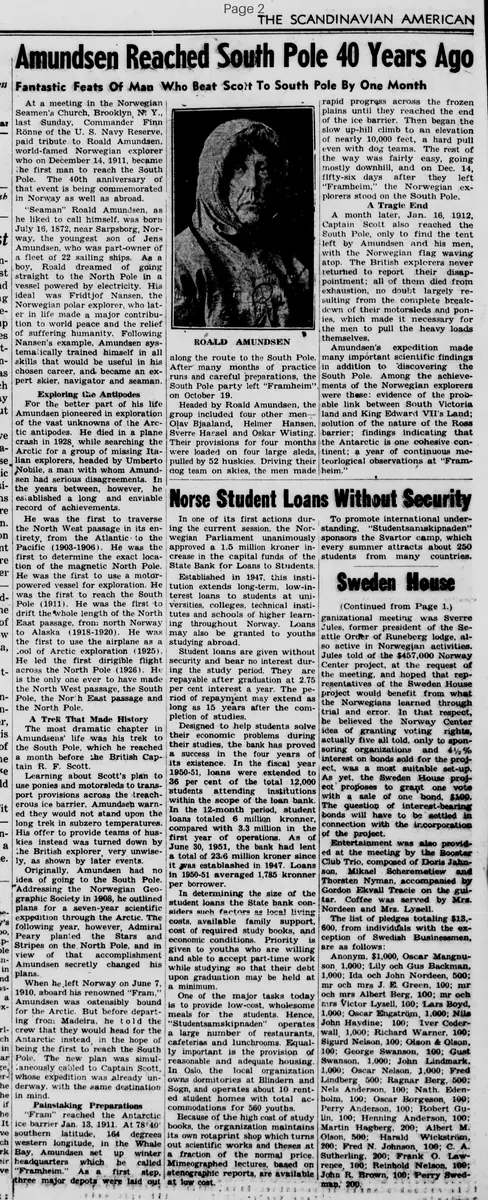
Amundsen Reached South Pole 40 Years Ago
Fantastic Feats Of Man Who Beat Scott To South Pole By One Month
At a meeting in the Norwegian Seamen's Church, Brooklyn N. Y., last Sunday, Commander Finn Rönne of the U. S. Navy Reserve, paid tribute to Roald Amundsen, world-famed Norwegian explorer who on December 14, 1911, became the first man to reach the South Pole. The 40th anniversary of that event is being commemorated in Norway as well as abroad.
"Seaman" Roald Amundsen, as he liked to call himself, was born July 16, 1872, near Sarpsborg, Norway, the youngest son of Jens Amundsen, who was part-owner of a fleet of 22 sailing ships. As a boy, Roald dreamed of going straight to the North Pole in a vessel powered by electricity. His ideal was Fridtjof Nansen, the Norwegian polar explorer, who later in life made a major contribution to world peace and the relief of suffering humanity. Following Nansen's example, Amundsen systematically trained himself in all skills that would be useful in his chosen career, and became an expert skier, navigator and seaman.
Exploring the Antipodes
For the better part of his life Amundsen pioneered in exploration of the vast unknowns of the Arctic antipodes. He died in a plane crash in 1928, while searching the Arctic for a group of missing Italian explorers, headed by Umberto Nobile, a man with whom Amundsen had serious disagreements. In the years between, however, he established a long and enviable record of achievements.
He was the first to traverse the North West passage in its entirety, from the Atlantic to the Pacific (1903-1906). He was the first to determine the exact location of the magnetic North Pole. He was the first to use a motor-powered vessel for exploration. He was the first to reach the South Pole (1911). He was the first to drift the whole length of the North East passage, from north Norway to Alaska (1918-1920). He was the first to use the airplane as a tool of Arctic exploration (1925). He led the first dirigible flight across the North Pole (1926). He is the only one ever to have made the North West passage, the South Pole, the North East passage and the North Pole.
A Trek That Made History
The most dramatic chapter in Amundsen's life was his trek to the South Pole, which he reached a month before the British Captain R. F. Scott.
Learning about Scott's plan to use ponies and motorsleds to transport provisions across the treacherous ice barrier, Amundsen warned they would not stand up on the long trek in subzero temperatures. His offer to provide teams of huskies instead was turned down by the British explorer, very unwisely, as shown by later events.
Originally, Amundsen had no idea of going to the South Pole. Addressing the Norwegian Geographic Society in 1908, he outlined plans for a seven-year scientific expedition through the Arctic. The following year, however, Admiral Peary planted the Stars and Stripes on the North Pole, and in view of that accomplishment Amundsen secretly changed his plans.
When he left Norway on June 7, 1910, aboard his renowned "Fram," Amundsen was ostensibly bound for the Arctic. But before departing from Madeira, he told the crew that they would head for the Antarctic instead in the hope of being the first to reach the South Pole. The new plan was simultaneously cabled to Captain Scott, whose expedition was already underway, with the same destination in mind.
Painstaking Preparations
"Fram" reached the Antarctic ice barrier Jan. 13, 1911. At 78°40' southern latitude, 164 degrees western longitude, in the Whale Bay, Amundsen set up winter headquarters which he called "Framheim."
As a first step, three major depots were laid out along the route to the South Pole. After many months of practice runs and careful preparations, the South Pole party left "Framheim" on October 19.
Headed by Roald Amundsen, the group included four other men—Olav Bjaaland, Helmer Hansen, Sverre Hassel and Oskar Wisting. Their provisions for four months were loaded on four large sleds, pulled by 52 huskies. Driving their dog team on skis, the men made rapid progress across the frozen plains until they reached the end of the ice barrier. Then began the slow up-hill climb to an elevation of nearly 10,000 feet, a hard pull even with dog teams. The rest of the way was fairly easy, going mostly downhill, and on Dec. 14, fifty-six days after they left "Framheim," the Norwegian explorers stood on the South Pole.
A Tragic End
A month later, Jan. 16, 1912, Captain Scott also reached the South Pole, only to find the tent left by Amundsen and his men, with the Norwegian flag waving atop. The British explorers never returned to report their disappointment; all of them died from exhaustion, no doubt largely resulting from the complete breakdown of their motorsleds and ponies, which made it necessary for the men to pull the heavy loads themselves.
Amundsen's expedition made many important scientific findings in addition to discovering the South Pole. Among the achievements of the Norwegian explorers were these: evidence of the probable link between South Victoria Land and King Edward VII's Land; solution of the nature of the Ross barrier; findings indicating that the Antarctic is one cohesive continent; a year of continuous meteorological observations at "Framheim."
What sub-type of article is it?
What keywords are associated?
What entities or persons were involved?
Where did it happen?
Foreign News Details
Primary Location
South Pole, Antarctica
Event Date
December 14, 1911
Key Persons
Outcome
amundsen's team reached the south pole first; scott's team reached it a month later but all died on the return due to equipment failure and exhaustion. amundsen's expedition made scientific findings including links between lands, nature of ross barrier, antarctic as one continent, and meteorological observations.
Event Details
Roald Amundsen, born 1872 in Norway, became the first to reach the South Pole on December 14, 1911, with four companions using dog teams and skis. Originally planning an Arctic expedition, he switched to Antarctic upon Peary's North Pole success. Departed Norway June 7, 1910, on 'Fram', arrived Antarctic January 13, 1911, set up Framheim. After preparations, left October 19, 1911, reached pole after 56 days. Scott arrived January 16, 1912, found Norwegian flag, but perished returning. Amundsen's other achievements: Northwest Passage (1903-1906), magnetic North Pole location, Northeast Passage (1918-1920), airplane and dirigible use in Arctic. Died 1928 in plane crash searching for Nobile's group. 40th anniversary commemorated in 1951, tribute by Finn Rönne in Brooklyn.