Thank you for visiting SNEWPapers!
Sign up free
Story
February 17, 1816
Richmond Enquirer
Richmond, Richmond County, Virginia
What is this article about?
In Savannah on June 29, soldier James Nixon is tried and convicted of murdering fellow U.S. soldier Belden in May. Judge Berrien sentences him to hang on February 10, delivering an eloquent address urging repentance and divine mercy.
Clipping
OCR Quality
95%
Excellent
Full Text
SAVANNAH June 29.
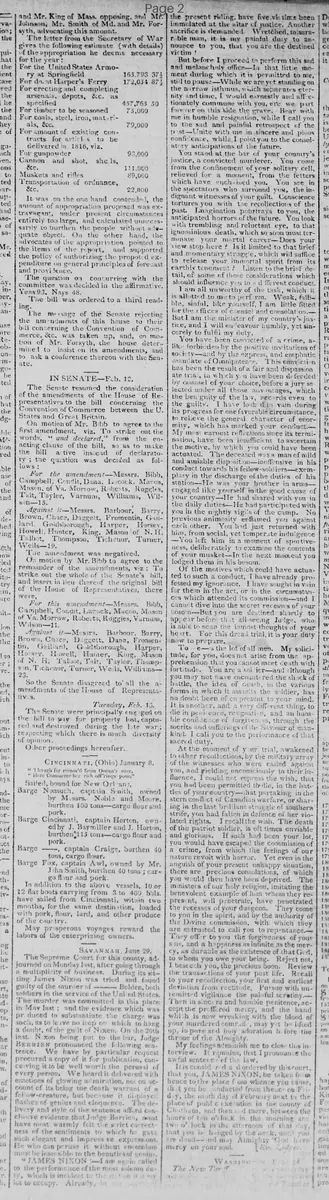
The Supreme Court for this county, adjourned on Monday last, after going through a multiplicity of business. During its sitting James Nixon was tried and found guilty of the murder of --- Belden, both soldiers in the service of the United States. The murder was committed in this place in May last; and the evidence which was produced to substantiate the charge was such, as to leave no loop on which to hang a doubt, of the guilt of Nixon. On the 20th inst. Nixon being put to the bar, Judge Berrien pronounced the following sentence. We have by particular request procured a copy of it for publication, conceiving it to be well worth the perusal of every person. We heard it delivered with emotions of glowing admiration, not on account of its being the death warrant of a fellow-creature, but because it displayed flashes of genius and eloquence. The delivery and style of the sentence afford conclusive evidence that Judge Berrien must have most warmly felt the strict correctness of the sentiments to which he gave such elegant and impressive expressions. He who can peruse it without encomium must be insensible to the beauties of genius.
"JAMES NIXON--I am again called to the performance of the most solemn duty, which is incident to the station its my lot to occupy. Already, in the present riding, have five victims been immolated at the altar of justice. Another sacrifice is demanded. Wretched, miserable man, it is my painful duty to announce to you, that you are the destined victim!
But before I proceed to perform this sad and melancholy office--In that little moment during which it is permitted to me, still to pause--While we are yet standing on the narrow isthmus, which separates eternity and time. I would earnestly and affectionately commune with you, ere we part forever on this side the grave. Bear with me in humble resignation, while I call you to the sad and painful retrospect of the past--Unite with me in sincere and pious confidence, while I point you to the consolatory anticipations of the future.
You stand at the bar of your country's justice, a convicted murderer. You come from the confinement of your solitary cell, relieved for a moment, from the fetters which have enchained you. You see in the spectators who surround you, the indignant witnesses of your guilt. Conscience tortures you with the recollections of the past. Imagination pourtrays to you, the anticipated horrors of the future. You look with trembling and reluctant eye, to that ignominious death, which so soon must terminate your mortal career--Does your view stop here? Is it limited to that brief and momentary struggle, which will suffice to release your immortal spirit from its earthly tenement? Listen to the brief detail, of some of those considerations which should influence you to a different conduct.
I am all unworthy of the task, which it is allotted to me to perform. Weak, fallible, sinful, like yourself, I am little fitted for the offices of counsel and consolation. But I am the minister of my country's justice, and I will endeavour humbly, yet sincerely to fulfil my duty.
You have been convicted of a crime, alike forbidden by the positive institutions of society--and by the express, and emphatic mandate of Omnipotence. This conviction has been the result of a fair and dispassionate trial, in which you have been defended by counsel of your choice, before a jury selected under all those advantages, which the benignity of the law, accords even to the guilty. I have looked in vain during its progress for one favorable circumstance, to relieve the general character of enormity, which has marked your conduct. My most earnest reflections since its termination, have been insufficient to ascertain the motive, by which you could have been actuated. The deceased was a man of mild and amiable disposition--inoffensive in his conduct towards his fellow-soldiers--exemplary in the discharge of the duties of his station--He was your brother in arms--engaged like yourself in the good cause of your country--He had shared with you in the daily duties--He had participated with you in the nightly vigils of the camp. No previous animosity enflamed you against each other. You had just returned with him, from social, yet temperate indulgence--You left him in a moment of spitefulness, deliberately to examine the contents of your musket--In the next moment you lodged them in his bosom.
Of the motives which could have actuated to such a conduct, I have already professed my ignorance. I have sought in vain for them in the act, or in the circumstances which attended its commission--and I cannot dive into the secret recesses of your bosom--But you are destined shortly to appear before that all-seeing Judge, who is able to scan the inmost thoughts of your heart. For this dreadful trial, it is your duty now to prepare.
To escape the lot of all men. My solicitude, for you, does not arise from the apprehension that you cannot meet death with fortitude. You are a soldier--and although you may not have encountered the shock of battle, the idea of death, in the various forms in which it assults the soldier, has no doubt been often present to your mind. It is another, and a very different thing, to die in penitence, resignation, and an humble confidence of forgiveness, through the merits and sufferings of the Saviour of mankind. I call you to the performance of that sacred duty.
At the moment of your trial, awakened to other recollections, by the military array of the witnesses who were called against you, and yielding unconsciously to their influence, I could not repress the wish, that you had been permitted to die, in the battles of your country--that partaking in the stern conflict of Canadian warfare, or sharing in the last brilliant struggle of southern strife, you had fallen in defence of her violated rights. I recall the wish. The death of the patriot soldier, is oftentimes enviable and glorious. If such had been your lot, you would have escaped the commission of a crime, from which the feelings of our nature revolt with horror. Yet even in the anguish of your present unhappy situation, there are precious consolations, of which you would then have been deprived. The ministers of our holy religion, imitating the benevolent example of him whom they represent, will penetrate, have penetrated the recesses of your dungeon. They come to you in the spirit, and by the authority of the Divine commission, with which they are entrusted to call you to repentance. They offer to you the forgiveness of your sins, and a happiness as infinite as the mercy, as durable as the existence of that God, to whom you owe your being. Reject not, I beseech you, the precious boon. Review the transactions of your past life. Recall to your recollection, your first and earliest deviation from rectitude, Pursue with unremitted vigilance the painful scrutiny. Then in sincere and humble penitence, accept the proffered mercy, and the hand which is now wreaking with the blood of your murdered comrade, may yet be lifted up, in pure and holy adoration before the throne of the Almighty.
My feelings admonish me to close this interview. It remains, that I pronounce the awful sentence of the law,
It is considered and ordered by this court, that you, JAMES NIXON, be taken from hence to the place from whence you came, that you be conducted thence on Friday, the tenth day of February next to the place of public execution in the county of Chatham, and there and then, between the hours of ten o'clock in the morning, and two o'clock in the afternoon of that day, that you be hanged by the neck, until you are dead--and may Almighty God have mercy on your soul."
The Supreme Court for this county, adjourned on Monday last, after going through a multiplicity of business. During its sitting James Nixon was tried and found guilty of the murder of --- Belden, both soldiers in the service of the United States. The murder was committed in this place in May last; and the evidence which was produced to substantiate the charge was such, as to leave no loop on which to hang a doubt, of the guilt of Nixon. On the 20th inst. Nixon being put to the bar, Judge Berrien pronounced the following sentence. We have by particular request procured a copy of it for publication, conceiving it to be well worth the perusal of every person. We heard it delivered with emotions of glowing admiration, not on account of its being the death warrant of a fellow-creature, but because it displayed flashes of genius and eloquence. The delivery and style of the sentence afford conclusive evidence that Judge Berrien must have most warmly felt the strict correctness of the sentiments to which he gave such elegant and impressive expressions. He who can peruse it without encomium must be insensible to the beauties of genius.
"JAMES NIXON--I am again called to the performance of the most solemn duty, which is incident to the station its my lot to occupy. Already, in the present riding, have five victims been immolated at the altar of justice. Another sacrifice is demanded. Wretched, miserable man, it is my painful duty to announce to you, that you are the destined victim!
But before I proceed to perform this sad and melancholy office--In that little moment during which it is permitted to me, still to pause--While we are yet standing on the narrow isthmus, which separates eternity and time. I would earnestly and affectionately commune with you, ere we part forever on this side the grave. Bear with me in humble resignation, while I call you to the sad and painful retrospect of the past--Unite with me in sincere and pious confidence, while I point you to the consolatory anticipations of the future.
You stand at the bar of your country's justice, a convicted murderer. You come from the confinement of your solitary cell, relieved for a moment, from the fetters which have enchained you. You see in the spectators who surround you, the indignant witnesses of your guilt. Conscience tortures you with the recollections of the past. Imagination pourtrays to you, the anticipated horrors of the future. You look with trembling and reluctant eye, to that ignominious death, which so soon must terminate your mortal career--Does your view stop here? Is it limited to that brief and momentary struggle, which will suffice to release your immortal spirit from its earthly tenement? Listen to the brief detail, of some of those considerations which should influence you to a different conduct.
I am all unworthy of the task, which it is allotted to me to perform. Weak, fallible, sinful, like yourself, I am little fitted for the offices of counsel and consolation. But I am the minister of my country's justice, and I will endeavour humbly, yet sincerely to fulfil my duty.
You have been convicted of a crime, alike forbidden by the positive institutions of society--and by the express, and emphatic mandate of Omnipotence. This conviction has been the result of a fair and dispassionate trial, in which you have been defended by counsel of your choice, before a jury selected under all those advantages, which the benignity of the law, accords even to the guilty. I have looked in vain during its progress for one favorable circumstance, to relieve the general character of enormity, which has marked your conduct. My most earnest reflections since its termination, have been insufficient to ascertain the motive, by which you could have been actuated. The deceased was a man of mild and amiable disposition--inoffensive in his conduct towards his fellow-soldiers--exemplary in the discharge of the duties of his station--He was your brother in arms--engaged like yourself in the good cause of your country--He had shared with you in the daily duties--He had participated with you in the nightly vigils of the camp. No previous animosity enflamed you against each other. You had just returned with him, from social, yet temperate indulgence--You left him in a moment of spitefulness, deliberately to examine the contents of your musket--In the next moment you lodged them in his bosom.
Of the motives which could have actuated to such a conduct, I have already professed my ignorance. I have sought in vain for them in the act, or in the circumstances which attended its commission--and I cannot dive into the secret recesses of your bosom--But you are destined shortly to appear before that all-seeing Judge, who is able to scan the inmost thoughts of your heart. For this dreadful trial, it is your duty now to prepare.
To escape the lot of all men. My solicitude, for you, does not arise from the apprehension that you cannot meet death with fortitude. You are a soldier--and although you may not have encountered the shock of battle, the idea of death, in the various forms in which it assults the soldier, has no doubt been often present to your mind. It is another, and a very different thing, to die in penitence, resignation, and an humble confidence of forgiveness, through the merits and sufferings of the Saviour of mankind. I call you to the performance of that sacred duty.
At the moment of your trial, awakened to other recollections, by the military array of the witnesses who were called against you, and yielding unconsciously to their influence, I could not repress the wish, that you had been permitted to die, in the battles of your country--that partaking in the stern conflict of Canadian warfare, or sharing in the last brilliant struggle of southern strife, you had fallen in defence of her violated rights. I recall the wish. The death of the patriot soldier, is oftentimes enviable and glorious. If such had been your lot, you would have escaped the commission of a crime, from which the feelings of our nature revolt with horror. Yet even in the anguish of your present unhappy situation, there are precious consolations, of which you would then have been deprived. The ministers of our holy religion, imitating the benevolent example of him whom they represent, will penetrate, have penetrated the recesses of your dungeon. They come to you in the spirit, and by the authority of the Divine commission, with which they are entrusted to call you to repentance. They offer to you the forgiveness of your sins, and a happiness as infinite as the mercy, as durable as the existence of that God, to whom you owe your being. Reject not, I beseech you, the precious boon. Review the transactions of your past life. Recall to your recollection, your first and earliest deviation from rectitude, Pursue with unremitted vigilance the painful scrutiny. Then in sincere and humble penitence, accept the proffered mercy, and the hand which is now wreaking with the blood of your murdered comrade, may yet be lifted up, in pure and holy adoration before the throne of the Almighty.
My feelings admonish me to close this interview. It remains, that I pronounce the awful sentence of the law,
It is considered and ordered by this court, that you, JAMES NIXON, be taken from hence to the place from whence you came, that you be conducted thence on Friday, the tenth day of February next to the place of public execution in the county of Chatham, and there and then, between the hours of ten o'clock in the morning, and two o'clock in the afternoon of that day, that you be hanged by the neck, until you are dead--and may Almighty God have mercy on your soul."
What sub-type of article is it?
Crime Story
Historical Event
Biography
What themes does it cover?
Crime Punishment
Justice
Moral Virtue
What keywords are associated?
Murder Trial
Soldier Killing
Death Sentence
Judge Berrien Speech
Repentance Urging
Savannah Court
What entities or persons were involved?
James Nixon
Belden
Judge Berrien
Where did it happen?
Savannah, County Of Chatham
Story Details
Key Persons
James Nixon
Belden
Judge Berrien
Location
Savannah, County Of Chatham
Event Date
May Last (Murder), June 29 (Trial), February 10 Next (Execution)
Story Details
Soldier James Nixon murders fellow soldier Belden in a moment of spite after shared duties; convicted in fair trial with irrefutable evidence; Judge Berrien sentences him to hang, eloquently urging repentance, reflection on life, and acceptance of divine mercy.