Thank you for visiting SNEWPapers!
Sign up free
Constitutional Whig
Richmond, Virginia
What is this article about?
Reports on the aftermath of the July Revolution in France: ex-King Charles X and family arrive in Cowes, England, from Cherbourg on Aug 13, 1830, seeking asylum; diplomatic consultations in London; Louis Philippe's proclamation as King in Paris on Aug 15; various Parisian news including a banquet for Lafayette.
Clipping
OCR Quality
Full Text
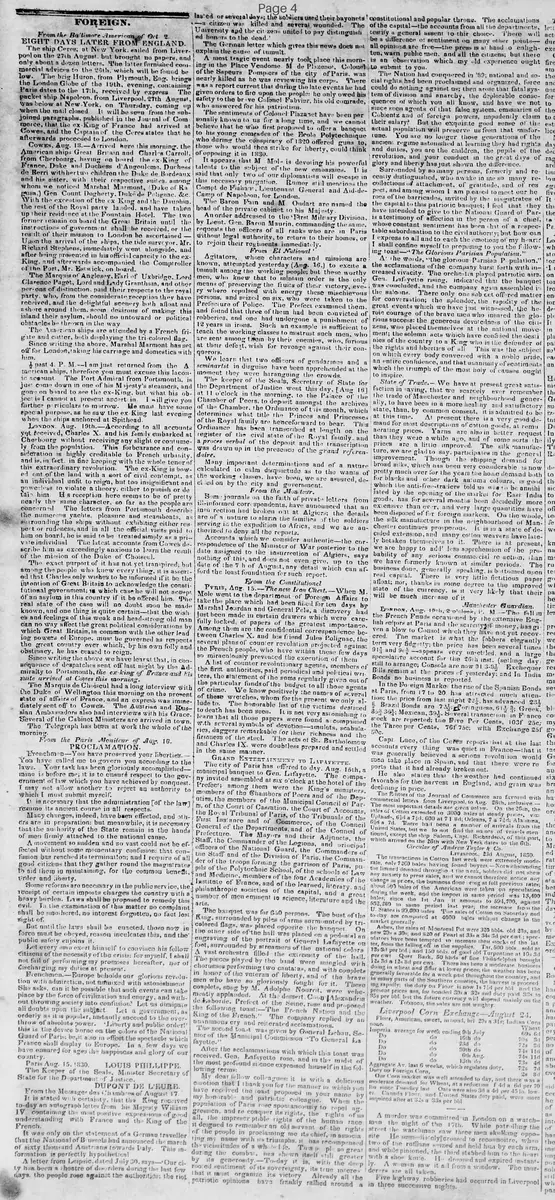
From the Baltimore American of Oct. 2.
EIGHT DAYS LATER FROM ENGLAND.
The ship Ceres at New York, sailed from Liverpool on the 27th August, but brought no papers, and only about a dozen letters. The latter furnished commercial advices to the 20th, which will be found below. The brig Huron, from Plymouth, Eng., brings the London Globe of the 19th, evening, containing Paris dates to the 17th, received by express. The packet ship Napoleon, from Liverpool, 27th August, was below at New York, on Thursday, coming up when the mail closed. It will be seen from the subjoined paragraphs, published in the Journal of Commerce, that the ex-King of France had arrived at Cowes, and the Captain of the Ceres states that he afterwards proceeded to London.
Cowes, Aug. 13.--Arrived here this morning, the American ships Great Britain and Charles Carroll, from Cherbourg, having on board the ex-King of France, Duke and Duchess d'Angoulême, Duchess de Berri with her two children, the Duke de Bordeaux and his sister, with their respective suites, among whom we noticed Marshal Marmont, (Duke of Ragusa,) Gen. Count Dogherty, Duke de Polignac, &c.
With the exception of the ex-King and the Dauphin, the rest of the Royal party landed, and have taken up their residence at the Fountain Hotel. The two former remain on board the Great Britain until the instructions of government shall be received, or the result of their mission to London be ascertained.
Upon the arrival of the ships, the tide surveyor, Mr. Richard Stephens, immediately went alongside, and after being presented in his official capacity to the ex-King, and afterwards accompanied the Comptroller of the Port, Mr. Estwick, on board.
The Marquis of Anglesey, Earl of Uxbridge, Lord Clarence Paget, Lord and Lady Grantham, and other persons of distinction, paid their respects to the royal party, who, from the considerate reception they have received, and the delightful scenery both afloat and ashore around them, seem desirous of making this island their asylum, should no untoward or political obstacles be thrown in the way.
The American ships are attended by a French frigate and cutter, both displaying the tri-colored flag.
Since writing the above, Marshal Marmont has set off for London, taking his carriage and domestics with him.
Past 4, P.M.--I am just returned from the American ships; therefore you must excuse this laconic account. The Port Admiral from Portsmouth, is just come down in one of his Majesty's steamers, and gone on board to see the ex-King, but what his object is I cannot at present ascertain. I will give you further particulars tomorrow. He must have some special purpose, as he saw the ex-King last evening when the ships anchored at Spithead.
London, Aug. 19th.--According to all accounts yet received, Charles X. and his family embarked at Cherbourg without receiving any slight or contumely from the population. This forbearance and consideration is highly creditable to French urbanity, and is, in fact, in fine keeping with the whole tenor of this extraordinary revolution. The ex-King is bowed out of the land with a sort of civil contempt, as an individual unfit to reign, but too insignificant and powerless to violate a treaty, either to punish or detain him. His reception here seems to be of pretty nearly the same character, so far as the people are concerned. The letters from Portsmouth describe the numerous yachts, pleasure and steamboats, as surrounding the ships without exhibiting either respect or rudeness, and in all the official visits paid to him on board, he is said to be treated simply as a private individual. The latest accounts from Cowes describe him as exceedingly anxious to learn the result of the mission of the Duke of Choiscul.
The exact purport of it has not yet transpired; but among the people who know every thing, it is asserted that Charles only wishes to be informed if it be the intention of Great Britain to acknowledge the constitutional government; in which case he will not accept of an asylum in this country if it be offered him. The real state of the case will no doubt soon be made known, and one thing is quite certain--that the wishes and feelings of this weak and head-strong old man can no way affect the great political considerations by which Great Britain, in common with the other leading powers of Europe, must be governed as respects the great country over which, by his own folly and obstinacy, he has ceased to reign.
Since writing the above we have learnt that, in consequence of despatches sent off last night by the Admiralty to Portsmouth, the ex-King of France and his suite arrived at Cowes this morning.
The Marquis de Choiscul had a long interview with the Duke of Wellington this morning on the present state of affairs of France, and an express was immediately sent off to Cowes. The Austrian and Russian Ambassadors also had interviews with his Grace.
Several of the Cabinet Ministers are arrived in town.
The Telegraph has been at work the whole of the morning.
From the Paris Moniteur of Aug. 16.
PROCLAMATION.
Frenchmen--You have preserved your liberties.
You have called me to govern you according to the laws. Your task has been gloriously accomplished--mine is before me; it is to ensure respect to the government of law which you have achieved by conquest.
I may not allow another to reject an authority to which I must submit myself.
It is necessary that the administration [of the law] resume its ancient course in all respects.
Many changes, indeed, have been effected, and others are in preparation: but meanwhile, it is necessary that the authority of the State remain in the hands of men strictly attached to the national cause.
A movement so sudden and so vast could not be effected without some momentary confusion: that confusion has reached its termination; and I require of all good citizens that they gather round the magistrates to aid them in maintaining, for the common good, order and liberty.
Some reforms are necessary in the public service, the receipt of certain imposts charges the country with a heavy burden. Laws shall be proposed to remedy this evil. In the examination of this matter no complaint shall be smothered, no interest forgotten, no fact lost sight of.
But until the laws shall be enacted, those now in force must be obeyed, reason inculcates this, and the public safety enjoins it.
Let every man exert himself to convince his fellow citizens of the necessity of the crisis: for myself, I shall not fail of performing my promises hereafter, nor of discharging my duties at present.
Frenchmen.--Europe beholds our glorious revolution with admiration, not unmixed with astonishment. She asks, can it be possible that such events can take place by the force of civilization and energy, and without throwing society into confusion? Let us dissipate all doubts upon the subject. Let a government, as orderly as it is popular, instantly succeed to the overthrow of absolute power. 'Liberty and public order!' this is the device borne on the colors of the National Guard of Paris; be it so in effect the spectacle which France shall display to Europe. In a few days we have ensured for ages the happiness and glory of our country.
Paris, Aug. 15, 1830.
LOUIS PHILIPPE.
The Keeper of the Seals--Minister Secretary of State for the Department of Justice.
DUPONT DE L'EURE.
From the Messager des Chambres of August 17.
It is stated with certainty, that the King received to-day an autograph letter from his Majesty William IV. containing the most positive expressions of good understanding with France and its King of the French.
It was only on the statement of a German traveller that the National of Brussels had announced the march of sixty thousand Austrians towards Italy. This information is perfectly hypothetical.
A letter from Leipsic, dated July 30, says--'Our city has been a theatre of disorders during the last few days, the people rose against the authorities; the riot lasted for several days; the soldiers used their bayonets--a citizen was killed and several wounded.' The University and the citizens united to pay distinguished honors to the dead.
The German letter which gives this news does not explain the cause of tumult.
A most tragic event nearly took place this morning in the Place Vendome. M. de Plazenot, Colonel of the Sapeurs Pompiers of the city of Paris, was nearly killed as he was reviewing his corps. There was a report current that during the late events he had given orders to fire upon the people: he only owed his safety to the brave Colonel Fabvier, his old comrade, who answered for his patriotism.
The sentiments of Colonel Plazenot have been personally known to us for a long time, and we cannot believe that he who first proposed to offer a banquet to his young comrades of the Ecole Polytechnique who during the conspiracy of 1820 offered guns to, those who would then strike for liberty, could think of opposing it in 1830.
It appears that M. Molé is devoting his powerful talents to the subject of the new embassies. It is said that only two of our diplomatists will escape in this necessary purgation. Rumor still mentions the Comte de Flahaut, Lieutenant General and Aid-de-Camp of Napoleon, for London.
The Baron Fain and M. Oudart are named the head of the private cabinet to his Majesty.
An order addressed to the 'First Military Division, by Lieut. Gen. Baron Maurin, commanding the same, requests the officers of all ranks who are in Paris without legal authority, to return to their homes, or to rejoin their regiments immediately.
From El National.
Agitators, whose characters and missions are known, attempted yesterday (Aug. 16.) to excite a tumult among the working people; but these worthy men, who knew that to maintain order is the only means of preserving the fruits of their victory, everywhere repulsed with energy these mischievous persons, and seized on six, who were taken to the Prefecture of Police. The Prefect examined them, and found that three of them had been convicted of robberies, and one had undergone a punishment of 12 years in irons. Such an example is sufficient to teach the working classes to mistrust such men, who are sent among them by their enemies, who, furious at their defeat, wish for revenge against their conquerors.
We learn that two officers of gendarmes and a seminarist in disguise have been apprehended at the moment they were haranguing the crowds.
The keeper of the Seals, Secretary of State for the Department of Justice went this day, [Aug 16] at 11 o'clock in the morning, to the Palace of the Chamber of Peers, to deposit amongst the archives of the Chamber, the Ordinance of this month, which determines what title the Princes and Princesses of the Royal family are henceforward to bear. This Ordinance has been transcribed at length on the register of the civil state of the Royal family, and a proces verbal of the deposit and the transcription was drawn up in the presence of the grand referendaire.
Many important determinations and of a nature calculated to calm disquietude as to the wants of the working classes, have been, we are assured, decided on by the city and government.
From the Moniteur.
Some journals on the faith of private letters from ill-informed correspondents, have announced that an insurrection had broken out at Algiers; the details are of a nature to alarm the families of the soldiers serving in the expedition to Africa, and we are authorized to deny all the reports.
Accounts which we consider authentic--the correspondence of the Minister of War posterior to the date assigned to the insurrection of Algiers, says nothing of this, and does not even give, up to the date of the 7th of August, any detail which can afford the least foundation for such report.
From the Constitutionnel.
Paris, Aug. 15.--The new Iron Chest.--When M. Mole went to the department of Foreign Affairs to take the place which had been filled for ten days by Marshal Jourdan and General Pélissier, a discovery had just been made in certain drawers which were carefully locked, of papers of the greatest importance.
Among them are the confidential correspondence between Charles X. and his friend Jules Polignac, the several plans of counter revolution projected against the French people, who have within these few days so miraculously prevented the execution of them.
A list of counter revolutionary agents, members of the first authorities, paid periodical and political writers, the statement of the sums regularly given out of the particular funds of the budget to all those agents of crime. We know positively the names of several of these wretches, whom for the present we only allude to. The honorable list of the victims destined to death has been seen. It is not very astonishing to learn that all those papers were found accompanied with several symbols of devotion--amulets, scapularies, daggers remarkable for their richness and the firmness of the steel. The acts of St. Bartholomew and Charles IX. were doubtless prepared and settled in the same manner.
GRAND ENTERTAINMENT TO LAFAYETTE.
The city of Paris has offered to day, Aug. 15th, a municipal banquet to Gen. Lafayette. The company invited assembled at six o'clock at the hotel of the Prefect; among them were the King's ministers, members of the Chambers of Peers and of the Deputies, the members of the Municipal Council of Paris, of the Court of Cassation, the Court of Accounts, the Royal Tribunal of Paris, of the Tribunals of the First Instance and of Commerce, of the Council General of the Departments, and of the Council of Prefectare. The Mayors and their Adjoints, the Staff, the Commander of the Legions, and principal officers of the National Guard, the Commanders of the Staff and of the Division of Paris, the Commander of the troops forming the garrison of Paris, pupils of the Polytechnic School, of the schools of Law and Medicine, members of the four Academies of the Institute of France, and of the learned, literary, and philanthropic societies of the capital, and a great number of men eminent in science, literature and the arts.
The banquet was for 350 persons. The bust of the King, surrounded by piles of arms surmounted by tri-colored flags, was placed opposite the banquet. On the other side of the hall was placed on a pedestal an engraving of the portrait of General Lafayette on foot, surrounded by streamers of the national colors.
A vast orchestra filled the extremity of the hall. The pieces played by the band were mingled with choruses performing two cantatas, and with couplets in honor of the veteran of liberty, and of the brave men who have so gloriously fought for it. These couplets, sung by M. Adolphe Nourrit, were vehemently applauded. At the dessert, Count Alexandre de Laborde, Prefect of the Seine, rose and proposed the following toast:--The French Nation and the King of the French. The company replied by an unanimous cry and reiterated acclamations.
The second toast was given by General Laharpe, Senior of the Municipal Commission "To General Lafayette."
After the acclamations with which this toast was received, Gen. Lafayette rose, and in the midst of the most profound silence expressed himself in the following terms:
My dear fellow colleagues: it is with a delicious emotion that I thank you for the manner in which you have received the toast proposed in your name by my honorable and patriotic colleague. When the population of Paris rose spontaneously to repel aggression, and reconquer its rights, the rights of us all, the imprescriptible rights of the human race, it deigned to remember an old servant of the rights of the people in proclaiming me its chief, in associating my name with its triumphs. it has recompensed the vicissitudes of a whole life. This people so great during the combat, has shown itself still greater by its generosity.--To-day it is, with the deep rooted sentiment of its sovereignty, its true interest, that it must organize its victory. Already all the patriotic opinions have frankly rallied around a constitutional and popular throne. The acclamations of the capital--the accounts from all the departments, testify a general assent to this choice. There will be a difference of sentiment on many other points--all opinions are free--the press is at hand to enlighten, warn public men, and all the citizens; but there is an observation which my old experience ought to submit to you.
The Nation had conquered in '89; national and social rights had been proclaimed and organized, force could do nothing against us; then arose that fatal system of division and anarchy, the deplorable consequences of which you all know, and have we not since seen agents of that false system, emissaries of Coblentz and of foreign powers, impudently claim their salary? But the exquisite good sense of the actual population will preserve us from that misfortune. You are no longer those generations of the ancient regime astonished at learning they had rights and duties, you are the children, the pupils of the revolution, and your conduct in the great days of glory and liberty has just shown the difference.
Surrounded by so many persons, formerly and recently distinguished, who awake in me so many recollections of attachment, of gratitude, and of respect, and among whom I am pleased to meet our heroes of the barricades, invited by the magistrates of the capital to this patriotic banquet; I feel that they have intended to give to the National Guard of Paris a testimony of affection in the person of a chief, whose constant sentiment has been that of a respectable subordination to the civil authority; but how can I express to all and to each the emotions of my heart? I shall confine myself to proposing to you the following toast--"The Glorious Parisian Population."
At the words, "the glorious Parisian Population," the acclamations of the company burst forth with increased vivacity. The orchestra played patriotic airs.
Gen. Lafayette rising, indicated that the banquet was concluded, and the company again assembled in the saloon. There only one subject offered matter for conversation; the splendor, the rapidity of the great events which we have just witnessed, the heroic courage of the brave men who insured the glorious success: the generous devotedness of the citizens, who placed themselves at the national movement; the solemn acts which have confided the destinies of the country to a King who is the defender of the rights and liberties of all. This was the subject on which every body conversed with a noble pride, an entire confidence, and that unanimity of sentiments which the triumph of the most holy of causes ought to inspire.
What sub-type of article is it?
What keywords are associated?
What entities or persons were involved?
Where did it happen?
Foreign News Details
Primary Location
France
Event Date
August 1830
Key Persons
Outcome
ex-king charles x and family exiled to england; louis philippe proclaimed king of the french; revolution succeeds without major reported casualties; diplomatic recognitions sought; counter-revolutionary plots discovered and denied rumors of insurrection in algiers.
Event Details
Ex-King Charles X and Bourbon family arrive in Cowes, England, on American ships from Cherbourg on Aug 13, seeking asylum amid the French Revolution; diplomatic missions to London inquire about British recognition of new constitutional government; Louis Philippe issues proclamation in Paris on Aug 15 affirming rule of law and order; reports of minor disorders in Paris and Leipzig denied or resolved; discovery of counter-revolutionary documents; grand banquet honors Lafayette on Aug 15.