Thank you for visiting SNEWPapers!
Sign up free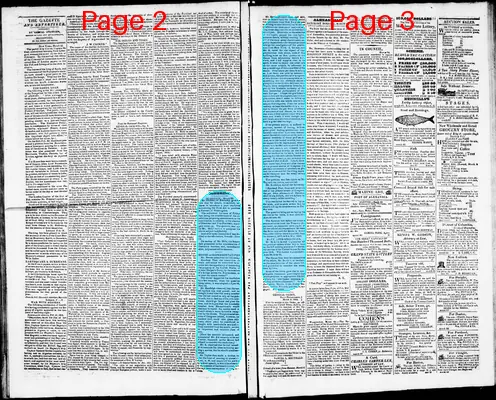
Alexandria Gazette & Advertiser
Alexandria, Virginia
What is this article about?
On March 22, the U.S. Senate discussed constitutional amendments and postponed them, then adjourned. In the House, resolutions were introduced for a bridge at Harper's Ferry and to reduce meeting hours and per diem allowances, with debates on long sessions' harms. Navy appropriations bill was considered amid discussions.
Merged-components note: Continuation of the report on congressional proceedings in the House of Representatives across pages.
Clippings
1 of 2
OCR Quality
Full Text
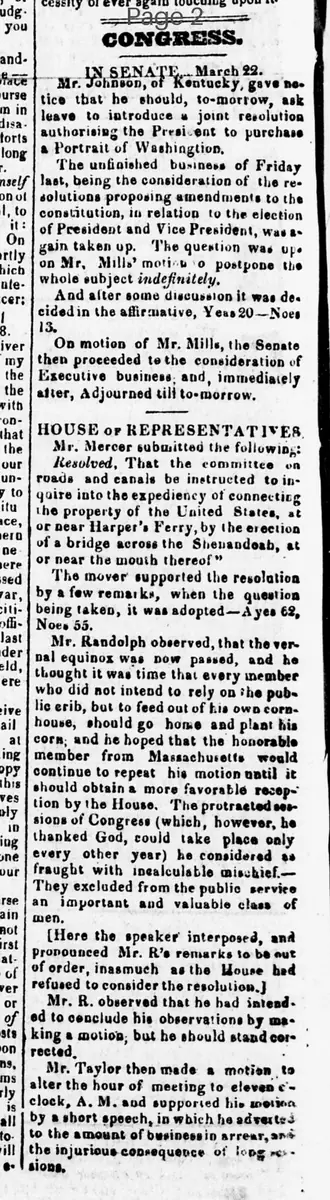
IN SENATE... March 22.
Mr. Johnson, of Kentucky, gave notice that he should, to-morrow, ask leave to introduce a joint resolution authorising the President to purchase Portrait of Washington.
The unfinished business of Friday last, being the consideration of the resolutions proposing amendments to the constitution, in relation to the election of President and Vice President, was again taken up. The question was upon Mr. Mills' motion to postpone the whole subject indefinitely.
And after some discussion it was decided in the affirmative, Yeas 20--Noes 13.
On motion of Mr. Mills, the Senate then proceeded to the consideration of Executive business: and, immediately after, adjourned till to-morrow.
HOUSE OF REPRESENTATIVES
Mr. Mercer submitted the following:
Resolved, That the committee on roads and canals be instructed to enquire into the expediency of connecting the property of the United States, at or near Harper's Ferry, by the erection of a bridge across the Shenandoah, at or near the mouth thereof.
The mover supported the resolution by a few remarks, when the question being taken, it was adopted--Ayes 69, Noes 55.
Mr. Randolph observed, that the vernal equinox was now passed, and he thought it was time that every member who did not intend to rely on the public crib, but to feed out of his own corn-house, should go home and plant his corn: and he hoped that the honorable member from Massachusetts would continue to repeat his motion until it should obtain a more favorable reception by the House. The protracted sessions of Congress (which, however, he thanked God, could take place only every other year) he considered as fraught with incalculable mischief.-- They excluded from the public service an important and valuable class of men.
[Here the speaker interposed, and pronounced Mr. R's remarks to be out of order, inasmuch as the House had refused to consider the resolution.]
Mr. R. observed that he had intended to conclude his observations by making a motion: but he should stand corrected.
Mr. Taylor then made a motion to alter the hour of meeting to eleven o'clock, A. M. and supported his motion by a short speech, in which he adverted to the amount of business in arrear, and the injurious consequence of long sessions.
Mr. Randolph again rose, and said that he should take the liberty which the gentleman from New York seemed so willing to take himself, but to refuse to others—no uncommon case—of making some observations on an interdicted subject. He should, in the selection of his topics, pursue his own lights however feeble, without availing himself of the very great discernment, sagacity, experience—(he wished he could enlarge the catalogue)—of the gentleman from New York. I, for one, said Mr. R. voted for the repeal of that preposterous rule which, even if this building were on fire, prevented the House from adjourning before 4 o'clock: and I did suppose that, in its spirit, it went to repeal the other rule on the same subject, in reference to the proceedings of the committee of the whole. Four hours per diem is as long as I, at least, am able to endure—I will not say, the pestilential atmosphere of this House—but an atmosphere, such as nothing but the wretched animals plunged into the Grotto del Cane, near Naples, were compelled to breathe, to gratify the laudable curiosity of the very benevolent philosophers of modern Europe. I hope the gentleman's motion will not be adopted—and I now give notice, that I mean to follow up his motion with one which relates to a subject that requires, if not the actual cautery, at least the knife—it is a motion to reduce the per diem allowance of members of this House, to what it was when I first had the honor of a seat here, and which I then thought, and still think, as a per diem allowance, was fixed a great deal too high. If the present session is suffered to continue, instead of having, in Congress great leading professional men, we shall have what have been denominated the merely mechanical, the instrumental members of those professions. And, as to the landed interest, how can we expect it to be represented, when it is ruin to a landed man to attend here? I for one, cannot, sir, consent to sit here for so many months, de die in diem, for six days in the week, and hear nothing but the same strain forever repeated. It is enough, sir, to worry the patience of Job himself. I shall, therefore, move that, from and after the end of the present session of Congress, the per diem allowance of members be 6, and the allowance for travelling expenses be the same sum for every twenty miles travelling.
The question was then taken on Mr. Taylor's resolution, and carried.
Mr. Randolph moved the following:
"Resolved, That from and after the end of the present session of Congress, the per diem allowance of Members shall be six dollars, and six dollars for every twenty miles travelling."
This resolution he desired to lay on the table, and he gave notice that he should call up its consideration on Friday next.
The question being put on laying the resolve on the table, it was carried—Ayes 80, noes 60.
The Speaker laid before the house a communication from the Treasury Department, accompanied with copies of all the official correspondence between the Secretary and the Banks in which the public moneys were deposited, from 1st January, 1819, to 8th May 1822.
NAVY APPROPRIATIONS.
Mr. McLane moved to postpone all the previous orders of the day to take up the bill making provision for the naval service of the United States for the year 1824. The motion was carried—Ayes 84, noes 65.
The House then went into committee of the whole, Mr. Bartlett in the chair, on the consideration of the above bill, and proceeded to consider the same, item by item.
Some of the items gave rise to considerable discussion, particularly that which proposes to appropriate 225,000 dollars for contingent expenses, including all extra allowances.
In this discussion, Messrs. Cobb, Cocke, McLane, Taylor, Forsyth, and others, engaged. Adjourned.
What sub-type of article is it?
What keywords are associated?
What entities or persons were involved?
Where did it happen?
Domestic News Details
Primary Location
Washington
Event Date
March 22
Key Persons
Outcome
senate postponed constitutional amendments (yeas 20, noes 13); house adopted bridge inquiry resolution (ayes 69, noes 55), changed meeting time to 11 am, tabled per diem reduction resolution (ayes 80, noes 60), postponed to navy bill (ayes 84, noes 65), discussed appropriations and adjourned.
Event Details
U.S. Congress proceedings: Senate considered notice for Washington portrait purchase and postponed constitutional amendments on presidential election. House debated and adopted resolution for bridge at Harper's Ferry, discussed long sessions' issues with speeches by Randolph and Taylor, adjusted meeting hour, proposed and tabled per diem reduction, received Treasury communication, and debated navy appropriations bill item by item.