Thank you for visiting SNEWPapers!
Sign up free
Editorial
August 6, 1806
Virginia Argus
Richmond, Virginia
What is this article about?
The editorial celebrates the relative equality of property and opportunity in the United States compared to the stark inequalities under European monarchies, attributing this to republican institutions that promote widespread industry versus monarchical concentration of wealth.
Clipping
OCR Quality
98%
Excellent
Full Text
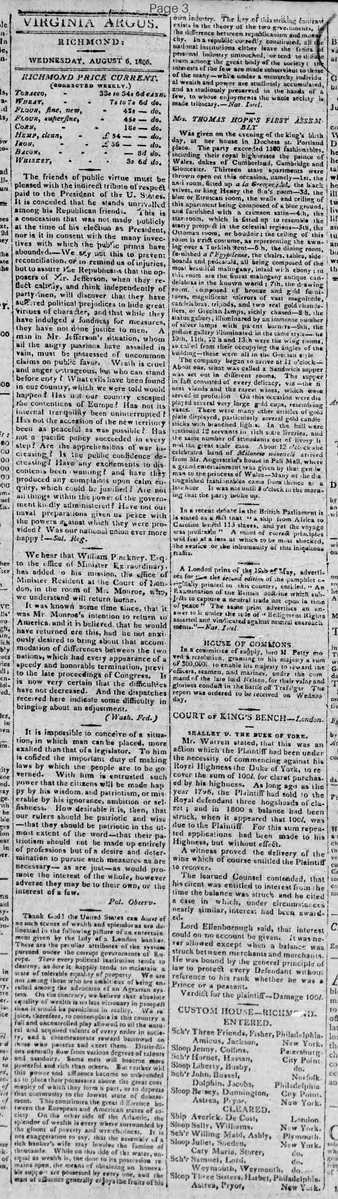
Thank God! the United States can boast of no such scenes of wealth and splendor as are delineated in the following picture of an entertainment given by the lady of a London banker.
These are the peculiar attributes of the system pursued under the corrupt governments of Europe. There every political institution tends to destroy, as here it happily tends to maintain a state of tolerable equality of property. We are not among those who are ambitious of being enrolled among the advocates of an Agrarian system. On the contrary, we believe that absolute equality of wealth is no less visionary in prospect than it would be pernicious in reality. We rejoice, therefore, to contemplate in this country a full and uncontrolled play allowed to all the natural and acquired talents of every order in society, and a commensurate reward bestowed on those who possess and exert them. Distinctions naturally flow from various degrees of talents and assiduity. Some men will become more powerful and rich than others. But neither will this power and affluence become so unbounded as to place their possessors above the great community of which they form a part, or to depress that community to the lowest state of debasement. This constitutes the great difference between the European and American states of society. On the other side of the Atlantic, the splendor of wealth is every where surrounded by the gloom of poverty and wretchedness. It is not exaggeration to say, that the assembly of a rich banker's wife may involve the famine of thousands. While on this side of the water, unequal as wealth is, the door to its possession remains open, the means of obtaining an honorable support are possessed by every one, and the man of affluence generally enjoys the fruits of his own industry. The key of this striking contrast exists in the theory of the two governments, the difference between republicanism and monarchy. In a republic correctly constituted, all the national institutions either leave the means of personal industry untouched, or tend to diffuse them among the great body of the society: the interests of the few are made subservient to those of the many ~while under a monarchy individual wealth and power are studiously accumulated, and as studiously preserved in the hands of a few, to whose enjoyments the whole society is made tributary.--Nat. Intel.
These are the peculiar attributes of the system pursued under the corrupt governments of Europe. There every political institution tends to destroy, as here it happily tends to maintain a state of tolerable equality of property. We are not among those who are ambitious of being enrolled among the advocates of an Agrarian system. On the contrary, we believe that absolute equality of wealth is no less visionary in prospect than it would be pernicious in reality. We rejoice, therefore, to contemplate in this country a full and uncontrolled play allowed to all the natural and acquired talents of every order in society, and a commensurate reward bestowed on those who possess and exert them. Distinctions naturally flow from various degrees of talents and assiduity. Some men will become more powerful and rich than others. But neither will this power and affluence become so unbounded as to place their possessors above the great community of which they form a part, or to depress that community to the lowest state of debasement. This constitutes the great difference between the European and American states of society. On the other side of the Atlantic, the splendor of wealth is every where surrounded by the gloom of poverty and wretchedness. It is not exaggeration to say, that the assembly of a rich banker's wife may involve the famine of thousands. While on this side of the water, unequal as wealth is, the door to its possession remains open, the means of obtaining an honorable support are possessed by every one, and the man of affluence generally enjoys the fruits of his own industry. The key of this striking contrast exists in the theory of the two governments, the difference between republicanism and monarchy. In a republic correctly constituted, all the national institutions either leave the means of personal industry untouched, or tend to diffuse them among the great body of the society: the interests of the few are made subservient to those of the many ~while under a monarchy individual wealth and power are studiously accumulated, and as studiously preserved in the hands of a few, to whose enjoyments the whole society is made tributary.--Nat. Intel.
What sub-type of article is it?
Constitutional
Social Reform
Economic Policy
What keywords are associated?
American Equality
European Inequality
Republicanism
Monarchy
Wealth Distribution
Social Institutions
Personal Industry
What entities or persons were involved?
United States
Europe
London Banker
Editorial Details
Primary Topic
Contrast Between American Republican Equality And European Monarchical Inequality
Stance / Tone
Celebratory Of American Republicanism And Critical Of European Monarchy
Key Figures
United States
Europe
London Banker
Key Arguments
United States Maintains Tolerable Equality Of Property Unlike Europe's Corrupt Systems
Rejects Absolute Equality As Visionary And Pernicious
American Society Allows Play Of Talents With Commensurate Rewards
Wealth In America Does Not Debase The Community
European Wealth Splendor Surrounds Poverty And Wretchedness
Banker's Entertainment May Cause Famine For Thousands
In America, Opportunity For Honorable Support Is Open To All
Difference Stems From Republicanism Versus Monarchy
Republic Diffuses Industry Among Society, Subordinating Few To Many
Monarchy Accumulates Wealth For Few At Society's Expense