Thank you for visiting SNEWPapers!
Sign up free
Constitutional Whig
Richmond, Virginia
What is this article about?
In the Virginia Senate, Mr. Bernard delivers a speech opposing the Convention Bill, arguing against calling a convention to amend the constitution due to risks to property rights and suffrage restrictions, and criticizing the vague voting proposition that could disenfranchise non-voters.
Merged-components note: Section title 'Virginia Legislature.' precedes and introduces the debate story, so merged; label remains story as dominant content.
Clipping
OCR Quality
Full Text
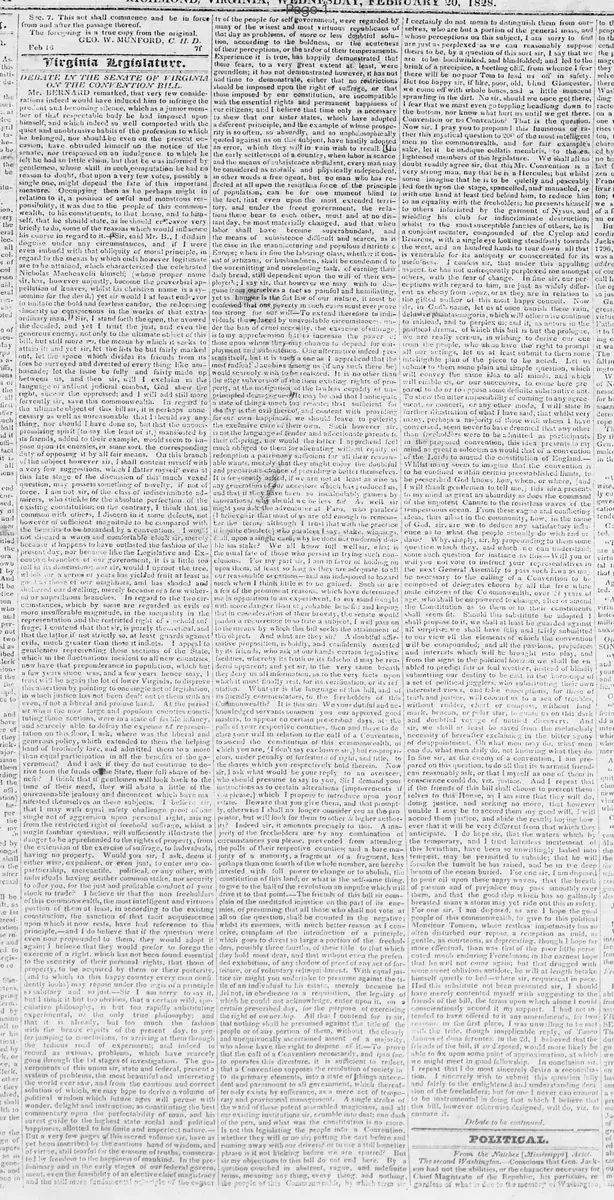
DEBATE IN THE SENATE OF VIRGINIA
ON THE CONVENTION BILL.
Mr. BERNARD remarked, that very few considerations indeed would have induced him to infringe the prudent and becoming silence, which as a junior member of that respectable body he had imposed upon himself, and which indeed so well comported with the quiet and unobtrusive habits of the profession to which he belonged, nor should he even on the present occasion, have obtruded himself on the notice of the senate, nor trespassed on an indulgence to which he felt he had so little claim, but that he was informed by gentlemen, whose skill in such computation he had no reason to doubt, that upon a very few votes, possibly a single one, might depend the fate of this important measure. Occupying then as he perhaps might in relation to it, a position of awful and monstrous responsibility, it was due to the people of this commonwealth, to his constituents, to that house, and to himself, that he should state, as he should endeavor very briefly to do, some of the reasons which would influence his course in regard to it.
--Sir, said Mr. B., I disdain disguise under any circumstances, and if I were even imbued with that obliquity of moral principle, in regard to the means by which ends however legitimate are to be attained, which characterized the celebrated Nicholas Machiavelli himself; (whose proper name sir, has, however unjustly, become the proverbial appellation of knaves, whilst his christian name is a synonyme for the devil,) yet sir would I at least endeavor to imitate the bold and fearless candor, the redeeming sincerity so conspicuous in the works of that extraordinary man. Sir, I stand forth the open, the avowed the decided, and set I trust the just, and even the generous enemy, not only to the ultimate object of this bill, but still more so, the means by which it seeks to attain it: and yet sir, let the lists be but fairly marked out, let the space which divides its friends from its foes be surveyed and divested of every thing like ambuscade; let the issue be fully and fairly made up between us, and then sir, will I exclaim in the language of ancient judicial combat, God shew the right, succor the oppressed; and I will add still more fervently sir, save this commonwealth.
In regard to the ultimate object of this bill sir, it is perhaps unnecessary as well as unreasonable that I should say any thing, nor should I have done so, but that the uncompromising spirit (to say the least of it,) manifested by its friends, added to their example, would seem to impose upon its enemies, in some sort, the corresponding duty of opposing it by all fair means. On this branch of the subject however sir, I shall content myself with avery few suggestions, which I flatter myself even at this late stage of the discussion of this much vexed question, may possess something of novelty, if not of force. I am not sir, of the class of indiscriminate admirers, who stickle for the absolute perfection. of the existing constitution; on the contrary, I think that in common with others, I discern in it some defects, not however of sufficient magnitude to be compared with the benefits to be hazarded by a convention. I would not discard a warm and comfortable cloak sir, merely because it happens to have outlasted the fashion of the present day, nor because like the Legislative and Executive branches of our government, it is a little too full in its dimensions; nor sir, would I uproot the tree, which for a series of years has yielded fruit at least as good as those of our neighbors, and has shaded and sheltered our dwelling, merely because of a few withered or superfluous branches.
In regard to the two circumstances, which by some are regarded as evils of more insufferable magnitude, in the inequality in the representation and the restricted right of freehold suffrage, I contend that that sir, is purely theoretical, and that the latter if not strictly so, at least guards against evils, much greater than those it inflicts. I appeal to gentlemen representing those sections of the State, which in the fluctuations incident to all new countries, now have that preponderance in population, which but a few years since was, and a few years hence may, I trust will be again the lot of lower Virginia, to disprove this assertion by pointing to one single act of legislation, in which justice has not been dealt out to them with an even, if not a liberal and profuse hand. At the period sir when the now large and populous counties constituting those sections, were in a state of feeble infancy, and scarcely able to defray the expense of representation on this floor, I ask, where was the liberal and generous policy, which extended to them the helping hand of brotherly love, and admitted them to a more than equal participation in all the benefits of the government? And I ask if they do not continue to derive from the funds of the State, their full share of benefits? I think that if gentlemen will look back to the time of their need, they will abate a little of the unreasonable jealousy and discontent which have manifested themselves on these subjects.
I believe sir, that I may with equal safety challenge proof of one single act of aggression upon personal right, arising from the restricted right of freehold suffrage, whilst a single familiar question, will sufficiently illustrate the danger to be apprehended to the rights of property, from the extension of the exercise of suffrage, to individuals, having no property. Would you sir, I ask, deem it either wise, expedient, or even just, to enter into co-partnership, mercantile, political, or any other, with individuals having neither common stake, nor security to offer you, for the just and profitable conduct of your stock in trade? I believe sir that the non freeholders of this commonwealth, the most intelligent and virtuous portion of them at least, in according to the existing constitution, the sanction of that tacit acquiescence upon which it now rests, have had reference to this principle,--and I do believe that if the question were even now propounded to them, they would adopt it again; I believe that they would prefer to forego the exercise of a right, which has not been found essential to the security of their personal rights, that those of property, to be acquired by them or their posterity. (and to which in this happy country every man confidently looks) may repose under the aegis of a principle so salutary and so just.
--Sir I am sorry to say it, but I think it but too obvious, that a certain wild, speculative philosophy, is but too rapidly substituting experimental, or the only true philosophy; and that it is already, but too much the fashion with the beaux esprits of the present day, to prefer jumping to conclusions, to arriving at them through the tedious road of experiment; and indeed to record as axioms, problems, which have scarcely gone through the first stages of investigation. The governments of this union sir, state and federal, present a system of problems, the most beautiful and interesting the world ever saw, and from the cautious and correct solution of which, we may hope to derive a volume of political wisdom which future ages will peruse with wonder, delight and instruction; as constituting the best commentary upon the perfectability of man, and his surest guide to the highest state social and political happiness, allotted to his finite and imperfect nature.
--But a very few pages of this sacred volume sir, have as yet been inscribed by the cautious hand of wisdom, and of virtue, still fearful for the erasure of truths, consecrated by freedom to the happiness of mankind. In the preliminary and in the early stages of our federal government, even the feasibility of an elective chief magistracy and the still more fundamental question of the capacity of the people for self government, were regarded by many of the wisest and most virtuous republicans of that day as problems, of more or less doubtful solution, according to the boldness, or the acuteness of their perceptions, or the ardor of their temperaments. Experience it is true, has happily demonstrated that those fears, to a very great extent at least, were groundless; it has not demonstrated however, it has not had time to demonstrate, either that no restrictions should be imposed upon the right of suffrage, or that those imposed by our constitution, are incompatible with the essential rights and permanent happiness of our citizens; and I believe that time only is necessary to shew that our sister states, which have adopted a different principle, and the example of whose prosperity is so often, so absurdly, and so unphilosophically quoted against us on this subject, have hastily adopted an error, which they will in vain wish to recall.
In the early settlement of a country, when labor is scarce and the means of subsistence abundant, every man may be considered as morally and physically independent, in other words a free agent, but no man who has reflected at all upon the resistless force of the principle of population, can be for one moment blind to the fact, that even upon the most extended territory, and under the freest government, the relations these bear to each other, must and at no distant day, be most materially changed, and that when labor shall have become superabundant, and the means of subsistence difficult and scarce, as is the case in the manufacturing and populous districts of Europe; when in fine the laboring class, whether it consist of artizans, or husbandmen, shall be condemned to the unre mitting and unrelenting task, of earning their daily bread, still dependent upon the will of their employer; I say sir, that however we may wish to disguise from ourselves a fact so painful and humiliating, yet as hunger is the first law of our nature, it must be confessed that our poverty in such cases must ever prove too strong for our will--To extend therefore to individuals thus placed by unavoidable circumstances, under the ban of cruel necessity, the exercise of suffrage, is to my apprehension but to increase the power of those upon whom they may chance to depend for employment and subsistence.
One alternative indeed presents itself, but it is such a one as I apprehend that the most radical Jacobins among us (if any such there be) would scarcely wish to be realized. It is no other than the utter subversion of the then existing rights of property, at the instigation of the lawless cupidity of unprincipled demagogues. It may be said that I anticipate a state of things much too remote; that sufficient for the day is the evil thereof, and content with providing for our own happiness, we should leave to posterity the exclusive care of their own. Such however sir, is not the language of tender and affectionate parents to their offspring, nor would the latter I apprehend feel much obliged to them for alienating without equity of redemption a patrimony sufficient for all their reasonable wants, merely that they might enjoy the doubtful and precarious chance of providing a better themselves.
It is frequently asked, if we are not at least as wise as any generation of our ancestors which has produced us, and that if they have been so incalculably gainers by innovations why should we be less so? As well sir might you ask the adventurer at Faro, who par takes (I believe sir that most of us are old enough to remember the term, although I trust that with the practice it is quite obsolete) who partakes I say, stake, winnings, &c. all, upon a single card, why he does not uniformly double his stake? we all know full well sir, that is the usual fate of those who persist in trying such conclusions. For my part sir, I am in favor of holding on upon them, at least so long as they are adequate to all our reasonable occasions--and am indisposed to hazard much when I think little is to be gained.
Such sir are a few of the prominent reasons, which have determined me in opposition to an experiment, to my mind fraught with more danger than probable benefit: and hoping that in consideration of their brevity, the senate would pardon a recurrence to so trite a subject, I will pass on to the means by which this bill seeks the attainment of this object. And what are they sir? A doubtful affirmative proposition, is boldly, and confidently asserted by its friends, who ask at our hands certain legislative facilities, whereby its truth or its falsehood may be rendered apparent; and yet sir, in the very same breath they deny us all information, as to the very facts upon which it must finally rest, for its verification, or its refutation.
What sir is the language of this bill, and of its friendly commentators, to the freeholders of this Commonwealth? It is this sir: We your dutiful and acknowledged servants summon you our approved good masters, to appear on certain prescribed days, at the polls of your respective counties, then and there to declare your will in relation to the call of a Convention, to amend the constitution of this commonwealth, of which you are, I don't say exclusive owners,) but co-proprietors, under penalty of forfeiture of right, and title, to the shares which you respectively hold therein.
Now sir, I ask what would be your reply to an overseer, who should presume to say to you, Sir I demand your instructions as to certain alterations (improvements if you please,) which I propose to introduce upon your estate. Beware that you give them, and that promptly, otherwise I shall no longer consider you as the proprietor, but will look for them to other & higher authority? Indeed sir, it amounts precisely to this. A majority of the freeholders are by any combination of circumstances you please, prevented from attending the polls of their respective counties and a bare majority of a minority, a fragment of a fragment, less perhaps than one fourth of the whole number, are hereby invested with full power to change or to abolish, this constitution of this land; or what is the self-same thing, to give to the ball of the revolution an impulse which will drive it to that point.
--The friends of this bill sir complain of the meditated injustice on the part of its enemies, of presuming that all those who shall not vote at all on the question, shall be counted in the negative; whilst its enemies, with much better reason as I conceive, complain of the introduction of a principle, which goes to divest so large a portion of the freeholders, possibly three fourths, of their title to that which they hold most dear, and that without even the pretended exhibition, of any shadow of proof of any act of forfeiture, or of voluntary relinquishment. With equal justice sir might you undertake to presume against the title of an individual to his estate, merely because he did not, in obedience to a requisition, the legality of which he could not acknowledge, enter upon it, on a certain prescribed day, for the purpose of exercising the right of owner ship.
All that I contend for is sir, that nothing shall be presumed against the title of the people or of any portion of them, without the clearly and unequivocally ascertained assent of a majority, who alone have the right to dispose of it.--To prove that the call of a Convention necessarily, and ipso facto operates this divestiture, it is sufficient to reflect, that a convention supposes the resolution of society into its primary elements, into a state of things antecedent and paramount to all government, which thereafter only exists by sufferance, as a mere act of temporary and provisional management. A single stroke of the wand of these potent assembled magicians, and all our existing institutions sir, crumble into dust; one dash of the pen, and what was the constitution is no more. Is not this legislating the people into a Convention, whether they will or no sir; putting the Cart before the horse and running away with our drivers? or to use a still homelier phrase is it not kicking before we are spurred?
But sir my objections to this bill do not end here. By a question couched in abstract, vague, and indefinite terms, meaning any thing, every thing, and nothing I certainly do not mean to distinguish them from our-selves, who are but a portion of the general mass, and whose perceptions on this subject, I am sorry to find are just as perplexed as we can reasonably suppose theirs to be, by a question of this sort sir, I say that we are to be hoodwinked, and blindfolded; and led to the brink of a precipice, a beetling cliff, from whence I fear there will be no poor Tom to lead us off in safety. But too happy sir, if like, poor, old, blind Gloucester, we come off with whole bones, and a little innocent sprawling in the dirt. No sir, should we once get there, I fear that we must even go toppling headlong down to the bottom, nor know what hurt us until we get there.
Convention or no Convention? That is the question. Now sir, I pray you to propound this luminous or rather this mystical question to any of the most intelligent men in the commonwealth, and for fair example's sake, let it be in duplicate collatis membris, to the enlightened members of this legislature. We shall all no doubt readily agree sir, that this Mr. Convention is a very strong man, nay that he is a Hercules; but whilst some imagine that he is to be quietly and peaceably led forth upon the stage, spancelled, and manacled, or with one hand at least tied behind him, to reduce him to an equality with the freeholders; he presents himself to others infuriated by the garment of Nysus, and wielding his club for indiscriminate destruction; whilst to the most susceptible fancies of others, he is a conjoint monster, compounded of the Cyclop and Briareus, with a single eye looking steadfastly towards the west, and an hundred hands to tear down all that is venerable for its antiquity or consecrated for its usefulness.
I confess sir, that under this appalling aspect, he has not unfrequently perplexed me amongst others, with the fear of change. in fine sir, our perceptions with regard to him, are just as widely different as ebony from topaz, or as they are in relation to the gifted author of this most happy conceit. Now sir, in God's name, let us at once banish these vain, delusive phantasmagoria, which will otherwise continue to mislead, and to perplex us; and if, as actors in the political drama, of which this bill is but the prologue, we are really serious, in wishing to derive our cue from the people, who alone have the right to prompt all our actings, let us at least submit to them some intelligible plan of the piece to be acted. Let us submit to them some plain and simple question, which will convey the same idea to all minds, and which will enable us, or our successors, to come here prepared to do or to oppose some definite substantive act.
To shew the utter impossibility of coming to any agreement, or concert, or any other mode, I will state in further illustration of what I have said, that whilst very many, perhaps a majority of those with whom I have conversed, seem never to have dreamed that any other than freeholders were to be admitted as participants in the proposed convention, this idea presents to my mind as great a solecism as would that of a convention of the Lords to amend the constitution of England.--Whilst many seem to imagine that the convention is to be confined within certain preestablished limits, to be prescribed God knows how, when, or where, (and I will thank gentlemen to tell me,) this idea presents to my mind as great an absurdity as does the command of the im potent Canute to the resistless waves of the tempestuous ocean.
From these vague and conflicting ideas, thus afloat in the community, how, in the name of God, sir, are we to deduce any satisfactory inference as to what the people actually do wish and ordain? Why, simply, sir, by propounding to them some question which they, and which we can understand; some such question for instance as this--Will you or will you not vote to instruct your representatives in the next General Assembly to pass such laws as may be necessary to the calling of a Convention to be composed of delegates chosen by all the free white male citizens of the Commonwealth, over 21 years of age, who shall be empowered to change, alter or amend the Constitution as to them or to their constituents shall seem fit.
Should this substitute be adopted I shall propose forthwith, we shall at least be guarded against all surprise; we shall have fully and fairly submitted to our view all the elements of which the convention will be compounded; and all the passions, prejudices and interests which will be brought into play, and from the signs in the political horizon we shall be enabled to predict fair or foul weather, instead of blindly submitting our destiny to be cast in the Ioro-cups of a set of political jugglers, who substituting their own interested views, and false conceptions, for those of truth and justice, will count us to a sea of troubles, without rudder, chart or compass, without land mark, beacon, or polar star, to guide us on this dark and doubtful voyage of untried discovery.
And sir, we shall at least be saved from the melancholy necessity of hereafter exclaiming in the bitter agony of disappointment, Oh what men may do, what men can do, what men daily do, not knowing what they do In fine sir, as the enemy of a convention, I am prepared on this question, to do all that its warmest friends can reasonably ask, or that I myself as one of them in conscience could do, viz. justice. And I repeat that if the friends of this bill shall choose to present them selves to this House, as I am sure that they will do, doing justice, and seeking no more, that however unable I may be to accord them my good will, I will accord them justice, and abide the result; hoping however that it will be very different from that which they anticipate.
I do hope sir, that the waters which by the temporary, and I trust harmless incitement of this leviathan, have been so unwittingly lashed into tempest, may be permitted to subside; that he will forsake the tumult he has raised, and be in the deep bosom of the ocean buried. For one sir, I am disposed to pour oil upon these angry waves, that the breath of passion and of prejudice may pass smoothly over them, and that the good ship which has gallantly breasted many a storm may yet ride out this in safety.
For one sir, I am disposed, as are I hope the good people of this commonwealth, to give to this political Monsieur Tonson, whose restless impetuosity has so often disturbed our repose, a reception as mild, as gentle, as courteous, as deprecating, though I hope far more effectual, than was that of the poor little persecuted much enduring Frenchman; in the earnest hope that he will not come again; but that drugged with some sweet oblivious antidote, he will at length betake himself quietly to bed--where sir, requiescat in pace.
Had this substitute not been presented sir, I should have merely contented myself with suggesting to the friends of the bill, the terms upon which alone I could conscientiously accord it my support. I had not intended to have offered to it any amendments, for two reasons: in the first place, I was unwilling to be met with the trite, though inapplicable reply, of Timco danuos et dona ferentes: in the 2d, I believed that the friends of the bill, if so disposed, would more likely be able to fix upon some point of approximation, at which we might meet in good fellowship.
In conclusion sir, I repeat that I do most sincerely desire a reconciliation. I sincerely wish to submit this question fully and fairly to the enlightened and understanding decision of the freeholders: but for one I never can consent to be instrumental in doing that which I believe that this bill, however otherwise designed, will do, viz. to ensnare it.
What sub-type of article is it?
What themes does it cover?
What keywords are associated?
What entities or persons were involved?
Where did it happen?
Story Details
Key Persons
Location
Senate Of Virginia
Story Details
Mr. Bernard opposes the Convention Bill in a detailed speech, defending the existing constitution's suffrage restrictions to protect property rights, warning against vague propositions that could disenfranchise non-voters, and proposing a clearer alternative question for freeholders.