Thank you for visiting SNEWPapers!
Sign up free
Daily National Intelligencer
Washington, District Of Columbia
What is this article about?
Congressional proceedings on January 9-10, 1816: Senate passes bill nullifying conflicting laws with US-British commerce convention ratified December 22, 1815. House debates bill to establish additional military academies, with speeches by Wright, Clay, Cuthbert, Forsyth, and Calhoun favoring multiple locations to promote national unity and military education. Other reports include extending a lease, medals for naval officers, and discussion on British treaty bill.
Merged-components note: These components form a continuous report on the congressional debate regarding military academies, spanning pages 2 and 3 with sequential reading orders; relabeling the domestic_news segment to story for coherence as a single focused legislative story.
Clippings
1 of 2
OCR Quality
Full Text
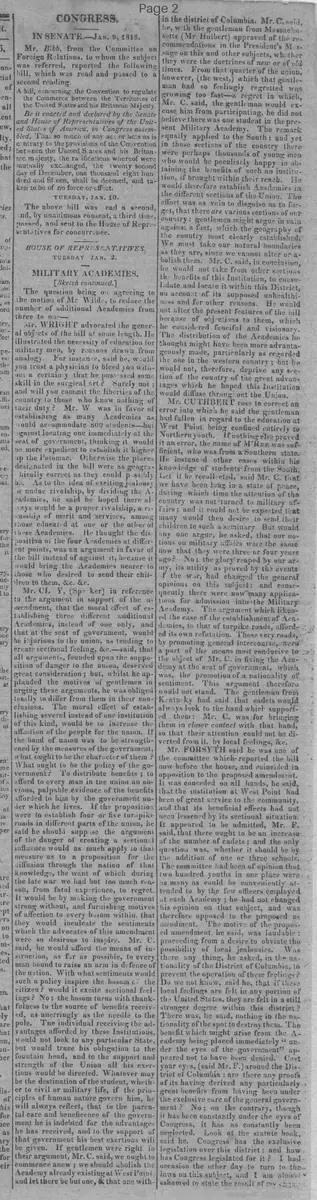
IN SENATE.-JAN. 9, 1816.
Mr. Bibb, from the Committee on Foreign Relations, to whom the subject was referred, reported the following bill, which was read and passed to a second reading
A bill, concerning the Convention to regulate the Commerce between the Territories of the United States and his Britannic Majesty.
Be it enacted and declared by the Senate and House of Representatives of the United States of America, in Congress assembled. That so much of any act or acts as is contrary to the provisions of the Convention between the United States and his Britannic majesty, the ratifications whereof were mutually exchanged, the twenty second day of December, one thousand eight hundred and fifteen, shall be deemed, and taken to be of no force or effect.
TUESDAY, JAN. 10.
The above bill was read a second, and, by unanimous consent, a third time, passed, and sent to the House of Representatives for concurrence.
HOUSE OF REPRESENTATIVES.
TUESDAY JAN. 9.
MILITARY ACADEMIES.
[Speech continued.]
The question being on agreeing to the motion of Mr Wilde, to reduce the number of additional Academies from three to one-
Mr. WRIGHT advocated the general objects of the bill at some length. He illustrated the necessity of education for military men, by reasons drawn from analogy. For instance, said he, would you trust a physician to bleed you without a certainty that he possessed some skill in the surgical art? Surely not; and will you commit the liberties of the country to those who know nothing of their duty? Mr. W was in favor of establishing as many Academies as would accommodate 800 students but against locating one immediately at the seat of government, thinking it would be more expedient to establish it higher up the Potomac. Otherwise the places designated in the bill were as geographically correct as they could possibly be. As to the idea of exciting jealousy or undue rivalship, by dividing the Academies, he said he hoped there always would be a proper rivalship, a rivalship of merit and services, among those educated at one or the other of these Academies. He thought the disposition of the four Academies at different points, was an argument in favor of the bill instead of against it, because it would bring the Academies nearer to those who desired to send their children to them, &c. &c.
Mr. CLAY. (Speaker) in reference to the argument in support of the amendment, that the moral effect of establishing three different additional Academies, instead of one only, and that at the seat of government, would be injurious to the union, as tending to create sectional feeling, &c.-said, that all arguments, founded upon the supposition of danger to the union, deserved great consideration; but, whilst he applauded the motives of gentlemen in urging these arguments, he was obliged totally to differ from them in their conclusions. The moral effect of establishing several instead of one institution of this kind, would be to increase the affection of the people for the union. If the bond of union was to be strengthened by the measures of the government, what ought to be the character of them? What ought to be the policy of the government? To distribute benefits; to afford to every man in the union an obvious, palpable evidence of the benefits afforded to him by the government under which he lives. If the proposition were to establish four or five turnpike roads in different parts of the union, he said he should suppose the argument of the danger of creating a sectional influence would as much apply to that measure as to a proposition for the diffusion through the nation of that knowledge, the want of which during the late war we had but too much reason, from fatal experience, to regret. It would be by making the government strong without, and furnishing motives of affection to every bosom within, that they would inculcate the sentiments which the advocates of this amendment were so desirous to inspire. Mr. C. said, he would afford the means of instruction, as far as possible, to every man bound to raise an arm in defence of the nation. With what sentiments would such a policy inspire the bosom of the citizen? would it excite sectional feelings? No; the bosom turns with thankfulness to the source of benefits received, as unerringly as the needle to the pole. The individual receiving the advantages afforded by these Institutions, would not look to any particular State, but would trace his obligation to the fountain head, and to the support and strength of the Union all his exertions would be directed. Whatever may be the destination of the student, whether to civil or military life, if the principles of human nature govern him, he will always reflect, that to the parental care and beneficence of the government he is indebted for the advantages he has received, and to the support of that government his best exertions will be given. If gentlemen were right in their argument, Mr. C. said, we ought to commence anew; we should abolish the Academy already existing at West Point and let there be but one, & that one within the district of Columbia. Mr. C. said, he, with the gentleman from Massachusetts (Mr. Hubert) approved of the recommendations in the President's Message on this and other subjects, whether they were the doctrines of new or of old times. From that quarter of the union, however, (the west,) which that gentleman had so feelingly regretted was growing too fast--a regret in which, Mr. C. said, the gentleman would excuse him from participating, he did not believe there was one student in the present Military Academy. The remark equally applied to the South; and yet in those sections of the country there were perhaps thousands of young men who would be peculiarly happy in obtaining the benefits of such an institution, if brought within their reach. He would therefore establish Academies in the different sections of the Union. The effort was as vain to disguise as to forget, that there are various sections of our country: gentlemen might argue in vain against a fact, which the geography of the country most clearly established. We must take our natural boundaries as they are, since we cannot alter or abolish them. Mr. C. said, in conclusion, he would not take from other sections the benefits of this Institution, to consolidate and locate it within this District, on account of its supposed unhealthiness and for other reasons. He would not alter the present features of the bill because of objections to them, which he considered fanciful and visionary. The distribution of the Academies he thought might have been more advantageously made, particularly as regarded the one in the western country; but he would not, therefore, deprive any section of the country of the great advantages which he hoped this Institution would diffuse throughout the Union.
Mr. CUTHBERT rose to correct an error into which he said the gentleman had fallen in regard to the education at West Point being confined entirely to Northern youth. If nothing else proved it an error, the name of M'Ren was sufficient. who was from a Southern state. He instanced other cases within his knowledge of students from the South. Let it be recollected--said Mr. C. that we have been long in a state of peace, during which time the attention of the country was not turned to military affairs; and it could not be expected that many would then desire to send their children to such a seminary. But would any one argue, he asked, that our notions on military affairs were the same now that they were three or four years ago? No; the glory reaped by our army, its utility as proved by the events of the war, had changed the general opinions on this subject: and consequently there were now many applications for admission into the Military Academy. The argument which likened the case of the establishment of Academies, to that of turnpike roads, afforded its own refutation. Those very roads, by promoting general intercourse, were a part of the means most conducive to the object of Mr. C. in fixing the Academy at the seat of government, which was, the promotion of a nationality of sentiment. This argument therefore would not stand. The gentleman from Kentucky had said that cadets would always look to the hand which supported them: Mr. C. was for bringing them in closer contact with that hand, so that their attention could not be diverted from it, by local feelings, &c.
Mr. FORSYTH said he was one of the committee which reported the bill now before the house, and coincided in opposition to the proposed amendment. It was conceded on all hands, he said, that the institution at West Point had been of great service to the community. and that its beneficial effects had not been lessened by its sectional situation. It appeared to be admitted, Mr. F. said, that there ought to be an increase of the number of cadets; and the only question was, whether it should be by the addition of one or three schools. The committee had been of opinion that two hundred youths in one place were as many as could be conveniently attended to by the few officers employed at each Academy; he had not changed his opinion on that subject, and was therefore opposed to the proposed amendment. The motive of the proposed amendment he said, was laudable: proceeding from a desire to obviate the possibility of local jealousies. Was there any thing, he asked, in the nationality of the District of Columbia, to prevent the operation of these feelings? Do we not know, said he, that if these local feelings are felt in any portion of the United States, they are felt in a still stronger degree within this district? There was, he said, nothing in the nationality of the spot to destroy them. The benefit which might arise from the Academy being placed immediately "under the eyes of the government" appeared not to have been denied. Cast your eyes (said Mr. F.) around the District of Columbia: are there any proofs of its having derived any particularly great benefits from having been under the exclusive care of the general government? No; on the contrary, though it has been constantly under the eyes of Congress, it has as constantly been neglected. Look at the statute book, said he. Congress has the exclusive legislation over this district: and how has Congress legislated for it? I had occasion the other day to turn to the laws on this subject, and I am almost ashamed to state the result of my inquiry.
Nearly. Half a dozen statutes of little importance embrace all that this Legislature has done for the District for near twenty years that it has been under its eyes & exclusive care. The laws of the District were not even uniform in its various parts. Crimes in one part of the district are punished in one way, and in another part differently. Whilst the condition of the citizens of Maryland and Virginia were experiencing a daily amelioration of their condition, by the improvement of their jurisprudence, the system of laws by which this district was governed remained stationary, as they existed when the district formed a part of those two states. If the District of Columbia had not flourished or improved under the care of Congress, what evidence was there that the Military Academy, under similar circumstances, would derive any advantage from such a location? Mr. F. said, for his part, he believed the Military Academy placed here would enjoy just the same advantages that had accrued to this district from the care of Congress; and, if the old Academy had been placed here, he believed it never would have produced the same results as had been experienced from it. His colleague (Mr. Cuthbert) and others appeared to be very anxious to destroy state feelings and jealousy and pride. Mr. F. said they ought to be destroyed. But why fight the shadow, and let the substance pass? These feelings of local animosity, he said, were cherished by other causes than such as that supposed by his colleague: of these he would refer to but one—the constant practice of selecting ministers and great officers of the government from local considerations—of taking, for instance, a man of inferior merit from one state, because there happens to be already one in service from the state whence a better might have been selected. To such practices as these, he said, we must look for the nourishment of local feelings and state jealousies. The object of the diffusion of these institutions was not the benefit or convenience of the states, but of the people, and their convenience was consulted by the distribution of Academies at different points. In regard to the argument of brotherly affection among the cadets being promoted by collecting them all together at one point, Mr. F. said there was no magical effect in the location within the ten miles square. Every object in this respect might be accomplished by their collection at any one point, wherever it may be, by a provision, legislative or otherwise, that the youth of the South should be placed in an academy in the North, and vice versa—or by having them intermingled in the academies, in due proportions from every section, one among another. All the benefits argued as likely to proceed from concentration, may thus be secured. Mr. F. was, therefore, wholly against the amendment.
Mr. CALHOUN said, the only question really before the house at this time appeared to be, what was the best mode to produce a national spirit. That policy, he said, which creates the best political system; which promotes the national prosperity; which provides efficiently for the national security: that policy, by the effect of which every part of the country feels itself secure, whilst commerce is prosperous, and agriculture and manufactures are protected; that, he said, was the policy which would certainly create a true national feeling. Every thing in opposition to such a policy would end in sectional feelings. Applying these general remarks to the present question, what, he asked, was the object of the bill? To establish a military school. What was the object of this school? To contribute to the national security, by the diffusion of military knowledge. Whether one great central school was better calculated to produce this effect, than several separate schools, was the question. Mr. C. said he believed it would not. If we had a central great school, as now proposed, it would principally be filled with the sons of wealthy men: of great and influential men, others would not have the means of sending their sons abroad for education—for, here, certainly, the allowance by the government would not cover the expenses of the young men. Where, in this country, shall we look for genius and talent? Most indubitably in the middle ranks, in the lower ranks in preference to the higher; not that these classes actually contain a greater portion of talent, but that they have stronger stimulants to its exertion. Rich men, being already at the top of the ladder, have no farther motive to climb. It is that class of the community who find it necessary to strive for elevation. that furnishes you with officers. Look, said Mr. C. at the officers who distinguished themselves in service during the late war. Were there among them the sons of wealthy men or of great men? If there were any such, Mr. C. said he knew of none.—Their rule he applied was a general one. If the school were established here, the means of support afforded by the government to the cadets would not cover their expenses; men in moderate circumstances would be unable to send their sons, and the country would be deprived of their valuable services. The Academy would be in a great measure filled by the sons of the wealthy and influential men within four hundred miles of this place. Mr. C. said he believed the provisions of this
bill were more important than any yet on the table of the house, and as important as any that would come before the house at the present Session. The way to render the nation secure, is not by maintaining a large foreign army, very expensive and a little dangerous; it is not thus you will keep up a proper military spirit; but by military education. Upon the Officers of armies in a great measure depends, particularly in a free government, the success of war. Free governments always afford materials for soldiers. Of the celebrated brigade of Scott, Mr. C. said, three-fourths of the privates had not been in service more than six months. All that was wanted to make soldiers amongst us was education, which the private can soon acquire; but the making of officers is the work of time, particularly in the present state of the science of war; and it was proper, therefore, to provide amply for that object. In time of war, Mr. C. said, we ought to get soldiers speedily—we ought to come into the population at once, by the measure so much reprobated at the last session from the other side of the house. Mr. C. was in favor of establishing more than one additional military school, in order to diffuse, as far as possible, military science. This, he said, would secure us against invasion from abroad, and, by making the militia formidable, against despotism at home. It was in this way that militia would be made more efficient than in any other. At present, the number of academies proposed to be established might be sufficient; but he hoped that they would be progressively increased, and that it would not be long before we should have one in every considerable state in the union. Mr. C. compared the feelings of the house now and previous to the war. Now, he said, we see every where a nationality of feeling; we hear sentiments from every part of the house in favor of union, and against a sectional spirit. What had produced this change? The glory acquired by the late war, & the prosperity which had followed it. Let us direct our attention, then, said he, to the objects calculated to accomplish the prosperity and greatness of the nation, and we shall certainly create a national spirit.
(Debate to be continued.)
WEDNESDAY, JAN. 10.
After the presentation and reference of petitions,
Mr. M'Kee, from the select committee, reported a bill to extend the lease of John Bate to the Saline near the Wabash, for a term not exceeding seven years; which was twice read and committed.
Mr. Pleasants, from the naval committee, reported a resolution directing the presentation to Captain Stewart, and the other officers of the Constitution, suitable medals, in testimony of the sense of Congress of the merits of their exploit, in the capture of the British sloops of war Cyane and Levant; which was read and referred to a committee of the whole.
Mr. Lancy, from the committee of claims, made an unfavorable report on the petition of Jacob Clement, which was concurred in.
THE BRITISH TREATY.
The engrossed bill to regulate the commerce of the United States according to the Convention of Commerce concluded with Great Britain on the 3d day of July last, was read the third time, and the question was stated "shall the bill pass?"
The passage of the bill was advocated by Mr. Easton, Mr. Tucker, and Mr. Cuthbert, and opposed by Mr. Pinkney; to whom Mr. Randolph replied.
During the discussion, the bill was received from the Senate, which is noticed above.
Mr. Forsyth stated the reasons why he hoped, notwithstanding the receipt of the bill from the Senate, that the bill now before the House would pass, as, according to his view, the Senate had, by passing that bill, attempted to evade the question before the House.
The question was about to be put, when Mr. Stanford having intimated his desire to speak on the question—
On motion, the house adjourned.
What sub-type of article is it?
What keywords are associated?
What entities or persons were involved?
Where did it happen?
Story Details
Key Persons
Location
United States Congress, District Of Columbia
Event Date
January 9 10, 1816
Story Details
Senate reports and passes bill nullifying laws conflicting with US-British commerce convention ratified December 22, 1815. House debates establishing additional military academies, arguing for multiple locations to foster national unity, educate from diverse regions, and avoid sectionalism; speakers oppose centralizing at Washington due to inaccessibility and neglect. Additional reports on lease extension, naval medals for capturing British sloops, unfavorable claim petition. House discusses and nearly passes bill regulating commerce per July 1815 British convention, with debate on Senate's related action.