Thank you for visiting SNEWPapers!
Sign up free
Literary
June 21, 1825
Rhode Island American
Providence, Providence County, Rhode Island
What is this article about?
An essay critiquing vulgarity through the anxious display of genteel etiquette knowledge, mocking pretenders who parade rules of politeness and reference authors like John Bull for their ostentatious refinement.
Clipping
OCR Quality
98%
Excellent
Full Text
FROM THE LONDON MAGAZINE.
PROOFS OF VULGARITY.
There is no surer sign of vulgarity than a jactation of gentility. An anxiety to appear particularly knowing in such rules of good-breeding as Mr. Dilworth expounded and governesses inculcate, betrays the miserable ambition of a vulgar mind. Under-bred pretenders to fashion are perpetually talking of what is not the thing: they have always a part to learn, and are, consequently, like the bourgeois gentilhomme, ever running on the subject of their studies; they are wonderfully shrewd observers of glaring solecisms, and are bitterly severe on any departure from those established canons laid down in the Primer of Politeness.
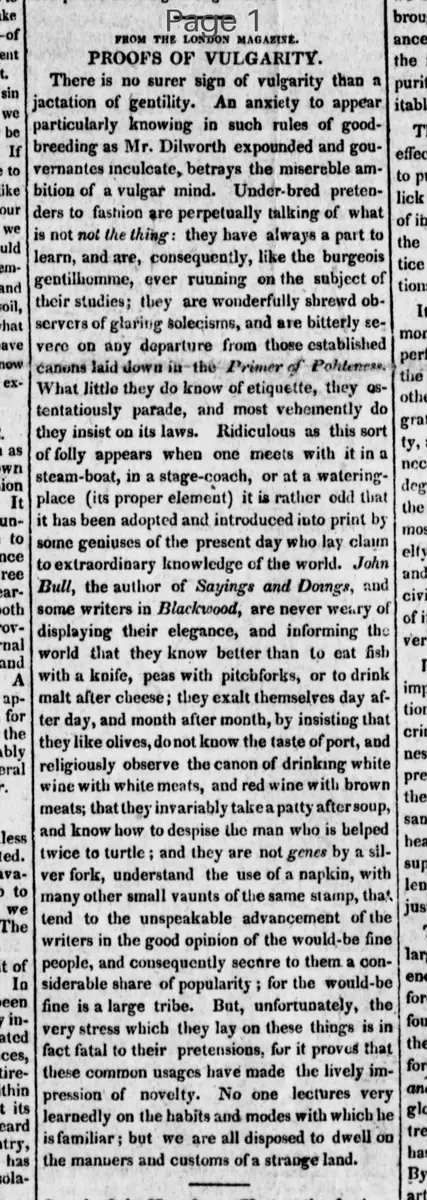
What little they do know of etiquette, they ostentatiously parade, and most vehemently do they insist on its laws. Ridiculous as this sort of folly appears when one meets with it in a steam-boat, in a stage-coach, or at a watering-place (its proper element) it is rather odd that it has been adopted and introduced into print by some geniuses of the present day who lay claim to extraordinary knowledge of the world. John Bull, the author of Sayings and Doings, and some writers in Blackwood, are never weary of displaying their elegance, and informing the world that they know better than to eat fish with a knife, peas with pitchforks, or to drink malt after cheese; they exalt themselves day after day, and month after month, by insisting that they like olives, do not know the taste of port, and religiously observe the canon of drinking white wine with white meats, and red wine with brown meats; that they invariably take a patty after soup, and know how to despise the man who is helped twice to turtle; and they are not geese by a silver fork, understand the use of a napkin, with many other small vaunts of the same stamp, that tend to the unspeakable advancement of the writers in the good opinion of the would-be fine people, and consequently secure to them a considerable share of popularity; for the would-be fine is a large tribe. But, unfortunately, the very stress which they lay on these things is in act fatal to their pretensions, for it proves that these common usages have made the lively impression of novelty. No one lectures very learnedly on the habits and modes with which he is familiar; but we are all disposed to dwell on the manners and customs of a strange land.
PROOFS OF VULGARITY.
There is no surer sign of vulgarity than a jactation of gentility. An anxiety to appear particularly knowing in such rules of good-breeding as Mr. Dilworth expounded and governesses inculcate, betrays the miserable ambition of a vulgar mind. Under-bred pretenders to fashion are perpetually talking of what is not the thing: they have always a part to learn, and are, consequently, like the bourgeois gentilhomme, ever running on the subject of their studies; they are wonderfully shrewd observers of glaring solecisms, and are bitterly severe on any departure from those established canons laid down in the Primer of Politeness.
What little they do know of etiquette, they ostentatiously parade, and most vehemently do they insist on its laws. Ridiculous as this sort of folly appears when one meets with it in a steam-boat, in a stage-coach, or at a watering-place (its proper element) it is rather odd that it has been adopted and introduced into print by some geniuses of the present day who lay claim to extraordinary knowledge of the world. John Bull, the author of Sayings and Doings, and some writers in Blackwood, are never weary of displaying their elegance, and informing the world that they know better than to eat fish with a knife, peas with pitchforks, or to drink malt after cheese; they exalt themselves day after day, and month after month, by insisting that they like olives, do not know the taste of port, and religiously observe the canon of drinking white wine with white meats, and red wine with brown meats; that they invariably take a patty after soup, and know how to despise the man who is helped twice to turtle; and they are not geese by a silver fork, understand the use of a napkin, with many other small vaunts of the same stamp, that tend to the unspeakable advancement of the writers in the good opinion of the would-be fine people, and consequently secure to them a considerable share of popularity; for the would-be fine is a large tribe. But, unfortunately, the very stress which they lay on these things is in act fatal to their pretensions, for it proves that these common usages have made the lively impression of novelty. No one lectures very learnedly on the habits and modes with which he is familiar; but we are all disposed to dwell on the manners and customs of a strange land.
What sub-type of article is it?
Essay
Satire
What themes does it cover?
Social Manners
Moral Virtue
What keywords are associated?
Vulgarity
Gentility
Etiquette
Social Manners
Satire
Politeness
Pretension
Literary Details
Title
Proofs Of Vulgarity
Subject
On Vulgarity In Pretensions To Gentility And Etiquette
Form / Style
Satirical Prose Essay
Key Lines
There Is No Surer Sign Of Vulgarity Than A Jactation Of Gentility.
Under Bred Pretenders To Fashion Are Perpetually Talking Of What Is Not The Thing: They Have Always A Part To Learn, And Are, Consequently, Like The Bourgeois Gentilhomme, Ever Running On The Subject Of Their Studies;
But, Unfortunately, The Very Stress Which They Lay On These Things Is In Act Fatal To Their Pretensions, For It Proves That These Common Usages Have Made The Lively Impression Of Novelty.