Thank you for visiting SNEWPapers!
Sign up free
Editorial
December 22, 1934
The Omaha Guide
Omaha, Douglas County, Nebraska
What is this article about?
Mildred J. Broncon's editorial warns against judging others, drawing from 'Judge not, that ye be not judged.' It argues that criticism hinders redemption, everyone has faults, and one should speak upliftingly or not at all, illustrated by a poem.
Clipping
OCR Quality
98%
Excellent
Full Text
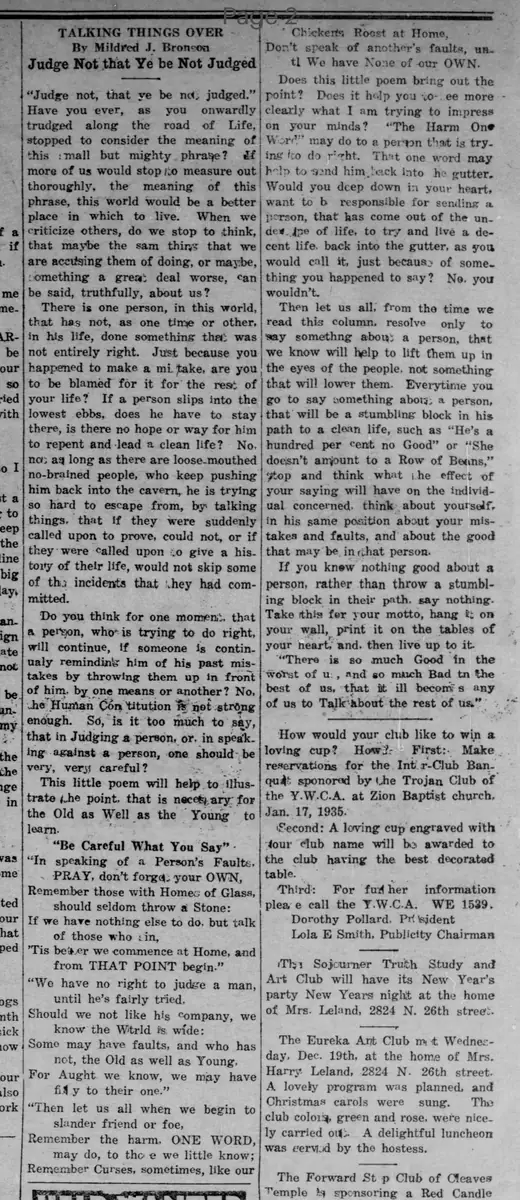
TALKING THINGS OVER
By Mildred J. Broncon
Judge Not that Ye be Not Judged
"Judge not, that ye be not judged."
Have you ever, as you onwardly trudged along the road of Life, stopped to consider the meaning of this small but mighty phrase? If more of us would stop to measure out thoroughly the meaning of this phrase, this world would be a better place in which to live. When we criticize others, do we stop to think, that maybe the same things that we are accusing them of doing, or maybe, something a great deal worse, can be said, truthfully, about us?
There is one person, in this world, that has not, at one time or other, in his life, done something that was not entirely right. Just because you happened to make a mistake, are you to be blamed for it for the rest of your life? If a person slips into the lowest ebbs, does he have to stay there, is there no hope or way for him to repent and lead a clean life? No. But as long as there are loose mouthed no-brained people, who keep pushing him back into the cavern, he is trying so hard to escape from, by talking things that if they were suddenly called upon to prove, could not, or if they were called upon to give a history of their life, would not skip some of the incidents that they had committed.
Do you think for one moment, that a person, who is trying to do right, will continue, if someone is continually reminding him of his past mistakes by throwing them up in front of him, by one means or another? No, the Human Constitution is not strong enough. So, is it too much to say that in judging a person, or, in speaking against a person, one should be very, very careful?
This little poem will help to illustrate the point, that is necessary for the Old as Well as the Young to learn.
"Be Careful What You Say".
"In speaking of a Person's Faults, PRAY, don't forget your OWN.
Remember those with Homes of Glass, should seldom throw a Stone:
If we have nothing else to do, but talk of those who sin,
'Tis better we commence at Home, and from THAT POINT begin."
"We have no right to judge a man, until he's fairly tried,
Should we not like his company, we know the World is wide:
Some may have faults, and who has not, the Old as well as Young,
For Aught we know, we may have fifty to their one."
"Then let us all when we begin to slander friend or foe,
Remember the harm, ONE WORD, may do, to those we little know;
Remember Curses, sometimes, like our
Chickens Roost at Home,
Don't speak of another's faults. until We have None of our OWN.
Does this little poem bring out the point? Does it help you to see more clearly what I am trying to impress on your minds? "The Harm One Word" may do to a person that is trying to do right. That one word may help to send him back into the gutter.
Would you deep down in your heart, want to be responsible for sending a person, that has come out of the underworld of life, to try and live a decent life, back into the gutter, as you would call it, just because of something you happened to say? No. you wouldn't.
Then let us all, from the time we read this column, resolve only to say something about a person, that we know will help to lift them up in the eyes of the people, not something that will lower them. Everytime you go to say something about a person, that will be a stumbling block in his path to a clean life, such as "He's a hundred per cent no Good" or "She doesn't amount to a Row of Beans," stop and think what the effect of your saying will have on the individual concerned. think about yourself, in his same position about your mistakes and faults, and about the good that may be in that person.
If you know nothing good about a person, rather than throw a stumbling block in their path, say nothing. Take this for your motto. hang it on your wall, print it on the tables of your heart, and then live up to it.
"There is so much Good in the worst of us, and so much Bad in the best of us, that it ill becomes any of us to Talk about the rest of us.".
By Mildred J. Broncon
Judge Not that Ye be Not Judged
"Judge not, that ye be not judged."
Have you ever, as you onwardly trudged along the road of Life, stopped to consider the meaning of this small but mighty phrase? If more of us would stop to measure out thoroughly the meaning of this phrase, this world would be a better place in which to live. When we criticize others, do we stop to think, that maybe the same things that we are accusing them of doing, or maybe, something a great deal worse, can be said, truthfully, about us?
There is one person, in this world, that has not, at one time or other, in his life, done something that was not entirely right. Just because you happened to make a mistake, are you to be blamed for it for the rest of your life? If a person slips into the lowest ebbs, does he have to stay there, is there no hope or way for him to repent and lead a clean life? No. But as long as there are loose mouthed no-brained people, who keep pushing him back into the cavern, he is trying so hard to escape from, by talking things that if they were suddenly called upon to prove, could not, or if they were called upon to give a history of their life, would not skip some of the incidents that they had committed.
Do you think for one moment, that a person, who is trying to do right, will continue, if someone is continually reminding him of his past mistakes by throwing them up in front of him, by one means or another? No, the Human Constitution is not strong enough. So, is it too much to say that in judging a person, or, in speaking against a person, one should be very, very careful?
This little poem will help to illustrate the point, that is necessary for the Old as Well as the Young to learn.
"Be Careful What You Say".
"In speaking of a Person's Faults, PRAY, don't forget your OWN.
Remember those with Homes of Glass, should seldom throw a Stone:
If we have nothing else to do, but talk of those who sin,
'Tis better we commence at Home, and from THAT POINT begin."
"We have no right to judge a man, until he's fairly tried,
Should we not like his company, we know the World is wide:
Some may have faults, and who has not, the Old as well as Young,
For Aught we know, we may have fifty to their one."
"Then let us all when we begin to slander friend or foe,
Remember the harm, ONE WORD, may do, to those we little know;
Remember Curses, sometimes, like our
Chickens Roost at Home,
Don't speak of another's faults. until We have None of our OWN.
Does this little poem bring out the point? Does it help you to see more clearly what I am trying to impress on your minds? "The Harm One Word" may do to a person that is trying to do right. That one word may help to send him back into the gutter.
Would you deep down in your heart, want to be responsible for sending a person, that has come out of the underworld of life, to try and live a decent life, back into the gutter, as you would call it, just because of something you happened to say? No. you wouldn't.
Then let us all, from the time we read this column, resolve only to say something about a person, that we know will help to lift them up in the eyes of the people, not something that will lower them. Everytime you go to say something about a person, that will be a stumbling block in his path to a clean life, such as "He's a hundred per cent no Good" or "She doesn't amount to a Row of Beans," stop and think what the effect of your saying will have on the individual concerned. think about yourself, in his same position about your mistakes and faults, and about the good that may be in that person.
If you know nothing good about a person, rather than throw a stumbling block in their path, say nothing. Take this for your motto. hang it on your wall, print it on the tables of your heart, and then live up to it.
"There is so much Good in the worst of us, and so much Bad in the best of us, that it ill becomes any of us to Talk about the rest of us.".
What sub-type of article is it?
Moral Or Religious
Social Reform
What keywords are associated?
Judging Others
Forgiveness
Repentance
Moral Speech
Personal Faults
Editorial Details
Primary Topic
Admonishment Against Judging Others For Past Mistakes
Stance / Tone
Moral Exhortation Advocating Compassion And Restraint In Speech
Key Arguments
Everyone Has Committed Wrongs And Deserves A Chance To Repent
Harsh Criticism Pushes People Back Into Bad Habits
Speak Only Words That Uplift Rather Than Tear Down
If No Good To Say, Say Nothing