Thank you for visiting SNEWPapers!
Sign up free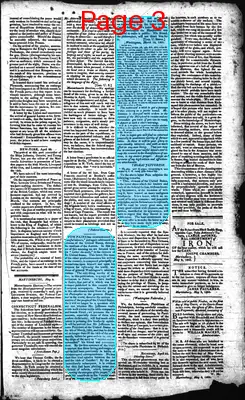
Editorial
May 6, 1803
Berkeley And Jefferson Intelligencer
Martinsburg, Berkeley County, Virginia
What is this article about?
Federal Gazette editorial criticizes Tom Paine's publication of a March 1801 letter from President Thomas Jefferson inviting him to return to the US aboard a naval vessel. It highlights their frequent correspondence, shared reformist principles, and Paine's attacks on Washington, portraying it as evidence of democratic impropriety.
Clipping
OCR Quality
95%
Excellent
Full Text
(Federal Gazette.)
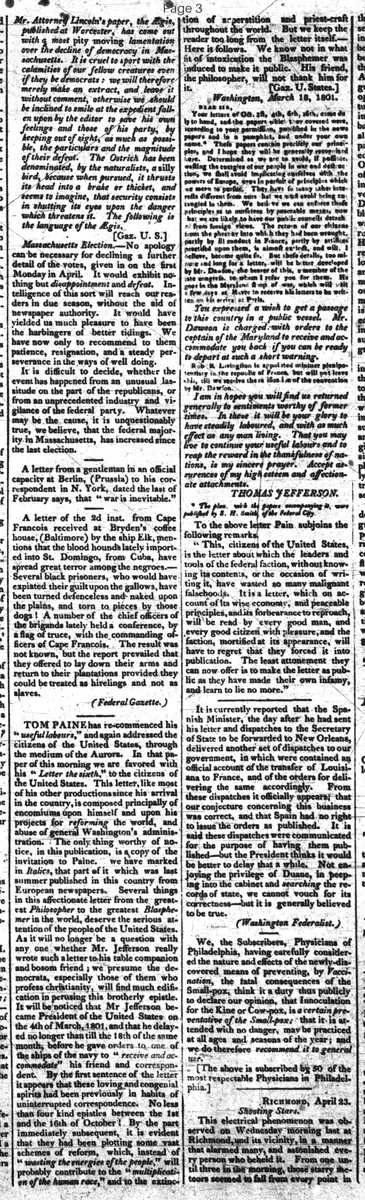
TOM PAINE has re-commenced his "useful labours," and again addressed the citizens of the United States, through the medium of the Aurora. In that paper of this morning we are favored with his "Letter the sixth," to the citizens of the United States. This letter, like most of his other productions since his arrival in the country, is composed principally of encomiums upon himself and upon his projects for reforming the world, and abuse of general Washington's administration. The only thing worthy of notice, in this publication, is a copy of the invitation to Paine. We have marked in Italics, that part of it which was last summer published in this country from European newspapers. Several things in this affectionate letter from the greatest Philosopher to the greatest Blasphemer in the world, deserve the serious attention of the people of the United States. As it will no longer be a question with any one whether Mr. Jefferson really wrote such a letter to his table companion and bosom friend; we presume the democrats, especially those of them who profess christianity, will find much edification in perusing this brotherly epistle. It will be noticed that Mr Jefferson became President of the United States on the 4th of March, 1801, and that he delayed no longer than till the 18th of the same month, before he gave orders to one of the ships of the navy to "receive and accommodate" his friend and correspondent. By the first sentence of "the letter it appears that these loving and congenial spirits had been previously in habits of uninterrupted correspondence." No less than four kind epistles between the 10th and the 16th of October! By the part immediately subsequent, it is evident that they had been plotting some vast schemes of reform, which, instead of "wasting the energies of the people" will probably contribute to the "multiplication of the human race," and to the extinction of superstition and priest-craft throughout the world. But we keep the reader too long from the letter itself.
Here it follows. We know not in what fit of intoxication the Blasphemer was induced to make it public. His friend the philosopher, will not thank him for it.
[Gaz. U. States.]
Washington, March 18, 1801.
Dear Sir,
Your letters of Oct. 1st, 4th, 6th, 16th, came duly to hand, and the papers which they covered were, according to your permission, published in the newspapers, and in a pamphlet, and under your own name.
These papers contain precisely our principles, and I hope they will be generally recognized here. Determined, as we are to avoid, if possible, wasting the energies of our people in war and destruction, we shall avoid implicating ourselves with the powers of Europe, even in pursuit of principles which we mean to pursue. They have so many other interests different from ours that we must avoid being entangled in them. We believe we can enforce those principles as to ourselves by peaceable means, now as we are likely to have our public councils detached from foreign views. The return of our citizens from the frenzy into which they had been wrought, partly by ill conduct in France, partly by artifices practiced upon them, is almost extinct, and will, I believe, become quite so. But these details, too minutely and long for a letter, will be better developed by Mr. Dawson, the bearer of this, a member of the late congress, to whom I refer you for them. He goes in the Maryland, a ship of war, which will wait a few days at Havre to receive his letters to be written on his arrival at Paris.
You expressed a wish to get a passage to this country in a public vessel. Mr. Dawson is charged with orders to the captain of the Maryland to receive and accommodate you back if you can be ready to depart at such a short warning.
Robert R. Livingston is appointed minister plenipotentiary to the republic of France, but will not leave this, till we receive the ratification of the convention by Mr. Dawson.
I am in hopes you will find us returned generally to sentiments worthy of former times. In these it will be your glory to have steadily laboured, and with as much effect as any man living: That you may live to continue your useful labours and to reap the reward in the thankfulness of nations, is my sincere prayer. Accept assurances of my high esteem and affectionate attachments.
THOMAS JEFFERSON.
The Plan, with the Papers published by S. H. Smith for the Federal City.
To the above letter Paine subjoins the following remarks
"This, citizens of the United States, is the letter about which the leaders and tools of the federal faction, without knowing its contents, or the occasion of writing it, have wasted so many malignant falsehoods. It is a letter, which on account of its wise economy, and peaceable principles, and its forbearance to reproach, will be read by every good man, and every good citizen with pleasure, and the faction, mortified at its appearance, will have to regret that they forced it into publication. The least atonement they can now offer is to make the letter as public as they have made their own infamy, and learn to lie no more.'
TOM PAINE has re-commenced his "useful labours," and again addressed the citizens of the United States, through the medium of the Aurora. In that paper of this morning we are favored with his "Letter the sixth," to the citizens of the United States. This letter, like most of his other productions since his arrival in the country, is composed principally of encomiums upon himself and upon his projects for reforming the world, and abuse of general Washington's administration. The only thing worthy of notice, in this publication, is a copy of the invitation to Paine. We have marked in Italics, that part of it which was last summer published in this country from European newspapers. Several things in this affectionate letter from the greatest Philosopher to the greatest Blasphemer in the world, deserve the serious attention of the people of the United States. As it will no longer be a question with any one whether Mr. Jefferson really wrote such a letter to his table companion and bosom friend; we presume the democrats, especially those of them who profess christianity, will find much edification in perusing this brotherly epistle. It will be noticed that Mr Jefferson became President of the United States on the 4th of March, 1801, and that he delayed no longer than till the 18th of the same month, before he gave orders to one of the ships of the navy to "receive and accommodate" his friend and correspondent. By the first sentence of "the letter it appears that these loving and congenial spirits had been previously in habits of uninterrupted correspondence." No less than four kind epistles between the 10th and the 16th of October! By the part immediately subsequent, it is evident that they had been plotting some vast schemes of reform, which, instead of "wasting the energies of the people" will probably contribute to the "multiplication of the human race," and to the extinction of superstition and priest-craft throughout the world. But we keep the reader too long from the letter itself.
Here it follows. We know not in what fit of intoxication the Blasphemer was induced to make it public. His friend the philosopher, will not thank him for it.
[Gaz. U. States.]
Washington, March 18, 1801.
Dear Sir,
Your letters of Oct. 1st, 4th, 6th, 16th, came duly to hand, and the papers which they covered were, according to your permission, published in the newspapers, and in a pamphlet, and under your own name.
These papers contain precisely our principles, and I hope they will be generally recognized here. Determined, as we are to avoid, if possible, wasting the energies of our people in war and destruction, we shall avoid implicating ourselves with the powers of Europe, even in pursuit of principles which we mean to pursue. They have so many other interests different from ours that we must avoid being entangled in them. We believe we can enforce those principles as to ourselves by peaceable means, now as we are likely to have our public councils detached from foreign views. The return of our citizens from the frenzy into which they had been wrought, partly by ill conduct in France, partly by artifices practiced upon them, is almost extinct, and will, I believe, become quite so. But these details, too minutely and long for a letter, will be better developed by Mr. Dawson, the bearer of this, a member of the late congress, to whom I refer you for them. He goes in the Maryland, a ship of war, which will wait a few days at Havre to receive his letters to be written on his arrival at Paris.
You expressed a wish to get a passage to this country in a public vessel. Mr. Dawson is charged with orders to the captain of the Maryland to receive and accommodate you back if you can be ready to depart at such a short warning.
Robert R. Livingston is appointed minister plenipotentiary to the republic of France, but will not leave this, till we receive the ratification of the convention by Mr. Dawson.
I am in hopes you will find us returned generally to sentiments worthy of former times. In these it will be your glory to have steadily laboured, and with as much effect as any man living: That you may live to continue your useful labours and to reap the reward in the thankfulness of nations, is my sincere prayer. Accept assurances of my high esteem and affectionate attachments.
THOMAS JEFFERSON.
The Plan, with the Papers published by S. H. Smith for the Federal City.
To the above letter Paine subjoins the following remarks
"This, citizens of the United States, is the letter about which the leaders and tools of the federal faction, without knowing its contents, or the occasion of writing it, have wasted so many malignant falsehoods. It is a letter, which on account of its wise economy, and peaceable principles, and its forbearance to reproach, will be read by every good man, and every good citizen with pleasure, and the faction, mortified at its appearance, will have to regret that they forced it into publication. The least atonement they can now offer is to make the letter as public as they have made their own infamy, and learn to lie no more.'
What sub-type of article is it?
Partisan Politics
Moral Or Religious
What keywords are associated?
Tom Paine
Thomas Jefferson
Federalist Criticism
Political Correspondence
Reform Schemes
Blasphemy Accusation
What entities or persons were involved?
Tom Paine
Thomas Jefferson
George Washington
Federal Faction
Democrats
Editorial Details
Primary Topic
Criticism Of Jefferson's Letter To Paine
Stance / Tone
Federalist Mockery And Condemnation
Key Figures
Tom Paine
Thomas Jefferson
George Washington
Federal Faction
Democrats
Key Arguments
Paine's Letter Praises Himself And Attacks Washington
Jefferson's Quick Invitation Shows Undue Favoritism
Their Correspondence Reveals Shared Radical Reformist Plots
Publication Exposes Democratic Hypocrisy And Blasphemy
Federalists Regret Forcing Its Release But It Vindicates Their Stance